It is currently Thu Aug 20, 2026 8:29 am

All times are UTC - 5 hours [ DST ]


Post new topic Reply to topic  [ 22 posts ]  Go to page Previous  1, 2
Author Message
 Post subject: Re: Knuckle Coupler History and Analysis
PostPosted: Tue Dec 30, 2014 5:59 pm 

Joined: Sun Aug 22, 2004 11:34 am
Posts: 107
Location: San Pedro CA
Image
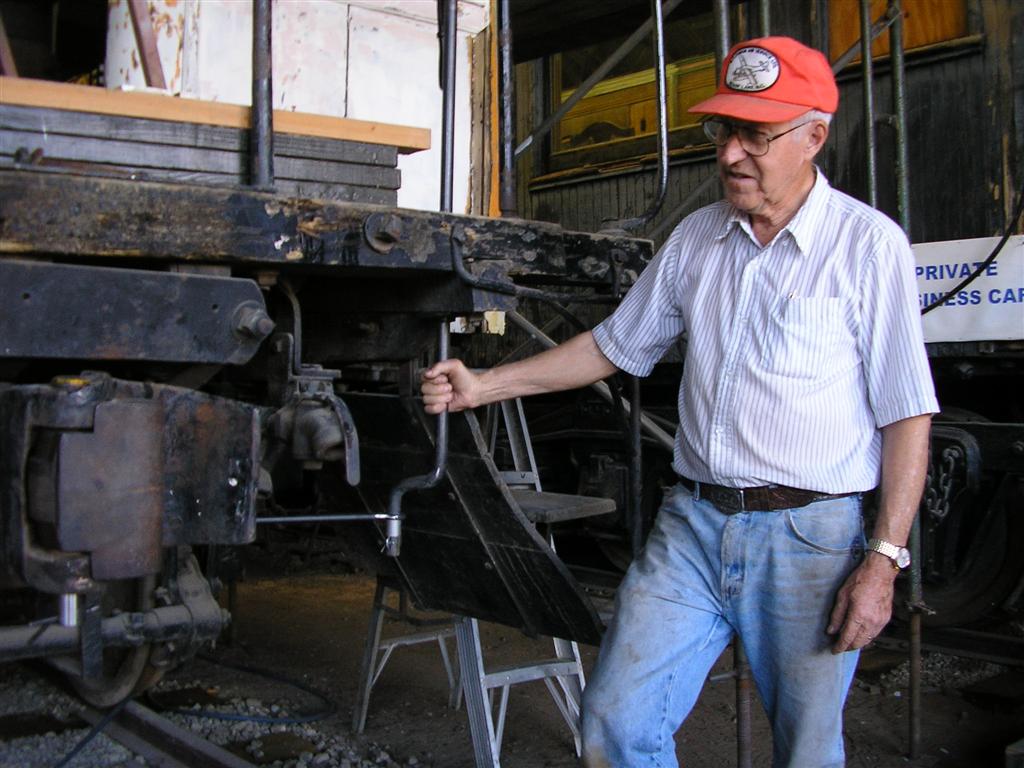
Notice the tug to combine.

Image
The Coupler a to cast Harold Whalen.

ROCKDALE, SANDOW, & SOUTHERN RAILROAD #3


This wooden combine is the oldest piece of operable rolling stock owned by the museum. It has “Jim Crow” racial segregation dividers, and was used in making many “period” motion pictures in the mid-20th century.
Built by The Pennsylvania Railroad, Altoona, PA; 1886

Originally PRR 3736, a Class PF coach (PRR’s first coaches with steam-heat piping), this open-platform car had yellow poplar exterior panels with edges covered by molding, and richly detailed white or golden oak interior wood. Its clerestory windows had 150 aquamarine-colored 5″ x 5″ cast glass panes featuring a 3-dimensional rosette design. It originally had a water cooler, five Adams & Westlake single-center nickel-plated oil lamps, one restroom, and 15 windows per side. The car had red plush upholstered walkover seats, a wood underframe with truss rods, and wood beam 4-wheel trucks. It weighs about 53,000 lbs. (26.5 tons), and is 46′ 10″ long (53′ 6″ with platforms), 9′ 4″wide (9′ 10″ at eaves), & 10′ 5 5/8″ high. Including a bench seat in an alcove designed for a stove, it seated 58 passengers as built. It’s a sister of restored Tuscan red PRR coach #3556 (built in August 1886), displayed at the Railroad Museum of Pennsylvania in Strasburg, PA.

This car’s PRR history is unknown. In May 1916, by which time the Class 1 railroads were forced by federal law to retire wood passenger cars, it was sold by car broker E. H. Wilson & Company, and sent from Birmingham, AL to the Dardanelle & Russellville Railroad, a five-mile Arkansas shortline opened in 1883 and still in business. Numbered D&R #10, it had a “Jim Crow” racial segregation divider installed roughly in the middle of the car to comply with Arkansas railroad segregation law, with eight windows per side in the “white” section, and seven in the “colored” section. On March 5, 1924, a fire that began in the depot at North Dardanelle burned one of the car’s sides so badly that it needed $972.16 worth of new siding, windows, curtains, and upholstery.

D&R #10 was retired on October 31, 1936 and sold to the six-mile Rockdale, Sandow & Southern Railroad in Texas, which like the D&R was then owned by the McAlester Fuel Company of McAlester, OK. (The RS&S originally transported lignite from a mine to an interchange with the International-Great Northern Railroad. Sold several times, it still operates today, as a switching road owned by RailAmerica, interchanging with the Union Pacific at Marjorie, TX.) The 1936 sale price for the ancient vehicle was $125 plus $625 to rebuild it into a combination passenger and baggage (combine) at the D&R’s North Dardanelle shops. A baggage room/coach wall replaced the racial divider, and a new segregation wall was added, creating an eight-seat “colored” section next to the baggage room and 22-seat “white” section. Sliding baggage room doors were installed, and five baggage room windows on each side were paneled over. Numbered RS&S #3, it was sent to Marjorie in November 1936. Texas laws required that all railroads offer passenger service at least once daily, except Sunday, with every train segregating the races.

In February 1945 RSS #3 (with its lettering removed) was sold to 20th Century-Fox and sent from Rockdale, TX to the West Los Angeles (Century City) studio, arriving July 24th with D&R #14. It was mis-identified as D&R #13, a number D&R never had. Appropriately relettered “Pennsylvania Railroad” for its first role, it was used from 1946-72 in many films, including Centennial Summer, The Raid, Love Me Tender, The True Story of Jesse James, The Second Time Around, Walls of Jericho, Powderkeg, and the Nichols and Bearcats TV series. At some point Fox removed the ceiling lamps and other fixtures. Moved to a Malibu canyon ranch in the late 1950s, it was sold to Short Line Enterprises for tourist railway use in 1972.

RS&S #3 (listed as D&R #13) and D&R #14 were traded in April 1976 to the PSRMA, trucked to Poway, CA June 7-8, and displayed for seven years at Old Poway Village, where roof and other repairs were made. Trucked to Campo February 10, 1983 and placed in the carbarn on the 12th, they were the first museum passenger cars there. It was finally identified as RS&S #3 in 1988.

The car is being restored to its 1936-1945 Jim Crow years, when it operated as the Rockdale, Sandow & Southern’s sole passenger car. Exterior restoration will be completed by the end of 2008, carried out by the Museum’s 4-man restoration crew: Harold Whalen, Frank Stites, Bob Gerdes, and Ted Kornweibel, Superintendent of Restoration. The car’s exterior was painted in September 2008 by master-painter Mark Gerdes. Interior restoration, including reupholstered seats and replica ceiling oil lamps, was finished in 2009. A $3,000 grant from the National Railway Historical Society, awarded in 2008, will help pay for recovering the seats and casting 90 replica pieces of clerestory glass. Now finished, the car is on view in the Display Building, accompanied by the Museum’s African American railroad heritage display, the most comprehensive photographic exhibit about black railroaders in the country.

1993 Pacific Southwest Railway Museum Association. W. Schneider

2008 update by Ted Kornweibel


Offline
 Profile  
 
 Post subject: Re: Knuckle Coupler History and Analysis
PostPosted: Tue Dec 30, 2014 8:54 pm 

Joined: Sun Mar 17, 2013 10:15 am
Posts: 44
And if you are going to study and understand coupler development, you need to learn about draft gear development along with that. Really can't have one without the other.


Offline
 Profile  
 
 Post subject: Re: Knuckle Coupler History and Analysis
PostPosted: Sun Jan 04, 2015 2:21 am 

Joined: Tue Jun 26, 2007 12:00 am
Posts: 554
Location: Dallas ,Texas. USA
The exact title of the book I mentioned is:

"Railway Couplers", National Malleable Castings Company.
.
I found a copy for sale about a year, but they are extremely. Rare.

_________________
Loco112 (NarrowGaugeExchange Forum)

Our "paper" archives will be the future railfans only hope. We (yes you too!) should endeavor to preserve all the info needed to allow them 100% accuracy in the building of their recreations.


Offline
 Profile  
 
 Post subject: Re: Knuckle Coupler History and Analysis
PostPosted: Sun Jan 04, 2015 10:53 am 

Joined: Sun May 15, 2005 2:22 pm
Posts: 1543
As I understand it, the knuckle pivot pin is not intended to carry any load. Yet it can acquire loading as other parts wear. Then once the knuckle pin acquires loading, it will break because it is not intended to carry a load. After it breaks, the knuckle may fall out the next time the locking pin is pulled, which presents an incredible hazard to the person who pulls the locking pin. How long have these circumstances existed?


Offline
 Profile  
 
 Post subject: Re: Knuckle Coupler History and Analysis
PostPosted: Sun Jan 04, 2015 5:31 pm 

Joined: Mon Jan 17, 2005 9:06 pm
Posts: 2567
Location: Thomaston & White Plains
Surprised that no one has mentioned this:

http://www.google.com/patents/US5145076

Howard P.

_________________
"I'm a railroad man, not a prophet."


Offline
 Profile  
 
 Post subject: Re: Knuckle Coupler History and Analysis
PostPosted: Sun Jan 04, 2015 10:37 pm 

Joined: Sun May 15, 2005 2:22 pm
Posts: 1543
Howard,

Thanks for posting that patent. I will definitely read it. I had heard about plastic knuckle pins, but never have seen one or knew the details. We were having a disussion on Trains forum once about how forces transmit through a coupler, and somebody mentioned the plastic knuckle pins. Somebody said that the plastic pins break more than the steel pins, but I don't know if that is true; or possibly there is more than one design for the plastic pins with some working better than others.


Offline
 Profile  
 
 Post subject: Re: Knuckle Coupler History and Analysis
PostPosted: Mon Jan 05, 2015 3:31 am 

Joined: Sun Jun 14, 2009 2:10 pm
Posts: 152
Location: Shingle Springs, California
When a C10 knuckle pin fails, only the bottom half falls to the ground. The top half usually remains intact, retaining the knuckle in the coupler body.


Offline
 Profile  
 
Display posts from previous:  Sort by  
Post new topic Reply to topic  [ 22 posts ]  Go to page Previous  1, 2

All times are UTC - 5 hours [ DST ]


You cannot post new topics in this forum
You cannot reply to topics in this forum
You cannot edit your posts in this forum
You cannot delete your posts in this forum
You cannot post attachments in this forum

Search for:
Jump to: