It is currently Thu Aug 20, 2026 7:09 pm

All times are UTC - 5 hours [ DST ]


Post new topic Reply to topic  [ 75 posts ]  Go to page Previous  1, 2, 3, 4, 5
Author Message
 Post subject: Re: Live Steam clubs as classrooms? No
PostPosted: Mon Oct 23, 2006 8:58 pm 

Joined: Thu Sep 16, 2004 7:17 pm
Posts: 553
Location: Ballard, WA
How about we skip the live steam and go straight to the real deal? I didn't learn how to handle trains by running my HO scale train.


Offline
 Profile  
 
 Post subject: Re: Live Steam clubs as classrooms? No
PostPosted: Mon Oct 23, 2006 11:11 pm 

Joined: Sun Aug 22, 2004 12:12 am
Posts: 88
Location: AZ
AMEN TO THAT!!!!!!!!!!!!!!!!! Yes, a live steam engine may be a good place to teach the rudiments of firing, but by no means should experience on a model be equated with experience on the real thing.
-Chris Zahrt
Grand Canyon Railway

_________________
It is not the critic who counts, not the man who points out how the strong man stumbles, or where the doer of deeds could have done them better. The credit belongs to the man in the arena, whose face is marred by dust and sweat and blood...


Offline
 Profile  
 
 Post subject: Re: Live Steam clubs as classrooms? No
PostPosted: Mon Oct 23, 2006 11:31 pm 

Joined: Thu Apr 14, 2005 9:34 pm
Posts: 2836
Location: Copenhagen, Denmark
Chris Salmonson wrote:
How about we skip the live steam and go straight to the real deal? I didn't learn how to handle trains by running my HO scale train.


You jumped to my point, but let me split up my planned messages further.

Correct, live steam can not replace full size experience. I learned live steam for a few years, and then moved on to the big trains by taking a job at Strasburg. I had a much stiffer learning curve than I expected. However, I was still much better prepared than if I had just been an electric train hobbyist without the basic mechanical fundamentals. I could, for example, at least identify all the components and their functions before arrival at Strasburg. I knew just enough to be dangerous. Plus, I had a much better intellectual understanding of what I was learning. Rather than just doing things because I was told to, I could connect what I was being told with the physical and mechanical properties I understood from my live steam experience. When the injector did not pick up, instead of just repeating my teacher's instructions (and failing again), I was able to think it through based on my live steam knowledge. I don't think I would have survived my training period at Strasburg without this.

Live steam as it is frequently operated does not correlate with the big trains, and that is where the training value is limited. There are many differences:

1) At most clubs engines are rarely loaded heavily, so you do not learn to operate under stress.

2) The little boilers heat and cool much faster, so the sense of timing is all wrong.

3) At most tracks, operation consists of filling the boiler full of water and filling the firebox with coal up to the firedoor before leaving the station. They you race around the track and hope you make it back to the station with enough steam and fire to repeat the process all over again. If you run out of steam, you stop and build it up before continuing. Clearly not an appropriate model for a scheduled operation. Now, I do not operate this way, largely due to my professional experience and preference for realism. I usually go out to the track alone, and run around the loop continuously for a half hour at a time, firing and feeding water at speed (and I do mean speed, I am guilty of being a little fast).

4) Most live steam models use pumps for water feed, so injector experience is lacking. The injectors we do have are not the same as the Hancock/Sellers lifting type, although non-lifting injectors are close matches, model to prototype.

5) Smoke control is not an issue with the models, so firing habits can be awful and hard to break.

With all these negatives, the little engines can still be a valuable tool to allow new members to become comfortable with hot steam, burned fingers, and "watching the water" at times convenient to their schedule and without the pressure to perform in service.

Solid live steam experience does not replace full size training, but I believe it reduces the amount of early learning time required, and that has real cash value if the engine is hot, and using flue time, solely for a training day. Live steam also provides a relaxed, unhurried option for a student to learn at their pace. On the other hand, if you have enough revenue operation planned to provide all the required training hours, then the live steam option is of trivial value.

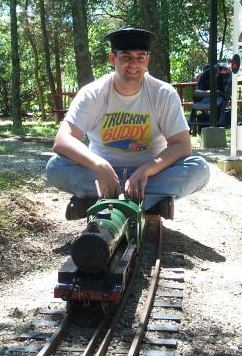
A compromise option might be one of these 12-18 inch gauge park trains.

Image

p.s. this thread is approaching 15,000 views! A record?

_________________
Steven Harrod
Lektor
Danmarks Tekniske Universitet


Offline
 Profile  
 
 Post subject: Re: Live Steam clubs as classrooms? Yes...
PostPosted: Tue Oct 24, 2006 3:39 am 

Joined: Sun Sep 04, 2005 11:29 am
Posts: 59
Location: California
Steven, thank you for emphasizing my point that there is value in learning the basics at a live steam club - you were better prepared for your training at Strasburg as a result.

I, too, started at the live steam club and found I had a steep learning curve when I moved up to full size. However, I did have a grasp of the fundamentals and a very healthy respect for keeping water in the glass which has served me well. Several other friends from the local live steam club who have joined me were also able to come up to speed on firing much faster than those around us without small scale experience.

When I was younger and my interest in steam began to grow, I didn't have easy access to a real operation. I did have access to a local live steam club which helped foster my interest so that my passion for trying my hand at the real thing continued to build instead of drifting off into the world of unfullfilled dreams...Like Stephen, I also strove to operate my live steamer as I imagined (or garnered from talking to real engineers) a full size locomotive would be on the road: trains of enough weight to make the engine work, balancing water and fire while on the road, anticipating grades and track conditions, etc.

Chris S. and Chris Z. if you check my original post on the subject you will note that I made a very clear statement that practice at a live steam club should only be used as a teaching tool and not as a substitute for full size operating experience.

Also, with our engine, we are lucky to get her out a few times a year. Therefore, we make the most of our opportunities and try to rotate folks through for practical training...but as Kelly pointed out, one has to strike a delicate balance between getting training accomplished and making sure the locomotive gets down the road in a safe and timely fashion. Anything that can help supplement our regular program and keep basic principles in people's minds is a good thing.

Most importantly, different people learn in different ways: some by seeing, others by hearing, etc. and most need a combination of these. Therefore, a properly designed training program will combine classroom and practical experiences. These should start with the most basic of principles and build in complexity such that the students have a thorough understanding of the material. Great teachers use as many tools, props, etc. as possible to illustrate their subject matter. Hence, my point about using a local live steam club as a resource.

It comes down to each group looking at their operating situation, local resources and personnel (both present and future; experienced and inexperienced) and designing their training program to make the most of what is available to them without neglecting certain core elements that should be taught at every operation.

_________________
Wolf


Offline
 Profile  
 
 Post subject: Re: Live Steam clubs as classrooms? Yes...
PostPosted: Tue Oct 24, 2006 8:05 am 

Joined: Wed Aug 25, 2004 6:27 am
Posts: 143
Steam locomotive boiler safety can be divided into two parts – mechanical and operation. The mechanical part is handled in the shop where proper practices will ensure a sound pressure vessel. Operation boils down to keeping water over the crownsheet.

Comprehensive training programs are not substitutes for experience and apprenticeship. I have known well trained, inexperienced people in operations who knew so much that “keeping water over the crownsheet” was just another entry in their knowledge base. Overwhelming newcomers with all the finer points of steam boiler operation, in my opinion, is a huge mistake.

The mechanical end is a much longer learning curve, however if a person can read, the information that will prevent gross errors is available in current codes and standards. Additionally there are a lot of experienced people in this industry who will gladly answer questions or refer you to someone who knows the answer.

When you look at the historical record of catastrophic boiler failures, the ones caused by operator error pretty much come down to one and only one thing – NOT ENOUGH WATER IN THE BOILER. Read a different way – THERE WASN’T ANY WATER IN THE GLASS OR THE WATER WASN’T BOBBING FREELY IN THE GLASS.

As Kelly alluded to in an earlier post, this isn’t rocket science. In my opinion, priority number one in training is – KNOW HOW TO READ THE WATER GLASS (and/or gauge cocks) AND MAKE SURE THERE IS WATER IN IT. If you don’t know how to use an injector it will show up in the water glass. If you can’t work an oil valve or a coal scoop it will show up in the water glass. If you don’t know the terrain it will show up in the water glass.

You can screw up the boiler, mess up the machinery, lose the schedule, fall down on the hill, anger the passengers, get fired, and generally screw the pooch, but if you maintain your water level or get rid of the fire when you don’t, you will not blow up. It’s that simple (mechanical issues aside or for another thread).

Clouding or subrogating the issue of proper water level in a sea of factoids, in my opinion is counterproductive. Focus on how to read the water level indicators and what to do if water is not present. Once these have become second nature you can get into the finer points.

_________________
Linn W. Moedinger


Offline
 Profile  
 
 Post subject: Re: Live Steam clubs as classrooms? Yes...
PostPosted: Tue Oct 24, 2006 9:27 am 

Joined: Sun Aug 22, 2004 5:19 pm
Posts: 2701
Location: Sackets Harbor, NY
Thank you Mr. Moedinger for bringing us to the crux of the matter. From my years around these marvelous machines observing the many different personalities of those entrusted to their safe operation it is my opinion that by far the most important ingredient in creating a capable steam locomotive fireman/engineer is apprenticeship.
There is no substitute for OJT in this profession. A lot can be (and should be) learned in a class room setting-but there's only one place to really "get it" and that's on the footplate, understudying an accomplished mentor.
Another thing I've noticed is that some folks are "naturals" at it and become very able and accomplished quickly(both firing and running) whilst others just can't seem to master it no matter how much they try! Guess that's true of life in general?
I've spent a good number of days firing and running steam on a number of shortlines and also out on the High Iron and while the principals are identical the skill level demanded (both firing&running) at 79 mph vs.15 mph are worlds apart. Things happen a whole lot quicker at 80 per than at 15 per!!!!
Also, if we step back and take a comprehensive look at our industry today the picture is one of accomplishment and professionalism with very very few exceptions. I agree that another Gettysburg(or worse) could well spell the end of the service as we now know it and thus it behooves us to do all possible to avoid that. Seems to me our best chance of doing that is to shore up our few "weak brothers" and thus help them avoid a tragedy. I'm not sure the best way to accomplish that,perhaps through TRAIN or some other mechanism but it behooves us all to address this issue while there's still time. Perhaps this could be a topic for discussion at the upcoming TRAIN/ARM convention??
Ross Rowland


Offline
 Profile  
 
 Post subject: Re: Live Steam clubs as classrooms? Yes...
PostPosted: Tue Oct 24, 2006 10:21 am 

Joined: Thu Apr 14, 2005 9:34 pm
Posts: 2836
Location: Copenhagen, Denmark
Operating a steam locomotive is a skill, and a skill is different from other procedural tasks because it requires some training of the mind and the subconcious. Operating a steam locomotive is comparable to riding a bicycle or playing a musical instrument. A certain fraction of one's mind has to be constantly attentive to water level, steam, and fire, at a level where it is no longer a conscious effort.

The closest comparison I can make is to driving on the highway. There are certain skills we all practice daily, to the point where we no longer even consciously think to command our bodies to perform them. Consider the awkwardness and hesitation of a new teenage driver. Remember how scared you were the first time you took the car onto the highway? It takes time and experience to develop reliable driving skills, and during this time unfortunately there is a high risk of accident.

"Watching the water" is one of these learned skills, not because it is a hard concept to understand, but because it is so easy to become distracted by other responsibilities. A certain rigorous mental training is required to program this onto the mind. It is also easy to take this training for granted, and forget what it was like "before". I have had the opportunity to train a few new steam people, and have been reminded of what I must have been like as a student.

As a student at Strasburg, I believe I had at least a week, maybe two, of aggressive personal teaching before I was on duty alone with an engineer. My teacher was somewhat like a drill sargent, constantly grilling me about issues such as water and fire condition. I was working 8+ hours a day, 6 days a week, so I had at least 50-100 hours of onboard training before I worked alone, and even then I still was supervised by a skilled engineer.

My point continues to be, many museums and volunteer organizations do not attain 100 hours of operation in a year, how are they going to develop the skills we are describing? That is why I have advocated a reduction in the level of skill required as I define it, as opposed to training or education, by addition of safety appliances.

_________________
Steven Harrod
Lektor
Danmarks Tekniske Universitet


Offline
 Profile  
 
 Post subject: Re: Live Steam clubs as classrooms? Yes...
PostPosted: Tue Oct 24, 2006 10:56 am 

Joined: Sat Feb 25, 2006 10:19 am
Posts: 56
In support of the idea of adding low water alarms:
A low water alarm doesn't replace the vigilance necessary to keep water at a safe and proper level, since it should only alarm when a dangerous state is approaching. As Mr. Harrod said, typically rules or new safety appliances are added as a result of an unnacceptable rate of accidents, or as new technology becomes available. After all, what is a safety valve if not an automatic appliance to keep the pressure within safe limits?
I believe that low water alarms existed in the steam era and still exist on stationary boilers, and would only reduce the requirement for proper training if they are set to give too many 'false positives' to borrow a term I learned while engineering medical electronics. A constantly beeping alarm is worse than no alarm at all.
Building on the technology available and adding some microcomputer 'smarts' should allow an accurate and reliable alarm to be developed at a price which is affordable, and could be made so that it cannot be ignored or easily defeated. Widespread adoption of them in the industry should result in a further reduction in the chance of an explosion.
From a regulatory point of view, one explosion and the ensuing publicity would likely result in the mandatory requirement of the sort of fix that we all would find more burdensome than a voluntary program.
Gordon Cook

_________________
G. Cook


Offline
 Profile  
 
 Post subject: Re: Live Steam clubs as classrooms? Yes...
PostPosted: Tue Oct 24, 2006 11:46 am 

Joined: Mon Aug 23, 2004 1:38 pm
Posts: 29
I would argue in favor of the opinions expressed in the thread by those who have emphasized apprenticeship/experience as the primary means of insuring safe operations.

Low water alarms are not the answer. If a crew can become inattentive enough to ignore the status of the water glass, they can also fail to respond to a signal from a low water alarm. As a historical case in point, one of the C&O Alleghenys blew up due to low water. These were very modern engines equipped with Barco low water alarms, if I remember correctly. If I also recall correctly, the investigation included a report from the operator of the tower which the engine passed shortly before the incident which indicated that the low water alarm was screaming at that time.

For those operations which don't have the number of hours of operation per year to get the kind of experience available to people at places such as Strasburg, their learning curves will just be a little longer. And, I would suggest that these operators need to be more welcoming and understanding of the need of having outside people with the experience come in to handle operations and training before less experienced people are put up in the engine cab to assume a responsibility they aren't properly prepared for.


Offline
 Profile  
 
 Post subject: Re: Live Steam clubs as classrooms? Yes...
PostPosted: Tue Oct 24, 2006 7:42 pm 

Joined: Sun Aug 22, 2004 8:31 am
Posts: 1341
Location: South Carolina
I also agree with the idea that the primary deficiency in this incident was crew error due to lack of OJT. There's (usually) no substitute for experience.

However, there is one thing I haven't seen mentioned yet, that I expect will eventually come to light. Since this is an oil-fired engine, it would be relatively easy to fix pneumatically or electrically controlled valves that would shut off steam and oil to the burner to immediately extinguish the fire in the event of a low water condition. This is a required feature on most stationary boilers, and I believe the new rack steamers that SLM (now DLM) built in Switzerland in the 1990's have this feature. This would be a better safety feature over and above fusible plugs, and it would not depend on any action by the crew to make the boiler safe unlike a low water alarm.

One downside I can see to this is if this feature is made mandatory for oil-fired steamers, it is likely that no exemption would be given for coal-fired engines. While a "drop fire" system for a coal-fired steamer would be much more difficult (and expensive) to provide, it certainly wouldn't be impossible.

I believe the bottom line here is that the crew just didn't grasp how serious of an issue low water is. I suspect that the generation(s) raised on video games and things like cars with electronic self-diagnostics and "limp home" modes (like the Cadillacs that can be run safely for unlimited distance with NO coolant in the engine) don't get quite the same gut reaction that most of us do to "no water in the sight glass" no matter what they're told or taught.

There are many measures that can be taken to prevent this issue from occurring again, but the time may have come to make steam locomotives inherently immune (at least as far as practicable) to low water catastrophes.

_________________
Hugh Odom
The Ultimate Steam Page
http://www.trainweb.org/tusp


Offline
 Profile  
 
 Post subject: Re: Live Steam clubs as classrooms? Yes...
PostPosted: Tue Oct 24, 2006 9:03 pm 

Joined: Sun Aug 22, 2004 5:19 pm
Posts: 2701
Location: Sackets Harbor, NY
With all due respect to Mr. Odum and the others who believe that the answer is to add this or that additional gadget to make the steam loco. fail safe I say NONSENSE. The answer is to make sure that the people on board are properly trained and capable of safely handling whatever that days operation brings! Period!
All the devices in the world will not trump stupidity. It's up to us to insure that these machines are in the hands of capable stewards. The only open (and difficult) question is how to achieve that!
Working together I'm confident we can find the solution.
Ross Rowland


Offline
 Profile  
 
 Post subject: Re: Live Steam clubs as classrooms? Yes...
PostPosted: Tue Oct 24, 2006 9:21 pm 

Joined: Thu Jun 16, 2005 11:54 am
Posts: 609
To make sure that the people on board are capable of safely handling whatever that days operation brings, you might have to drug and alcohol test them every time they operate the equipment!

Unfortunately the consequences of a catastrophic accident reach a lot further than the offices of the FRA, they also reach to every supplier of insurance for railroad operations. One major accident with deaths resulting could make it prohibitively expensive or even impossible to operate steam locomotives. If having a protective system provides an additional margin of safety toward avoiding the day when that happens, perhaps it is worth giving it at least some consideration.

MX

_________________
"We Repair No Locomotive Before Its Time"


Offline
 Profile  
 
 Post subject: Engine Crew Training Standards Session at ARM/TRAIN
PostPosted: Wed Oct 25, 2006 11:26 am 

Joined: Sun Sep 04, 2005 11:29 am
Posts: 59
Location: California
I know myself, Ross and a few others have suggested that this subject be brought up at the upcoming ARM/TRAIN convention...

Has there been any action taken to work in a special session?

Perhaps a few folks from this discussion could bring their training manuals/procedures to Sacramento and compare notes to get the ball rolling...

Again, regardless of your position on an imposed national standard, safety devices, etc., I think everyone can agree that a flexible set of standardized guidelines for engine crew training should be available as a guide for everyone...

_________________
Wolf


Offline
 Profile  
 
 Post subject: Re: Engine Crew Training Standards Session at ARM/TRAIN
PostPosted: Thu Oct 26, 2006 9:51 am 

Joined: Tue Jan 25, 2005 4:03 pm
Posts: 948
Wolf wrote:
I know myself, Ross and a few others have suggested that this subject be brought up at the upcoming ARM/TRAIN convention...


I've inquired about this as well.

More importantly, how will the information be disseminated? Can we look forward to a session between steam operators in the future to discuss proper practices? Who gets a say? Who gets to draw up the book? How can members of ARM/TRAIN be aided in helping everyone? I'd like a shot at it, myself!

Kelly Lynch


Offline
 Profile  
 
 Post subject: Re: Engine Crew Training Standards Session at ARM/TRAIN
PostPosted: Thu Oct 26, 2006 11:16 am 

Joined: Sun Sep 04, 2005 11:29 am
Posts: 59
Location: California
I agree with Kelly that there are some questions that need to be answered about who would be included in compiling a basic standard. Regardless of who is selected, there should be representatives from a cross-section of operation type and geographic regions i.e. coal, oil and gas fired engines (assuming there are a few park operations that might benefit), big mainline steam that rarely gets to run, smaller tourist lines that operate with high frequency, plus groups with lots of experience (Strasburg) and those who are newer or are still in the process of restoring an engine.

Kelly Lynch has volunteered. I would certainly be willing to participate. Any others (preferably folks with a lot more experience than Kelly or myself)? We could setup a web-based interchange to work through the process and then submit the document here or at next years ARM/TRAIN convention for review. The document could eventually be available through the ARM & TRAIN websites, and perhaps even through some of the insurance agencies.

I think that it is important that this step be driven by us in the industry as it shows professionalism (as others have mentioned). An example here would be the ASME (of which I am a member) developing and maintaining the Boiler Code.

_________________
Wolf


Offline
 Profile  
 
Display posts from previous:  Sort by  
Post new topic Reply to topic  [ 75 posts ]  Go to page Previous  1, 2, 3, 4, 5

All times are UTC - 5 hours [ DST ]


You cannot post new topics in this forum
You cannot reply to topics in this forum
You cannot edit your posts in this forum
You cannot delete your posts in this forum
You cannot post attachments in this forum

Search for:
Jump to: