It is currently Fri Aug 21, 2026 3:57 am

All times are UTC - 5 hours [ DST ]


Post new topic Reply to topic  [ 16 posts ]  Go to page 1, 2  Next
Author Message
 Post subject: Track machines
PostPosted: Mon Jul 07, 2003 6:37 pm 

The mechanization of railroad track maintenance had enormous impact on railroad employment and earnings. Track machines were, and are, marvels of mechanical wizardry. Many operating museums with track have acquired various antiquated track machines to assist with repair work. My question is this - are there any groups who have track machines as artifacts, displayed and interpreted for the public? Does anyone consider m/w machines as worthy of preservation?

Alan Maples

AMaples@aol.com


 Post subject: Re: Track machines
PostPosted: Mon Jul 07, 2003 6:53 pm 

We tend to treat them as consumables:
To date, two cinder tampers and a spiker have been "used up" ...working on a hyd. track jack and a tie crane next.


lamontdc@adelphia.net


 Post subject: Re: Track machines *PIC*
PostPosted: Mon Jul 07, 2003 9:46 pm 

Alan,

You bring up an interesting point. While we do use our small tamper and hopefully our tie extractor soon for maintenance on our railroad, we have struggled a bit with the interpretation part. Both machines find themselves in our display yard for periods of time and do raise a lot of eyebrows and questions.

We have yet to come up with a good way to interpret them at the museum yet, although we are planning a Gandy Dancer Day later this year which will demonstrate track work for the public. I am not sure if the tamper will be part of that demonstration or if they are planning to just should "the ole fashion way." Safety is always a concern.

However, I did recently put a little movie clip and some pics of our tamper in action on our website to give visitors there a feeling for what it is like. Take a look at the link below.

Until later,
Chris Hauf
Rochester & Genesee Valley Railroad Museum


R&GV Railroad Museum - Video Clips
Image
crhauf@frontiernet.net


 Post subject: Re: Track machines *PIC*
PostPosted: Tue Jul 08, 2003 3:43 pm 

> The mechanization of railroad track
> maintenance had enormous impact on railroad
> employment and earnings. Track machines
> were, and are, marvels of mechanical
> wizardry. Many operating museums with track
> have acquired various antiquated track
> machines to assist with repair work. My
> question is this - are there any groups who
> have track machines as artifacts, displayed
> and interpreted for the public? Does anyone
> consider m/w machines as worthy of
> preservation?

Hmm.

MOW stuff, for the most part, is ugly as homemade sin, even with fresh paint on it. All our stuff is, anyway. Motorheads will be interested in it, but the average museum visitor probably won't be. Too "modern" and WAY too ugly. Even most gearheads like their machines to have SOME aesthetic value. So unless the thing is REALLY significant, I can't see that an exhibit on the subject would be interesting to any but the real hardcore gearheads and railfans.

SCRM has the TR-1, which was Tamper's prototype tie inserter. We generally consider it a nusiance, since (like most things we get) it was slap wore out when we got it. Tamper hadn't quite nailed the design yet when they built TR-1, so it's not very good at doing the job it was designed to do. There's not enough up and down movement in the inserter arm, so unless the tie is perfectly level with the track, it tends to submarine. I'm told that before I got active, the machine inserted about 3 ties in the railroad. Getting them unburied was actually more work than changing the ties by hand!

For years, the TR-1 sat right next to SC 34 at the extreme end of Track 3 in the Rockton Yard. More than anything else, it made Rockton look like a railroad junkyard. It finally got moved to Greenbrier a couple years ago. Last year I got sick of loking at it every trip with the passenger train. Another volunteer and I sneaked it down to Rion when no one else was looking, both to free up space in the Greenbrier siding and to get the thing out of sight. It's currently sandwiched between a pair of flatcars and a very derelict 8-ton Vulcan.

Plans for the TR-1 are uncertain. One volunteer had started working on it back when I first got active in the Museum. He'd dissassembled the inserter mech to fix the worn-out parts. It's been that way since the middle 1990s. If we had plenty of room and money, we'd probably finish this repair job and put it on display as the historic artifact that it is. Since track space is at even more of a premium than money, opinions have ranged from mounting a bush hog on an articulated arm on it (it'd be perfect for this application, actually) to building a temporary spur over to the Rion quarry pit and giving it a good shove. I've had days when I've considered the latter, but for the most part I'm in favor of either the bush hog conversion or restoring it to operation and getting what use we can out of it.

Here's a pic of the thing, taken between when it was pulled off Track 3 and when it went to Greenbrier. See what I mean about ugly?

The South Carolina Railroad Museum
Image
mconrad@compuzone.net


 Post subject: Re: Track machines
PostPosted: Tue Jul 08, 2003 11:59 pm 

> Hmm.

> MOW stuff, for the most part, is ugly as
> homemade sin, even with fresh paint on it.

Howie's Three Rules of Track Equipment:

#1: It's painted yellow (or was)

#2: It leaks hydraulic oil (even when new)

#3: Wherever it gets parked, it's in the way of something else (and "no one has the key")

The above are in no particular order.


 Post subject: Re: Track machines
PostPosted: Wed Jul 09, 2003 3:12 am 

> Does anyone
> consider m/w machines as worthy of
> preservation?

Personally, I feel track machines are VERY worthy of preservation. Too often, museums focus on the equipment designed to haul freight and people over the rails, but not the support infrastructure and people who maintained it. A railroad is more than trains and train crews. There are clerks, track and signal maintainers, locomotive and car repair personnel, etcetera. The complete story of rail transportation cannot be told without including those people.

While track equipment may not be pretty, and often takes up valuable space, there are solutions that can also provide a realistic interpretation for museum patrons. Most track machinary moves on flat cars from worksite to worksite. Those flatcars have "rails" attached to the deck, and tie downs for the track equipment.... and are often large enough to hold multiple pieces of the smaller equipment. Since those flatcars can often be found for little more than scrap value, a museum should be able to pick them up, including the loading ramps, at a reasonable price.

Once the track equipment is restored, it can than be loaded onto the flats, tied down, and displayed as a more modern-day version of the "work train." Having the equipment on flats will also take up less space, and allows it to be moved much easier.

What most in the peservation community don't realize, is that there are TONS of treasures sitting in the MOW yards of the Class 1 RR's. One I pass nearly every day has an original EL boxcar still wearing the faded paint of its original owner, a PRR/PC boxcar of VERY ancient origin... looks to be some sort of early insulated box with PC reporting marks, but in PRR MOW yellow paint, and another 40' boxcar of unknown origin. Some modifications have been done over the years, but they look to be in excellent shape overall, with minimal body rot and are moved from time to time. Similarly, I also know of a LV covered hopper residing at Oak Island Yard in Newark, NJ, and several PRR baggage cars (sans trucks) in Harrisburg, PA... the latter of which have swinging end doors and may POSSIBLY be some of the cars PRR had modified for hauling theatrical production scenery. I assume that because they don't appear to be a post PRR jury-rigged deal, the work is "clean" enough to appear to have been purposely done while in revenue service.

Of course, MOW trucks are a complete other subject in themselves, and also help tell the story of the people who help make the RR go ... but I'll leave them for another post...

Fiv4HghStk@aol.com


 Post subject: Re: Track machines
PostPosted: Wed Jul 09, 2003 9:13 am 

> Once the track equipment is restored, it can
> than be loaded onto the flats, tied down,
> and displayed as a more modern-day version
> of the "work train." Having the
> equipment on flats will also take up less
> space, and allows it to be moved much
> easier.

While the rest of your post is well thought out, I'm not sure I agree with this part. Flats actually take up MORE space than your typical MOW machine. For example, our TR-1 is about 30 feet long. The shortest flat we've got (itself a nifty artifact) is 39 feet long.

Then you have the fact that flats are darned useful cars. We've got two 50-footers and a 60-foot pulpwood car in addition to the 39-foot flat. All except the 39-footer (which is too fragile to be used) get used in MOW service -- hauling brush, rail, etc. If you park something on the flatcar, you effectively remove that car from service and make it strictly a display piece. Nothing is really gained except an exhibit that, while it does tell an important part of the story, is not going to be that interesting to most visitors.

You've got to remember that we're not JUST preservationists. A certain amount of showmanship is required in order to get people (and their dollars) in the door and keep them coming back. It's a balancing act finding which exhibits are going to bring the most return on the investment -- whether it's in dollars, volunteer hours, or even display space -- required to implement those exhibits. In most cases, MOW equipment just doesn't bring enough of a return.

The South Carolina Railroad Museum
mconrad@compuzone.net


 Post subject: Re: Track machines
PostPosted: Wed Jul 09, 2003 9:17 am 

> Howie's Three Rules of Track Equipment:

> #1: It's painted yellow (or was)

> #2: It leaks hydraulic oil (even when new)

> #3: Wherever it gets parked, it's in the way
> of something else (and "no one has the
> key")

Or, in our case, there's no battery. We have only a couple batteries that get shifted between pieces of equipment. This way, both batteries get used just about every week so they don't go dead from sitting idle. This is small consolation when the darned thing's in your way and you can't start it, though.

The South Carolina Railroad Museum
mconrad@compuzone.net


 Post subject: Re: Track machines
PostPosted: Wed Jul 09, 2003 2:33 pm 

Well, this is certainly a varied topic of discussion....I personally love to see MOW equipment, and make an effort to try to maintain the pieces we already have in our collection....
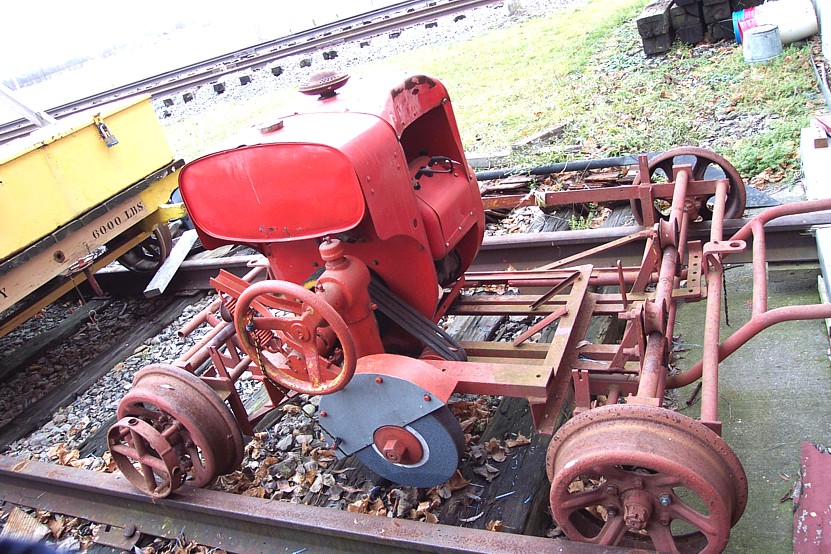
Our current collection includes 4 track motorcars (one ex-CP Rail, 2 ex-CNR, and one ex-C&O), numerous lorries (which the majority of museums have) a very rare PYKE hand operated crane (which is to undergo restoration sometime next year) and a very rare 1947 Nordberg single stone track grinder, with a hand crank waukesha motor. It's a helluva thing to start, but when you get it started, it runs like a charm. 3 of the 4 motorcars are in service, with the C&O undergoing complete rebuild from the ground up. The grinder will also have some cosmetic restoration done, as it is in excellent shape, although it doesn't get used, and is at this time not displayed.


MOW grinder & crane
digitekfx@kwic.com


 Post subject: Re: Track machines
PostPosted: Thu Jul 10, 2003 8:16 am 

> Howie's Three Rules of Track Equipment:

> #1: It's painted yellow (or was)

> #2: It leaks hydraulic oil (even when new)

> #3: Wherever it gets parked, it's in the way
> of something else (and "no one has the
> key")

I can't argue with you Howard, other than to point out that in Norfolk Southern country track machines are orange, not yellow.

Speaking of the NS, the old Southern Railway was a real innovator when it came to m/w equipment, and many of the common machines in use today had their genesis at the Charlotte roadway shop. I believe Southern president D.W. Brosnan personally held patents on several machines.

When static, track machines are difficult to explain, but when in use, their purpose and function is usually self-evident. Probably the best way to "interpret" for the public would simply be a video loop showing machines in action, combined with vintage footage showing the manual way of doing the same job.

Helping the public understand the work that goes into track repair is just one more angle for soliciting donations . . . a good display would be a rail, a tie, a spike, track bolt, etc., all with price tags attached - and a donation box adjacent.


AMaples@aol.com


 Post subject: Re: Track machines *PIC*
PostPosted: Fri Jul 11, 2003 12:00 am 

Ken,

For your info, our partner museum, the New York Museum of Transportation, in Rush, New York (just south of Rochester) also rosters a single stone rail grinder. Here is a pic from their website below. Never seen it run myself, but I understand it does run and just needs a little cosmetic work. A neat machine.

They have it listed as 1960 Fairbanks-Morse, but it looks very close to yours. Any insight?

Until later,
Chris Hauf
Rochester & Genesee Valley Railroad Museum
www.rochnrhs.org


NYMT - Railroad equipment roster
Image
crhauf@frontiernet.net


 Post subject: Re: Track machines
PostPosted: Fri Jul 11, 2003 1:04 pm 

It is a similar piece of equipment, as i'm guessing in that era, not much changed....There are a few differences, besides the builder, and the fact that ours is 13 yrs older. The belts drive system is the same, with 4 belts, as ia much of the mechanism that moves the motor carriage around on the cart....Is this unit crank start, or does it have a started on it. Ours is a crank start 4cyl motor.

Ken

> Ken,

> For your info, our partner museum, the New
> York Museum of Transportation, in Rush, New
> York (just south of Rochester) also rosters
> a single stone rail grinder. Here is a pic
> from their website below. Never seen it run
> myself, but I understand it does run and
> just needs a little cosmetic work. A neat
> machine.

> They have it listed as 1960 Fairbanks-Morse,
> but it looks very close to yours. Any
> insight?

> Until later,
> Chris Hauf
> Rochester & Genesee Valley Railroad
> Museum
> www.rochnrhs.org


digitekfx@kwic.com


 Post subject: Re: Track machines
PostPosted: Fri Jul 06, 2007 9:49 pm 

Joined: Fri Apr 13, 2007 10:45 pm
Posts: 3
Location: Baltimore, MD
I doubt anyone will read this because the original post is 4 years old, but here goes....

I think track equipment is important to diplay and interpret. Not necessarily an entire surfacing gang but one or two pieces that could also be used in the museum's track maintenance. As someone else pointed out it's not all about passenger and freight trains, or at least it shouldn't be.

As to MOW machines being ugly...well, beauty is in the eye of the beholder. I think these machines are cool to look at, but I must admit I was a professional track worker (and foreman) for eight years.


Offline
 Profile  
 
 Post subject: Re: Track machines
PostPosted: Sat Jul 07, 2007 12:21 am 

Joined: Fri Dec 03, 2004 9:42 pm
Posts: 3011
railroadhistorygeek wrote:
I doubt anyone will read this because the original post is 4 years old, but here goes....

I think track equipment is important to diplay and interpret. Not necessarily an entire surfacing gang but one or two pieces that could also be used in the museum's track maintenance...


I agree, but probably since I also make a living building track. Without these piece of equipment, the railroad couldn't operate. You know the old track worker's lament about how he doesn't get to do anything, but if the dang thing falls off the track, guess who catches hell...

I certainly think it's an important part of railroad history. It's fascinating to see how far the equipment has come, and conversely how much of it still seems outdated compared to the other advances in railroading.


Offline
 Profile  
 
 Post subject: Re: Track machines
PostPosted: Sat Jul 07, 2007 12:26 am 

Joined: Fri Dec 03, 2004 9:42 pm
Posts: 3011
Matt Conrad wrote:
Or, in our case, there's no battery...


Or if there is one, it's dead.

That was a never ending battle for our company until we installed a battery cut-out switch. They're sold at autoparts stores, and they are installed directly on the positive battery cable. Turning them off cuts all power to the machine, which prevents the battery from discharging. Now our equipment can sit weeks at a time and still start.

As an added attraction, you can place the cutout switch in a locked or concealed place, which may discourage vandals from messing with the equipment. Of course, if you hide it too well, then your crews can't find it either...


Offline
 Profile  
 
Display posts from previous:  Sort by  
Post new topic Reply to topic  [ 16 posts ]  Go to page 1, 2  Next

All times are UTC - 5 hours [ DST ]


You cannot post new topics in this forum
You cannot reply to topics in this forum
You cannot edit your posts in this forum
You cannot delete your posts in this forum
You cannot post attachments in this forum

Search for:
Jump to: