| Railway Preservation News https://www.rypn.org/forums/ |
|
| "Too big to scrap" - steam cotton compresses https://www.rypn.org/forums/viewtopic.php?f=1&t=29738 |
Page 1 of 1 |
| Author: | survivingworldsteam [ Wed Jul 07, 2010 1:13 pm ] |
| Post subject: | "Too big to scrap" - steam cotton compresses |
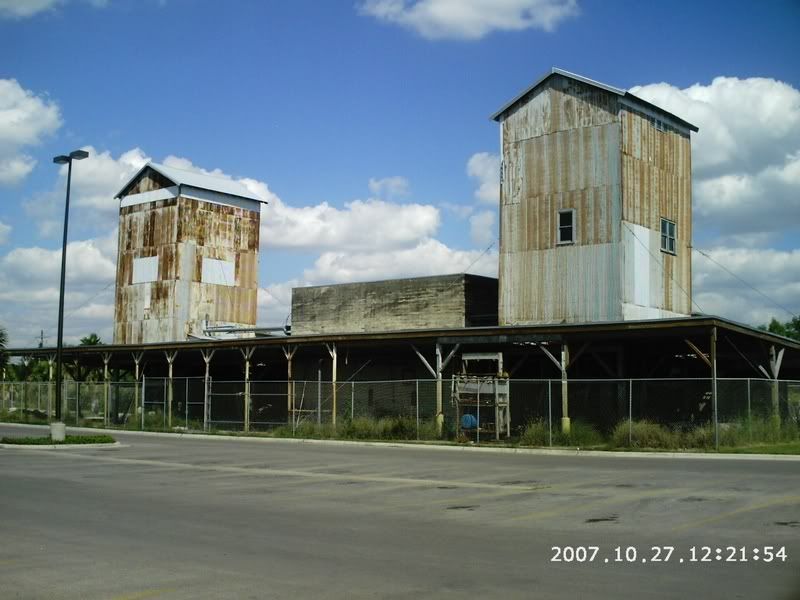
We often talk about trackside structures such as towers, stations, and water tanks (and even steam pumping stations.) I thought I would add an exclusive southern perspective to the mix. Any southern town worthy of the name in the late 1800s-early 1900s had a passenger station, freight station, -- and a cotton compress. During this time in the southeast United States, cotton was king. It was everywhere, and in demand by the cotton mills in the northeast and and in England. But coming from the field, a bale weighing 500 lbs was "fluffy" with a dimension of 4 feet by 4 feet by 6 feet. You could pile this up to the hurricane deck of a river steamboat, but you couldn't fill a boxcar or steamship to full capacity. (In the interest of dialup users, I kept the pictures small; click on each to go to webshots and get the full size image.) ![]() So, the steam cotton compress was invented. It would take these bales, and squeeze them down to 8-10 inches thick. You could then load a boxcar or the hold of a steamship up to it's maximum load. I have found several of these compresses around the states of Texas and Louisiana. But, just last week, I purchased a book that showed the Cleburne Compress in the 1800s, and gave the street it was on. So, I decided to drive down that street, and see if I could spot it. Sure enough, I found it, looking like an "iron giant" trying to hide in a grove of trees. You can barely see the smokestack for the former Cleburne Santa Fe Shops in the distance in this picture. Here is a better view of the 110+ year old giant. According to the Denton, NC group restoring the similiar Southern Railroad's Charlotte Cotton Compress; It is 35 feet tall, and weighs 135 tons. Its 8-foot-diameter piston has a 10-foot stroke. It was designed to squeeze a 500-pound, 4x4x6-foot cotton bale down to 8-10 inches in thickness. Notice the linkage from the auxillary steam cylinder on the side that raised the side plates; one on each side. These side plates kept the cotton bale from squishing out the sides of the compress as it was being compressed. Here, you can see the two side plates. The one closest to us appears to be in decent shape, but the one of the other side is badly rusted through. This view shows the valves and piping that admitted steam to the bottom of the main cylinder and the bottom (and maybe the top -- if so, that's a later modification) of each auxlliary steam cylinder. The valves were operated by levers from the ground; to be seen on the McKinney, Texas compress. You can just see the platen in this view of the heart of the compress; with it's slots to allow the bale to be wrapped with steel bands after the bale had been compressed. You can also see the side plates; raised on each side to keep the bale between the platen on the bottom and the table on top. In this 1894 patent drawing for the Web compress, steam was admitted by the valve on the side into the space between the base of the steam cylinder and piston (19). This caused the piston to rise, lifting also the piston rod (15). This rotated the two linkages (35), which in turn lifted the four scissors legs (29), which lifted the platen (28), compressing the cotton bale against the table (1). The Charlotte compress was tested in September, 1899, and was found to exert a pressure of 60 PSI or 130,000 lbs. per bale, using low pressure (50 lbs.) steam. Next installment, we will find out why I picked this title for this thread. If you want to read ahead, you can see the entire gallery in advance at: http://travel.webshots.com/album/578047488CEERkL Also, here is a Webshots gallery by the group restoring the Charlotte Compress. They are currently planning on moving the caboose and steam locomotive on display in Cleburne to a spot next to the station. This compress is a short distance away; I would love to see it moved to a spot right behind them; the trio would make a great heritage park, though moving the compress would be a major undertaking. http://news.webshots.com/album/400282637DACiQd |
|
| Author: | jim templin [ Thu Jul 08, 2010 6:55 pm ] |
| Post subject: | Re: "Too big to scrap" - steam cotton compresses |
RE. Greenville compress.The last time i was in there, there were two compresses in the building, the original 1890s one made of heavy timbers, and the later, all iron and steel one. If memory recalls right, one of them had a little vee twin engine on it to run a donkey press or some such. It also had a reciprocating steam engine powered dynamo for lights and a neat bank of HRTs in the power house. The Audie Murphy museum got some of the stuff BTW the cotton compress in McKinney, TX pressed with steam as late as 1999. Google producers compress for a Dallas News piece about it by Roy Appleton. |
|
| Author: | whodom [ Fri Jul 09, 2010 9:17 pm ] |
| Post subject: | Re: "Too big to scrap" - steam cotton compresses |
Very cool finds James. The cotton gin that was in my hometown (Salters, SC) when I was growing up in the early 1960's had a compress as the final step in the ginning operation, although it was electro-hydraulic. A friend of mine's family had owned and operated the gin since it's inception and he mentioned once that an earlier iteration of the gin had been steam powered, so I'm sure it had a steam compress at that time. |
|
| Author: | wm7545 [ Sat Jul 10, 2010 4:43 pm ] |
| Post subject: | Re: "Too big to scrap" - steam cotton compresses |
Very cool, and very interesting. Thanks for posting. |
|
| Author: | Bob Davis [ Sun Jul 11, 2010 1:06 am ] |
| Post subject: | Re: "Too big to scrap" - steam cotton compresses |
For those of us not familiar with cotton processing, what is used nowadays that takes the place of a "compress"? The "Too big to scrap" heading reminds me of the time the Pacific Electric rails were pulled out of Olive Ave. in Monrovia CA (I saw this process from the schoolyard when I was 11 years old). Later I learned that in other places (e.g. Fort Collins) the rails were merely paved over. Since the Korean War was being fought at the time, I presumed that scrap iron prices were high enough to justify the expense of yanking out the rails. The Pacific Electric Historical website has photos of the strange machine that performed this unhappy task. There are also photos of a similar (or the same) machine doing this on North Lake Ave. in Pasadena during the early 40's. |
|
| Author: | survivingworldsteam [ Mon Jul 12, 2010 11:58 am ] |
| Post subject: | Re: "Too big to scrap" - steam cotton compresses |
Bob Davis wrote: For those of us not familiar with cotton processing, what is used nowadays that takes the place of a "compress"? It is now pressed into a bread shaped "module" in the field by a hydraulic press, and by a hydraulic press at the gin prior to shipping. No need to take it to a seperate compress building and warehouse by the side of the tracks; as it will probably get shipped by truck rather than train. Here are a few more compress facilities I have found either in my travels or via Goggle Earth. Notice how in several instances the boiler room appears to be complete; the compress may still be there as well. Clicking on the title will take you to that location via Google Earth: US 82, Ralls, Texas Schulenburg Cotton Compress, James and Main Sts., Schulenburg, Texas Power Ave. Warehouse, 434 E. Power Ave, Victoria, Texas National Compress Company Building, Matthews St, Waxahachie, TX Here is my photograph of the Vernon compress. Notice that the boiler room (under the smokestack) was a seperate structure made out of cinder blocks or concrete, while the rest of the compress building is conventional warehouse construction. This was to prevent an accident involving the steam boilers from burning down the entire building and the thousands of bales of cotton it might contain. Memphis Cotton Compress, 820 Lucille St, Memphis, Texas Could you see a compress from aerial photographs if the building is scrapped? Well, I found a Flicker website with excellent pictures of the compress in La Grange, TX; as the compress building was being demolished: http://www.flickr.com/photos/stall/sets ... 06/?page=3 Looking at it on Google Earth, you can see down into the "cup" of the compress' steam cylinder, and see it's shadow, as it sits exposed in the open now. Yep, too big to scrap. compress site, 910 E La Fayette St, La Grange, TX Finally, to round out our whirlwind tour of compresses across Texas for now, here is my picture of the one in Vernon; once again with it's substantial boiler room. Vernon Compress Co., 100 US Highway 287 E, Vernon, Texas A couple more pictures and a map showing a surprising number of facilities I have found so far wrap up my material to date. |
|
| Author: | Bob Davis [ Mon Jul 12, 2010 3:23 pm ] |
| Post subject: | Re: "Too big to scrap" - steam cotton compresses |
Thanks for the update; "module" is not a word I would normally associate with cotton harvesting, but progress marches on. |
|
| Author: | survivingworldsteam [ Tue Jul 13, 2010 3:04 pm ] |
| Post subject: | Re: "Too big to scrap" - steam cotton compresses |
Last installment. ;) As I was moving our stuff to Cleburne, I noticed this industrial location in the one-horse town of Itasca, Texas. I wondered what an industrial site was doing in such a small town; I now realize it was the site of a cotton gin and compress. I don't know if the water tank on top of the compress coupola is later addition or what; never seen this at any other location (but never seen such a substantial coupola, either.) Harris Ave / Weave St, Itasca, TX Crossing the Sabine River into Louisiana; there is the former Southern Cotton gin site on Mill St. in Natchitoches, LA. I was going to drive in closer to the compress itself, and take a picture of it, but the wife said "no way." So, you will have to settle for this Google Street view. It looks like the gin itself maybe in the process of being demolished or reused for another business. Southern Cotton Gin, Mill St., Natchitoches, LA And here is a naked compress on Railroad Ave. in Oak Grove, LA; photo taken and sent to me by Matt Ritchie: I was going to share all the locations I have found date, but it is up to 36! So, I will share the following link with you instead. Enjoy them in your travels across Texas and across the South, and if you see any others, I would like to hear about them. There is a list at the bottom of the page, and click on each mark for an address and description. http://gmaps.kaeding.name/saved/Surviving_Compresses8 |
|
| Page 1 of 1 | All times are UTC - 5 hours [ DST ] |
| Powered by phpBB © 2000, 2002, 2005, 2007 phpBB Group http://www.phpbb.com/ |
|