| Railway Preservation News https://www.rypn.org/forums/ |
|
| Old hands at the throttle https://www.rypn.org/forums/viewtopic.php?f=1&t=31671 |
Page 1 of 1 |
| Author: | Les Beckman [ Tue Jul 05, 2011 12:44 am ] |
| Post subject: | Old hands at the throttle |
On one of the runs of Nickel Plate Road #765 at Hoosier Valley Railroad Museum this past Saturday, I was surprised to see a guy in a nice clean sport shirt and cap sitting in the engineers seat. Quite a contrast to the "grungy" appearance of the guys that maintain and operate the Berkshire! The engine was set to depart the museums North Judson depot building and head west toward La Crosse, and I stood there, probably with my mouth open, as I realized that this gentleman wasn't just there for a quick experience, but was going to actually RUN the big Berk. As the engine slowly moved out, I turned to one of the Ft. Wayne Railroad Historical Society members on the ground and asked for the story. Well, he said that the fellow was 87 years old and was one of the last surviving Nickel Plate engineers that actually ran the NKP 2-8-4's in regular service, apparently in and out of Lima, Ohio. I thought it was pretty remarkable, especially when I figured it out that the NYC&StL had stopped running the Berks in 1958, which would have made this guy about 34 years old at that time. I thought that that was pretty young for an engineer on the NKP, but certainly not impossible, figuring that he might have started as a fireman at a young age. There are probably other gentleman still around that operated steam on the Class 1 railroads in regular service, but I wonder how many are still healthy enough to still do it, even if only on occassion, such as at HVRM this past weekend? Anyone know of others? Les |
|
| Author: | Frisco1522 [ Tue Jul 05, 2011 11:23 am ] |
| Post subject: | Re: Old hands at the throttle |
During 1522's restored life, I had a couple of guys come up and tell me they hired out on the Frisco in the late '40s firing, but they were too young to have run steam as the Frisco dieselized in Feb of 1952 (Dammit!) but did some firing on them. One had even broken in firing for my Dad and had very nice things to say about how he ran a steam engine. One local guy who fired steam worked with us on the restoration to help us learn how to fire her. He was a big help. Men who actually ran steam are getting sort of rare unless it's in IC or N&W,GTW or NKP or even UP. They are all long retired. I loved seeing one of these guys look the engine over and get "that look" in their eyes. I was up at IRM back in the early '70s and remember an old retired MILW engineer sitting down and running the Frisco 1630 gentle as a baby. |
|
| Author: | Txhighballer [ Wed Jul 06, 2011 12:20 am ] |
| Post subject: | Re: Old hands at the throttle |
About four years ago when I was working at Texas State Railroad, and elderly gentleman came up in the cab with his daughter..he pulled out his rules card with an engineers' seniority date of 1943 with the Southern Pacific. He was still quite spry and I asked him would he like to ride in the cab..he politely told me that he wouldn't mind marking up,but his daughter might be a little upset!. At the end of the run back in Rusk, he came back up to the cab again. I was down checking the pins and he came up to me and said all they had were black firemen back when he ran, but you would have made the grade running on the SP. I don't think my feet touched the ground for the rest of the day... |
|
| Author: | J3a-614 [ Wed Jul 06, 2011 3:07 am ] |
| Post subject: | Re: Old hands at the throttle |
The comments about the old timers reminds me of my first main line trip behind steam, which was a New River train (Huntington to Hinton and return) with the 2101 in September of 1977. Ross Rowland had run out of time on the hours-of-service law, and we were heading back to Huntington with a C&O/Chessie System engineer. On this return leg, I went forward to a baggage car that was being used as a sound-recording car for those who wanted audio tapes (no personal video cameras back then!) Riding at the lead end of the now-empty car were two other old-timers, at least one of whom was on duty, in uniform and with one of those big, yellow walkie-talkie type radios that were the state of the art back then on his hip. As I foggily remember it, one of them commented to the other, "Listen to -------- (I've forgotten the name), he's having fun with that whistle. There isn't a grade crossing for three miles yet." The other replied, "I guess he should have fun, it's the first chance he's had to run a steam engine in 25 years." Although off topic, I have to recall one image from earlier in this trip that is particularly vivid in my mind. On this return run, the light was almost completely gone as we were approaching Deepwater, W.Va. The sky was a deep, rich, dark indigo blue, with stars; the hills were black, and the Kanawha River was also deep blue with sparkles, reflecting the darkening sky. The train itself was also mostly invisible. Goggles down, look out the window, and on a curve all you could see of 2101 was a lumpy silhouette, with a headlight beam lighting up the trees and the track, and a glimpse of the fire through the vents in the ash pan. Check for approaching trees, look back at the train, and what was visible was a string of golden rectangles, with a second golden string dancing along on the ground. Forward again, to the engine--and an approaching block signal. The signal was displaying "approach," but we were coming on it at track speed, no slowing down. The signal went to "clear" practically in front of the pilot, and of course flashed to "stop" as the engine roared under the typical C&O cantilevered signal bridge; I remember the smoke swirling in the red lights as my car ran under. Into one curve, and then another, and at this point we were on a long curve paralleling the river, and approaching another signal. This one, like the first, was also displaying "approach." Visible beyond along this long, sweeping curve was another signal, displaying "stop." And beyond that signal, there were two moving red lights--the markers of another train! Our C&O veteran continued to run at speed to this signal. It got closer and closer, and was almost in front of the engine. The two moving red lights passed another red signal that had come into view. The first red signal dropped from "stop" to "approach," and the yellow signal dropped from "approach" to "clear" in front of the pilot. Talk about heads-up railroading! This went on for miles, until we slowed for the stop at Montgomery, W.Va. It was a glimpse of how things used to be. It brought to life the descriptions of the 20th Century Limited running up the Hudson in multiple sections. Steam railroading is great in all its forms, including the short lines, logging lines, and narrow-gauge roads we are so fortunate to have, but there is something very different, very special, in main line operations like that. Thanks, Ross, and thanks, Chessie System, for bringing that back. . .now, if only we could get CSX to see what they could have. . . |
|
| Author: | p51 [ Wed Jul 06, 2011 11:19 pm ] |
| Post subject: | Re: Old hands at the throttle |
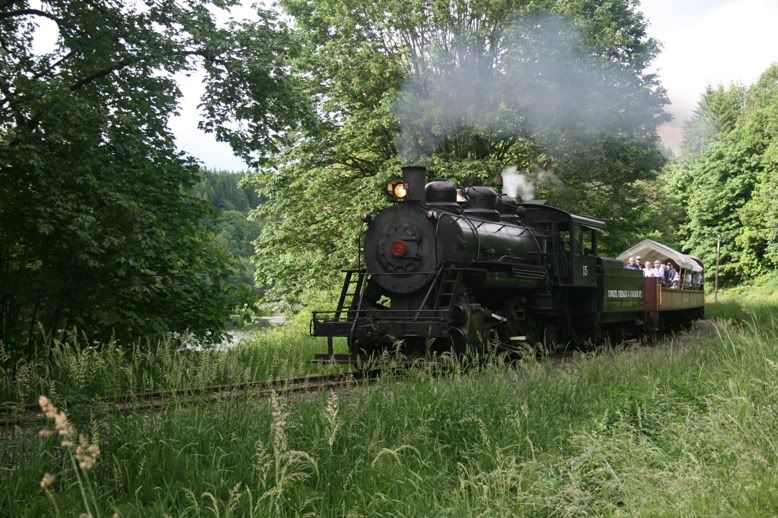
At Chehalis, WA, there is a tourist operation with a very light logging Mike and the engineer who ran her in regular service still runs her from time to time. He ran the NRHS special for the convention recently: I have a photo of him with the loco here: http://www.railroadforums.com/photos/sh ... by/cat/500 |
|
| Author: | Jim Baker [ Thu Jul 07, 2011 2:11 am ] |
| Post subject: | Re: Old hands at the throttle |
Unfortunately this goes back a few years, but when we got our ex SP 10-wheeler (2353) running back in 1996, two old heads who had actually run her taught us how to do it. Leonard, the engineer had retired after 50 years with the SD&A(E) and was 89 years old in 1996. He climbed up into the cab like a kid, and sat down in the right seat like the last time he was there was yesterday. He really know how to do the job, and was an excellent teacher. He worked with a couple of our guys for several days, and then came back every six months or so to see how we were doing. Dick, the fireman, was younger than Leonard. He had a seniority date as a fireman of about 1944. He'd worked a short time for the RR, went into the Navy for a couple of years at the last part of WWII, then came back to the RR. He fired until about 1952 when he got seriously injured and had to take up another occupation. But, her became involved with our group in about 1991, and was one of the stalwarts in the restoration of 2353. Like Leonard, he was a great teacher, and a lot of fun to work with. Both of these fine gentlemen have now passed away. And, if we learned only 10% of what they knew, we learned a lot, but we sure can't say we're experts. |
|
| Page 1 of 1 | All times are UTC - 5 hours [ DST ] |
| Powered by phpBB © 2000, 2002, 2005, 2007 phpBB Group http://www.phpbb.com/ |
|