It is currently Fri Aug 21, 2026 9:50 am

All times are UTC - 5 hours [ DST ]


Post new topic Reply to topic  [ 25 posts ]  Go to page 1, 2  Next
Author Message
 Post subject: Mystery Truck Question
PostPosted: Wed Jun 19, 2013 9:53 am 

Joined: Sun May 15, 2005 2:22 pm
Posts: 1543
Does anybody know of any existing equipment having this type of trucks? I am referring to the third caboose from the top of this page. It is the Canadian Pacific Conductor’s Van #3015. I would like to know if this type of truck was a standard design with a name. I would also like to know if one exists so that I might be able to study the details of the design. And I would like to know if anyone knows of any drawings or plans for this type of truck, or has seen any other photographs of it.

Here is the page: http://www.nyow.org/Articles/Stanulevich/caboose.html

The only other images of this type of truck that I have seen are photos of two M&StL cabooses dating from the 1800s. It appears to be a swing motion truck.


Offline
 Profile  
 
 Post subject: Re: Mystery Truck Question
PostPosted: Wed Jun 19, 2013 12:12 pm 

Joined: Tue Mar 22, 2011 11:32 pm
Posts: 29
They look like the same trucks as those on the SL&LC #53 caboose at Steamtown.

Fred Heilich


Offline
 Profile  
 
 Post subject: Re: Mystery Truck Question
PostPosted: Thu Jun 20, 2013 10:49 am 

Joined: Sun May 15, 2005 2:22 pm
Posts: 1543
Fred,

Thanks for that tip. I did find that caboose listed on the Steamtown inventory as originally built by B&M RR prior to 1893. I could not find any photos of it, but I will check with them directly for further details. The date roughly corresponds to the M&StL cabooses I have seen with these trucks. However, the description of the B&M caboose trucks says they are wood frame.

I believe the trucks I am asking about have the iron truck frames tied together only by two wooden beams across the top. From those beams, swing hangers suspend a swinging spring plank which carries two elliptical springs at each side of the truck. Between the two wooden cross beams on the top, sits the truck bolster with its ends resting on the tops of the elliptical springs. The trucks have a relatively short wheel base, so I suspect the design dates from maybe the 1860 era.


Offline
 Profile  
 
 Post subject: Re: Mystery Truck Question
PostPosted: Thu Jun 20, 2013 11:52 am 

Joined: Sun Aug 22, 2004 8:31 am
Posts: 1341
Location: South Carolina
I think this caboose I saw at the Oklahoma City Railway Museum last month has the same trucks:

Image

http://www.oklahomarailwaymuseum.org/eq ... gallery=14

_________________
Hugh Odom
The Ultimate Steam Page
http://www.trainweb.org/tusp


Offline
 Profile  
 
 Post subject: Re: Mystery Truck Question
PostPosted: Thu Jun 20, 2013 12:20 pm 

Joined: Sun May 15, 2005 2:22 pm
Posts: 1543
Hugh,

The caboose I am referring to is shown in the linked page of my first post, and it is the third caboose down on the page. It has no cupola, and is lettered as "Canadian Pacific Conductors Van."

From your photo, you must be comparing it to the first caboose on that page.


Offline
 Profile  
 
 Post subject: Re: Mystery Truck Question
PostPosted: Thu Jun 20, 2013 12:41 pm 

Joined: Sun Aug 22, 2004 8:31 am
Posts: 1341
Location: South Carolina
Ron Travis wrote:
Hugh,

The caboose I am referring to is shown in the linked page of my first post, and it is the third caboose down on the page. It has no cupola, and is lettered as "Canadian Pacific Conductors Van."

From your photo, you must be comparing it to the first caboose on that page.


Yes, sorry. I didn't look far enough. Those are definitely some different trucks!

_________________
Hugh Odom
The Ultimate Steam Page
http://www.trainweb.org/tusp


Offline
 Profile  
 
 Post subject: Re: Mystery Truck Question
PostPosted: Fri Jun 21, 2013 5:08 pm 

Joined: Sun May 15, 2005 2:22 pm
Posts: 1543
I have seen this type of truck in photographs of five different cabooses of the Minneapolis & St. Louis RR in the 1880-1900 era, and in the one photograph of the CP caboose linked to the first post here. I have found no other photograph or reference to this type of truck.

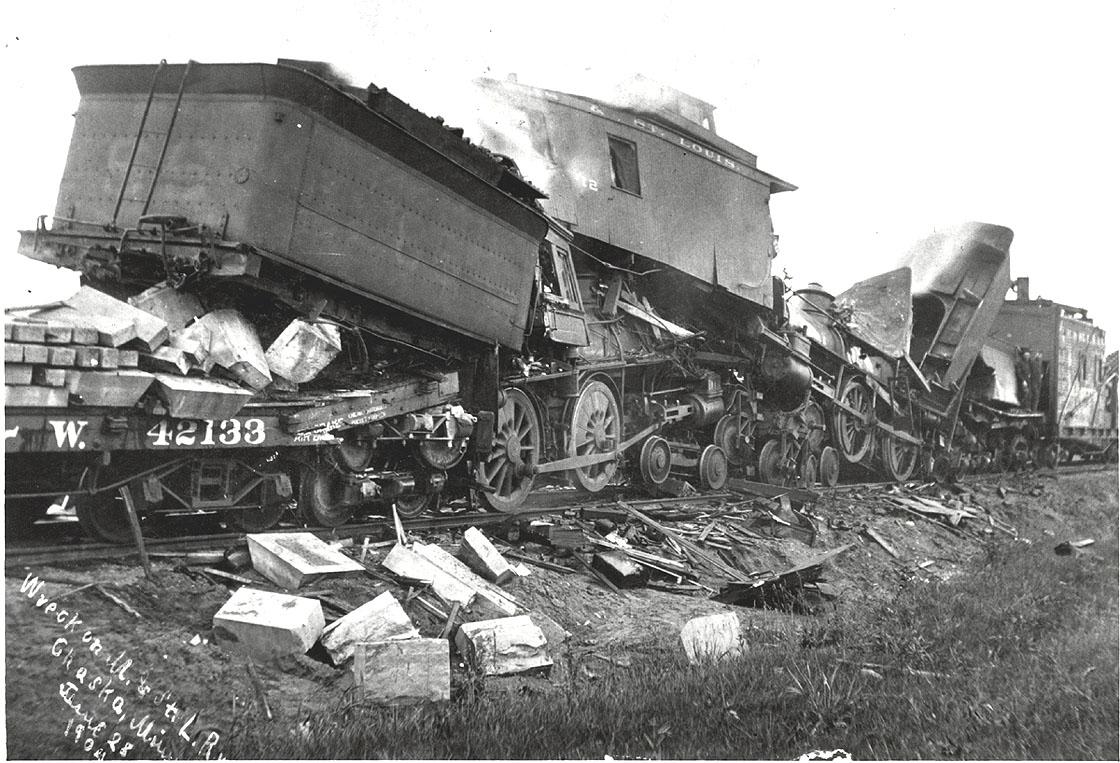
Of the six different cabooses, I presume that the latest photograph of the group is this one showing M&StL caboose no. 12 destroyed in a head on collision in 1904 at Chaska, MN. The trucks are quite visible, but also quite torn up from the wreck.

http://www.northeast.railfan.net/images ... tl1904.jpg

I once wrote an article about caboose #12, and in the process, I analyzed the photos and was able to reconstruct the trucks in a cad model, but I had to omit some details for lack of information. At the time, I informally dubbed it a “two-story arch bar truck.”

In his book, The American Railroad Freight Car, John White talks about how some early designers did not fully understand the structural geometry of the arch bar frame and so they added redundant bars. Some of Mr. White’s examples of trucks with redundant bars do resemble the truck that I am referencing here.

However, I don’t believe this design was an example of redundant bars. In my analysis of the M&StL trucks and in the identical trucks of the CP caboose, they appear to be swing motion design. So the extra structure appears to be needed to accommodate the swing motion design. As I understand it, the era of swing motion freight car trucks flourished for a time and then abruptly ended. I suspect that there is a lot of lost history in the category of swing motion truck design.

Generally, I conclude that the type of truck shown in caboose #12 was obsolete by 1900. Indeed, caboose #12 was being used in work train service when it was destroyed in the 1904 wreck, suggesting that it was in a phase of downgraded service.


Offline
 Profile  
 
 Post subject: Re: Mystery Truck Question
PostPosted: Fri Jun 21, 2013 6:38 pm 
Site Admin

Joined: Sat Aug 28, 2004 1:15 pm
Posts: 1502
Location: Henderson Nevada
I suspect it is just a variation on a wood transom arch bar freight truck... It is a bit weird, in that the transoms are above the arch and top bar, but sill a wood transom arch bar truck.

It is likely that the tall transom is in part to allow swing motion. The top extension may be there to allow taller spring assemblies, or simply to raise the truck height.

Randy

_________________
Randy Hees
Director, Nevada State Railroad Museum, Boulder City, Nevada, Retired
http://www.nevadasouthern.com/
https://www.facebook.com/FriendsOfNevadaSouthernRailway


Offline
 Profile  
 
 Post subject: Re: Mystery Truck Question
PostPosted: Mon Jun 24, 2013 12:50 pm 

Joined: Sun May 15, 2005 2:22 pm
Posts: 1543
Randy Hees wrote:
I suspect it is just a variation on a wood transom arch bar freight truck... It is a bit weird, in that the transoms are above the arch and top bar, but sill a wood transom arch bar truck.

It is likely that the tall transom is in part to allow swing motion. The top extension may be there to allow taller spring assemblies, or simply to raise the truck height.

Randy


Randy,

I follow what you are saying. When you speak of the truck transom in a non-swing motion arch bar trucks with coil springs, I would understand the transom to be the spring plank that ties the two side frames together and sits on the top of the bottom arch bars.

In the case of these swing motion trucks, the transom would be the two beams tying the two side frames together by attaching to the side frames just under the tops of the top arch bars. So with this truck, the cross tie is at the top, whereas with a non-swing motion arch bar truck, the cross tie is at the bottom.

There is a spring plank in these swing motion trucks, but it has to swing, so it cannot have its ends attached to the side frames as a connecting transom. Instead, it hangs from the two transoms by four swing hangers. A pair of elliptical springs sits on top of each end of the swinging spring plank. The truck bolster is nested between the two connecting transom beams at the top, and the ends of the bolster sit on top of the elliptical springs.


Offline
 Profile  
 
 Post subject: Re: Mystery Truck Question
PostPosted: Tue Jun 25, 2013 10:25 am 
Site Admin

Joined: Sat Aug 28, 2004 1:15 pm
Posts: 1502
Location: Henderson Nevada
The transom beams (in some cases a pair of steel beams) are in pairs, stand vertically across the truck, spanning side frame to side frame, between the wheels. In a conventional freight truck the bolster and swing plank hold the side frames together. It a transom beam style truck (like the one that started this tread) they don’t.

The spring plank is suspended from the transoms, either via swing motion, or rigidly (in which case the spring plank may also be bolted to the side frames) The springs (either coil or elliptical) sit on the spring plank, the bolster sits on the springs.

A good example of rigid motion trucks with transom beams (in this case steel) are the Southern Pacific Railroad’s “faux” theilson trucks used on their narrow gauge equipment after about 1917. True theilson are steel transom swing motion trucks… SP built their copies without the swing motion.

Randy

_________________
Randy Hees
Director, Nevada State Railroad Museum, Boulder City, Nevada, Retired
http://www.nevadasouthern.com/
https://www.facebook.com/FriendsOfNevadaSouthernRailway


Offline
 Profile  
 
 Post subject: Re: Mystery Truck Question
PostPosted: Tue Jun 25, 2013 10:30 am 

Joined: Thu Mar 24, 2011 12:07 pm
Posts: 1202
Location: Leicester, MA.
I was in Palmer the other day, and I noticed the tender trucks on the Porter are strikingly similar to the trucks on the Canadian Pacific Van in question (the shot was just to big to upload here);
https://www.facebook.com/media/set/?set ... 425&type=3

_________________
Dylan M. Lambert
https://www.facebook.com/LambertLocomotive/


Offline
 Profile  
 
 Post subject: Re: Mystery Truck Question
PostPosted: Tue Jun 25, 2013 11:41 am 

Joined: Thu Aug 26, 2004 2:50 pm
Posts: 2815
Location: Northern Illinois
Swing motion or not has no bearing on those goofy side frames. Here is a photo of some of the last swing motion archbar trucks with wood transoms produced:

http://www.rr-fallenflags.org/soo/soo-c239bds.jpg

These trucks are original to the car, built by AC&F 3/1907. The ends of the wood transoms are very prominent. Trucks of this style stayed in service on the Soo Line until the late sixties; a life of about sixty years.

As you can see, there is no reason to have the intermediate straight bar that ties the tops of the journal boxes; the combination of the two bars that form the "diamond" and the ends of the transoms acting in compression to space them apart is all that is needed to transfer the weight from the transoms to the journals. Since the transoms aren't quite as tall as the depth of the side frame truss, an iron casting below the transoms makes up the difference. Both wood and cast iron are better in compression than tension, and this design takes advantage of that fact.The straight bar across the bottom of the boxes keeps them from splaying outward, since he upper bars come together inboard of the journal box, rather than on its center line, which would be optimal.

It seems the designer of the CPR truck illustrated hasn't yet figured out that steel is better used in tension rather than compression; he puts both bars in compression. Yeah, it works given the relatively light loads these trucks carried, but the lower bar would be much more effective in tension, angling down under the transoms to carry the load as in later trucks. The top bar is in compression out of necessity; some of the last archbar trucks made this bar larger in section, or used a channel section because of this.

I looked through what period literature I have; only found similar trucks in the Gregg reprint of the 1879 Car Builder's Dictionary. There is no formal name given for the design, they are simply labeled "Iron Truck".

_________________
Dennis Storzek


Offline
 Profile  
 
 Post subject: Re: Mystery Truck Question
PostPosted: Tue Jun 25, 2013 5:40 pm 

Joined: Sun May 15, 2005 2:22 pm
Posts: 1543
Dennis,

I see that truck you refer to in The Car Builder’s Dictionary (1879) on page 258. It has the structural elements of the one I am inquiring about, although the lower bar of the two upper bars is not straight like the one I am inquiring about. In his book The American Railroad Freight Car, John White shows the truck in The Car Builder’s Dictionary (1879), and says it was designed by Leander Garey for the NYC. White says that Garey and a few others were proponents of the “four-bar side frame” before the universal adoption of the “three-bar side frame.” White does devote some discussion to the structural redundancy of the four-bar side frame in a few variations. He mentions your points about the bars being in compression or tension.

On page 451 of White’s book is an illustration of a Grand Trunk Railway truck with four-bar side frames identical to the one I linked to in my original post. It also happens to be a changeable gage truck. So, apparently the truck I am inquiring about is simply an example of the brief era of the four-bar side frame. I understand your point that the four-bar side frame is not a requirement for a swing motion truck. But coincidentally, all of the four-bar trucks that I have seen in the photos I mentioned above, and in all of the examples in these books are swing motion trucks.


Offline
 Profile  
 
 Post subject: Re: Mystery Truck Question
PostPosted: Tue Jun 25, 2013 7:10 pm 

Joined: Mon Aug 09, 2010 10:48 pm
Posts: 40
The caboose at Steamtown has the same trucks as the first caboose, not the others--presuming that Mr. Heilich meant SJ&LC and not SL&LC, as I am unable to find any railroads with the initials SL&LC.

A video of SJ&LC #59 is here: http://www.youtube.com/watch?v=u1fwUVRBnNw
And a picture of #53 is here: http://www.ebay.com/itm/St-Johnsbury-Lake-Champlain-Railroad-Caboose-No-53-8x10-Photograph-/290936027479


EDIT: The Green Bay & Western appears to have used similar trucks through the 1930s.

Pictures are down a bit on the right on this page: http://www.greenbayroute.com/cabooseroster.htm

Scrolling further down, a bay window caboose on the GB&W had a similar truck through at least 1950!

EDIT2: I'm not sure if this is -exactly- the same thing, but the 1888 Car Builder's Dictionary (available on Google Books here) has, on page 315, something similar; it calls it a "continuous frame truck", and claims that it originated on the Boston & Albany.

_________________
Unofficial Historian - American Industrial Railroad Society
https://industrialrails.org


Offline
 Profile  
 
 Post subject: Re: Mystery Truck Question
PostPosted: Tue Jun 25, 2013 9:28 pm 

Joined: Sun May 15, 2005 2:22 pm
Posts: 1543
Robbie,

Thanks for that information. I am amazed to see four cabooses on that GB&W page that have the same or nearly the same truck design as the one I have asked about in the original post here. So that is a total of ten different photographic examples of cars with these mystery trucks, and they are all cabooses. When I posed the original question, the mystery was why they built this type of truck design.

The four-bar side frame design seems to go back to about 1856 on the IC, and was used on other railroads and copied by other designers with some degree of variation on the theme. In his book on freight cars, John White presents this early history of the four-bar side frame truck as though it were an error in structural reasoning. I am beginning to wonder if that is all there is to the explanation.

So the mystery has shifted to asking why a structural error was propagated and standardized to the extent it was. White’s early references show quite a bit of variety in the four-bar frames, whereas the ten cabooses have the four-bar frames all identical to each other. If it was an error in structural design, I am somewhat surprised to see it show up standardized under multiple cabooses on the M&StL, GB&W, and CP that seem likely to have originated near the end of the era of four-bar examples that Mr. White covers in his book.

In my original work in drawing the M&StL caboose #12, I had misinterpreted the makeup of the four-bar side frames based on the appearance of the truck ripped apart from the wreck in 1904. I perceived that the columns were formed by bending and doubling or even tripling the bars to make the column structure. This would have resulted in some really convoluted forming and joining of the bars to make the column features. Now, I see that the CP example in the original post appears to have cast iron columns, and that is what is actually showing in the wreck photo of M&StL #12. So I would conclude that the mystery truck four-bar frame is made with two identical arch bars and two identical straight bars.

While the bars may appear to be wrong-headed in structural terms, the structural disadvantage is not great. I would speculate that there was a purpose to the design, and that was to focus the frame structure around the connection with the cross transom beams. It would have bars above and below the transoms to bolt through the bars and through the transoms. Furthermore, the bars below the transoms were doubled and connected to the tops and bottoms of the journal boxes in a triangular fashion. It seems like a good design to transfer the spring hanger loading on the transoms most directly to the side frames, and on to the journal boxes. I don’t believe it was a structural error.


Offline
 Profile  
 
Display posts from previous:  Sort by  
Post new topic Reply to topic  [ 25 posts ]  Go to page 1, 2  Next

All times are UTC - 5 hours [ DST ]


You cannot post new topics in this forum
You cannot reply to topics in this forum
You cannot edit your posts in this forum
You cannot delete your posts in this forum
You cannot post attachments in this forum

Search for:
Jump to: