Railway Preservation News
https://www.rypn.org/forums/

B&O's stillborn 4-2-2-2-2-4 streamlined steam engine
https://www.rypn.org/forums/viewtopic.php?f=1&t=36419
Page 1 of 1

Author:  Mgoldman [ Sun Mar 30, 2014 6:04 pm ]
Post subject:  B&O's stillborn 4-2-2-2-2-4 streamlined steam engine

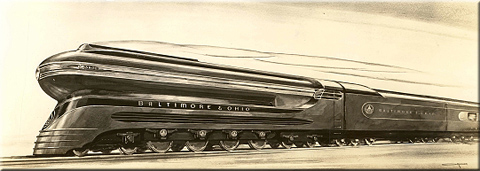
Remember "Chaski Railfan" - it's still up and running and I came across this a post by "Millhouse" regarding a feature at "American-Rails.com" regarding an experimental B&O Besler Type steam engine design of the late 30's.

Pretty wild!

The B&O Class W-1 Besler Type
http://www.american-rails.com/class-w1-besler-type.html

Chaski link:
http://www.chaski.org/railfan

/Mitch

Image

Author:  Overmod [ Sun Mar 30, 2014 8:47 pm ]
Post subject:  Re: B&O's stillborn 4-2-2-2-2-4 streamlined steam engine

Pity none of the pieces were saved -- B&O got a long way toward building this, even on their somewhat limited budget...

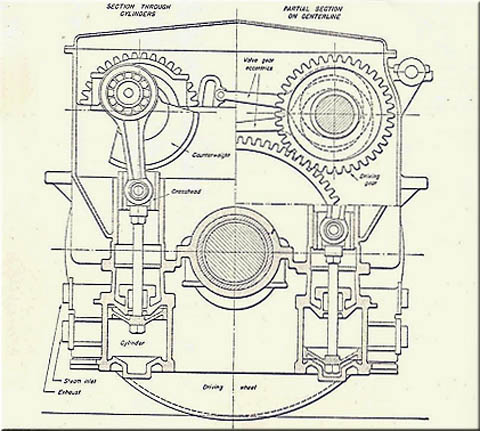
I'm actually gkad they stopped when they did -- if you think a T1 is slippery, consider individual-axle high-horsepower drive without even conjugating the valve gear (a la the German 19 1001 motor locomotive). Individual little motors, right down near axle level where grit, ballast, water, and what else have you fly around, and the only compliance against lateral shock is the play in the leaf suspension springs. Think getting to the rear cambox in a T1 was fun? Look at what's involved in getting to the active parts...

Image

Three points to who can tell me how the valve gear is arranged from this drawing. Note the Bulleid-optimistic construction of the upper 'crankcase' and tell me how long you expect it to remain in necessary tram. My understanding was that these motors were the equivalent of two 2-cylinder-compound single-acting motors in one casing, but the steam arrangements in the drawing shown do not seem to bear that out... but the relative absence of valves combined with the utter absence of uniflow pistons makes me wonder.

I still think the full plans for the motors exist in the Besler archives, and this locomotive is technically much less of an 'undertaking' (no pun intended!) than a large conventional reciprocating locomotive of cimilar indicated power. There is little question that it would make substantial power at very high effective speed -- it is also probably true that its water rate would restrict it similarly to good examples of 2-cylinder power with poppet valves... or a good noncondensing steam turbine. Which is to say 'not competitive with diesels' - Willard was justified.

Author:  J3a-614 [ Sun Mar 30, 2014 10:11 pm ]
Post subject:  Re: B&O's stillborn 4-2-2-2-2-4 streamlined steam engine

Overmod wrote:
Three points to who can tell me how the valve gear is arranged from this drawing. Note the Bulleid-optimistic construction of the upper 'crankcase' and tell me how long you expect it to remain in necessary tram. My understanding was that these motors were the equivalent of two 2-cylinder-compound single-acting motors in one casing, but the steam arrangements in the drawing shown do not seem to bear that out... but the relative absence of valves combined with the utter absence of uniflow pistons makes me wonder.


I'm going to take a guess at this. It looks like the individual motors use Stephenson valve gear (probably OK for something relatively small like this, has variable lead and simple, too), and like Young valve gear, the eccentrics of one cylinder or engine drive the valves of the other, with some sort of right-angle connection to the valves that aren't shown on the drawing. In fact, if my memory is right, didn't each of these motors have four cylinders?

Lots of moving parts in a small space, lots of performance potential, but even more maintenance problem potential, as noted, even when you allow that the motors were supposed to be easy to change out, like electric traction motors.

Author:  Brian Hebert [ Tue Jun 03, 2014 12:58 pm ]
Post subject:  Re: B&O's stillborn 4-2-2-2-2-4 streamlined steam engine

Bill Besler patented at least three versions of this motor. In one of the patent descriptions he explained " It is to be understood that any suitable valve gear may be employed for controlling the admission of live steam and hence the speeds forward, reverse and appropriate cut offs. "
So I'm guessing that the omission of valves in the patent drawings was because his focus was on the arrangement of the pistons, rods and cranks that make up the majority of the motor. I'd sure like to see a complete schematic of this design. There had to have been at least one.
I've been in contact with the Special Archives at the University of Iowa where the Davenport Besler Company papers are kept. They have no drawings of the design.
So that leaves two possible sources for more info. The Baltimore and Ohio Museum, and perhaps in a personal collection in the posession of Bill Besler's family.

As far as the slipping of the drive wheels, I don't know how they planned to mend that problem, but it has been dealt with by the French on one of their experimental locomotives.
The 232.P.1 was built as a conventional 4-6-2, but was heavily modified into a 4-6-4 with the drivers as individual steam motors. The thing looks like the Frankenstein of steam locomotives, but it was very successful, the major problem being access to the machinery for repairs and maintenance.
"The 232.P.1 was the result of a competition set up by POCEM to realize a locomotive without coupling-rods. In the absence of coupling rods there was nothing to equalize the work done by the motors and wheel slip was an obvious danger. The motors were therefore coupled together by a hydraulic servo system that controlled the inlet valve cams."
See this page for pics and other details:
http://www.douglas-self.com/MUSEUM/LOCO ... enchHP.htm

The Besler designs are really interesting and solving their problems is possible. The B&O thought it was worth a try, and bought one motor to test. I wonder how those tests turned out?

Brian Hebert

Page 1 of 1 All times are UTC - 5 hours [ DST ]
Powered by phpBB © 2000, 2002, 2005, 2007 phpBB Group
http://www.phpbb.com/