| Railway Preservation News https://www.rypn.org/forums/ |
|
| 4-2-0 "Experiment" question https://www.rypn.org/forums/viewtopic.php?f=1&t=38229 |
Page 1 of 1 |
| Author: | Frank J. DeStefano [ Mon Jun 22, 2015 3:21 pm ] | ||
| Post subject: | 4-2-0 "Experiment" question | ||
In a history I'm reading of the Mohawk & Hudson, there is a section dedicated to the first 4-2-0 ever created, Experiment designed by John B. Jervis in 1832. The book contained the following illustration of the locomotive (before conversion from Anthracite to wood burning and being pressed into service as the Brother Jonathan). I noticed these two rather odd appliances circled below which I'm assuming are early forms of safety valves, though their rather large size makes me think otherwise. Anyone know exactly what they are and how they function? This is nothing more than ongoing curiosity I wish to have satisfied.
|
|||
| Author: | daylight4449 [ Mon Jun 22, 2015 3:40 pm ] |
| Post subject: | Re: 4-2-0 "Experiment" question |
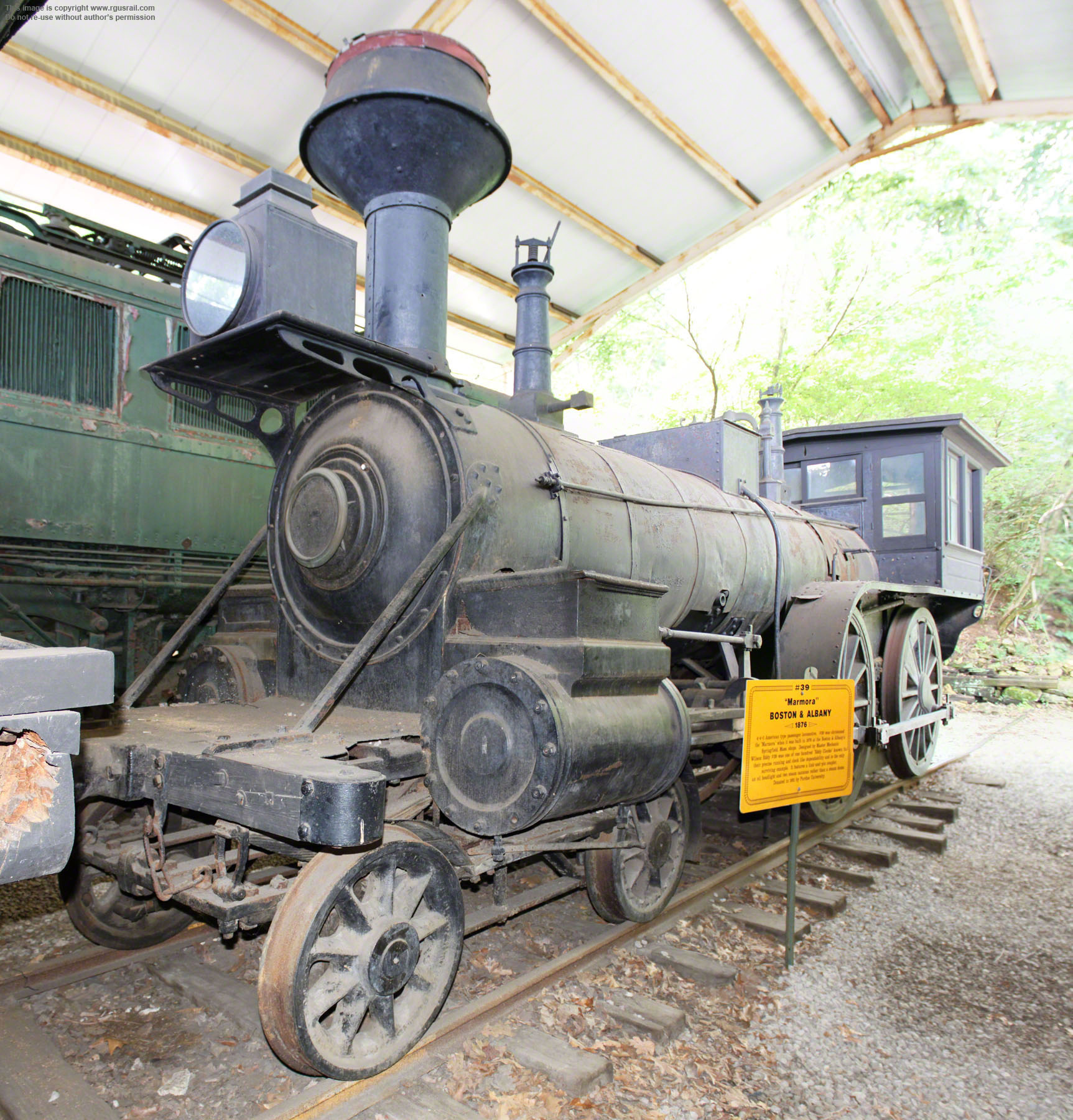
They could be safety valves... But considering the age I'd be inclined to say they're some sort of steam cannon, similar to that on Marmora at MoT; http://www.rgusrail.com/album/moslmtsheds/ba_39_02.jpg |
|
| Author: | hamster [ Mon Jun 22, 2015 3:51 pm ] |
| Post subject: | Re: 4-2-0 "Experiment" question |
OK, I googled "Steam Cannon" and found very little that may be related to steam locomotive technology. As a steam cannon was always conceived as a weapon, it seems unlikely that any locomotive was ever fitted with such a device. Any more guesses? |
|
| Author: | Mark Jordan [ Mon Jun 22, 2015 4:29 pm ] |
| Post subject: | Re: 4-2-0 "Experiment" question |
My educated guess: They are safety valves. The horizontal lever extending from the rearmost is the lever of a "lever & weight" or "Lever & spring" safety valve, which was standard of the era. The pipe above the valve is simply a discharge pipe, to get steam away from the operator. The forward pipe I'm guessing is similar. Maybe a simple "dead weight" valve, with a heavy weight fitted on an open pipe. You asked. I answered. I guarantee nothing. |
|
| Author: | philip.marshall [ Mon Jun 22, 2015 5:20 pm ] |
| Post subject: | Re: 4-2-0 "Experiment" question |
In his A History of the American Locomotive, Its Development: 1830-1880, John H. White identifies these structures as so-called "secret" or "lock-up" safety valves enclosed in tubular brass or copper housings that both prevented crews from tampering with them and also were tall enough to carry the exhaust steam above the engineer's line of sight. Two safety valves were often used for the sake of redundancy. -Philip Marshall |
|
| Author: | Mike Swanson [ Tue Jun 23, 2015 12:10 pm ] |
| Post subject: | Re: 4-2-0 "Experiment" question |
Most locomotive crews of that era didn't understand what the safety valves were for and were annoyed by the sound made by the valves (not to mention having clouds of steam in their faces), so sometimes they would tamper with the valves to prevent or reduce the frequency of their opening; one infamous example was when the Best Friend of Charleston's fireman tied shut the safety valve and the boiler exploded not long afterwards, badly damaging the locomotive and killing its crew, which undoubtedly helped to encourage the use of "tamper-proof" safety valves such as these. |
|
| Page 1 of 1 | All times are UTC - 5 hours [ DST ] |
| Powered by phpBB © 2000, 2002, 2005, 2007 phpBB Group http://www.phpbb.com/ |
|