Railway Preservation News
https://www.rypn.org/forums/

Steam Brake Question
https://www.rypn.org/forums/viewtopic.php?f=1&t=42589
Page 1 of 1

Author:  610BS [ Mon Oct 15, 2018 5:01 pm ]
Post subject:  Steam Brake Question

Sounds crazy but, I'd like to put brakes on a locomotive that will likely never run.

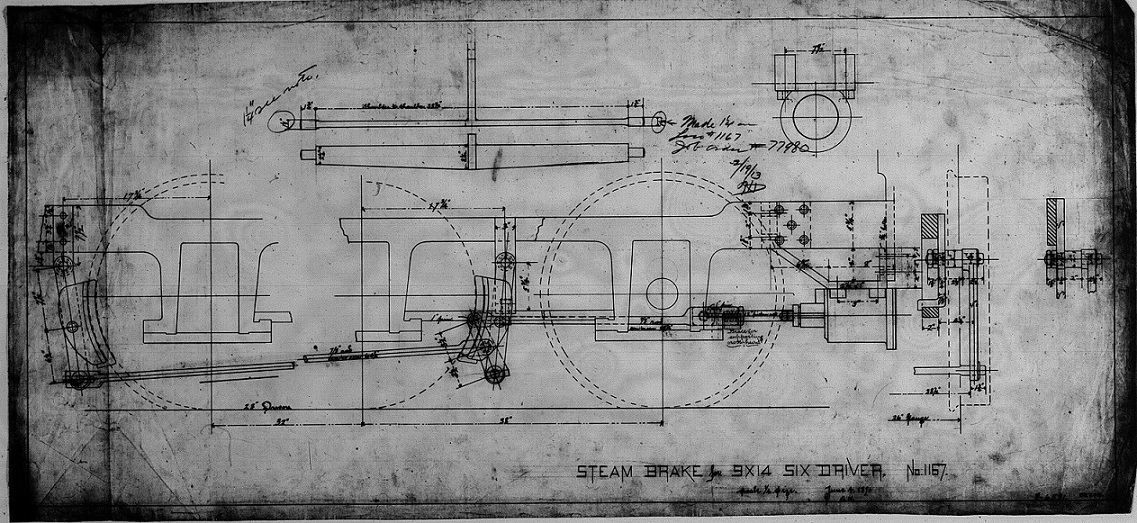
About a year ago, I acquired a 36 inch gauge 0-6-0 locomotive, built in 1890 by H. K. Porter as a street motor or steam dummy, CN 1167.

It originally had steam brakes but, the cylinder is missing.

Attachment:
File comment: Original Brake Rigging
7509_1r.jpg
7509_1r.jpg [ 312.73 KiB | Viewed 11828 times ]


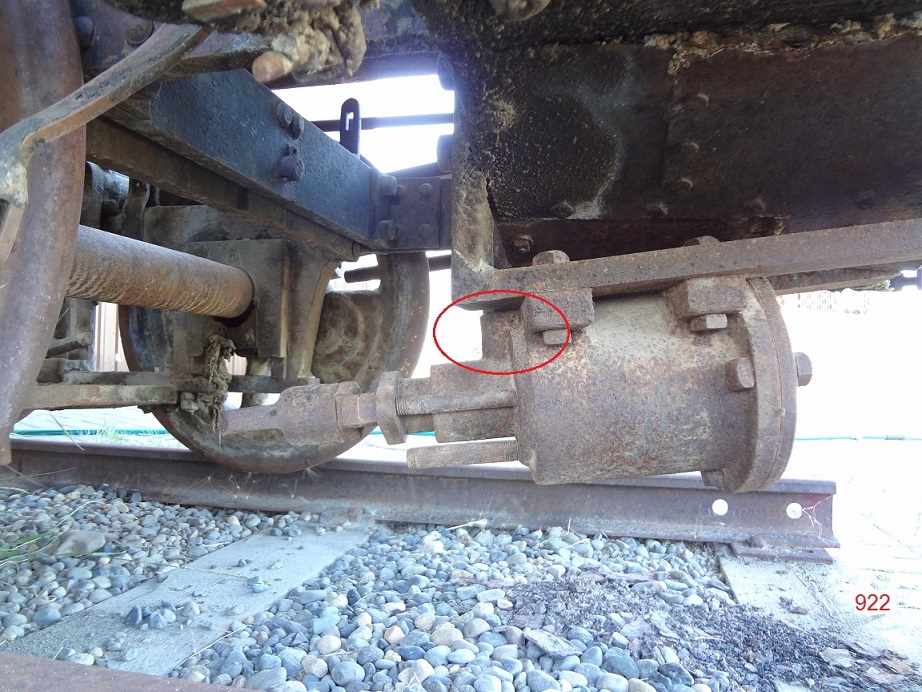
The cylinder is very similar to that on CN 922 shown below.
I regret not closely examining the feature circled in red below, when I had the chance.
However, based on the Porter drawings, it appears to be just a support.

Anyway, the cylinder seems simple enough to replicate.

CN 922 has a single steam line connection and small vent hole in the cylinder head.
There was no return spring so, any pressure was released either at the brake valve or through a cylinder drip valve, when the steam was cut off.

Does my theory about the support and steam connections make sense?

I'd like to hear about any similar setups.

Attachment:
File comment: CN 922 Cylinder
DSC04755r.jpg
DSC04755r.jpg [ 299.89 KiB | Viewed 11828 times ]


Attachment:
File comment: CN 922 Cylinder
DSC04756r.jpg
DSC04756r.jpg [ 341.43 KiB | Viewed 11828 times ]


Attachment:
File comment: Porter Drawing
DSC05330.jpg
DSC05330.jpg [ 321.25 KiB | Viewed 11828 times ]


Attachment:
File comment: Porter Drawing
DSC05332r.jpg
DSC05332r.jpg [ 301.76 KiB | Viewed 11828 times ]


Attachment:
File comment: Porter Drawing
DSC05331.jpg
DSC05331.jpg [ 315.05 KiB | Viewed 11828 times ]


Thanks,
Dave

Author:  Kelly Anderson [ Mon Oct 15, 2018 6:26 pm ]
Post subject:  Re: Steam Brake Question

.

Author:  Dave [ Mon Oct 15, 2018 6:57 pm ]
Post subject:  Re: Steam Brake Question

I've worked on some small lokies with steam jams - the majority do not have the steam pipe on the end with the packing gland - in fact, don't have a packing gland at all, because the steam goes in and out of the other end. Some don't even have a head on the steam side.... anyhow, what's important in your pictures is the slope down from the bore to the steam line in / out. At the lowest point is the condensation relief valve which is a poppet valve like a snifter but held up from its seat by a spring with very little spring rate on it. Steam entering the line to the cylinder close it against it's seat. Steam having been removed by means of the 3 way steam brake valve in the cab the lack of pressure in the cylinder / line allows the spring to lift it off its seat and gravity drains the condensation - vacuum is broken through the valve being open to the exhaust / outside air. Somewhere I think I have the Glover Machine Works drawings for this stuff...….

Author:  TrainDetainer [ Mon Oct 15, 2018 11:20 pm ]
Post subject:  Re: Steam Brake Question

Looks to me like the cylinder is in fact a single acting 'pull' type with packing gland. The rigging drawing confirms it's a pull type with the (looks like 5.5" x 5.5") dead lever arrangement on the rear brake beam. Do you have a drawing of the cylinder head? It would tell if there was provision for a spring return, even if 922 didn't have one. An older, small, inexpensive, very-low-tech switch engine might not have much of a return system since banging around would loosen things up fairly quickly and they weren't operating at high speed. The small hole in the head would be the air exhaust for applying the brakes - its small size would function as an orifice to limit the speed the piston can move to avoid hammering the brakes. The boss you circled looks like it's intended to be bored as an oil cup or lubricator line fitting for the piston. Might have been a customer option since there isn't any boring/finishing drawn on the prints. It's a pretty crappy location for a cup, being right in front of the ash pan. A better solution was probably steam oil in the brake steam supply - maybe a small single displacement lubricator if the customer wanted to splurge.

Author:  Kelly Anderson [ Tue Oct 16, 2018 8:55 am ]
Post subject:  Re: Steam Brake Question

.

Author:  Rick Rowlands [ Tue Oct 16, 2018 11:26 am ]
Post subject:  Re: Steam Brake Question

The Lima brakes were double acting, in that they had a steam back-off feature. When a Lima brake is released there is a very audible clunk as the brake fully retracts.

Author:  Dave [ Tue Oct 16, 2018 12:54 pm ]
Post subject:  Re: Steam Brake Question

The release on the little lokies is from the weight of the shoes dropping themselves away from the treads. I think the hole in the head in your picture is to prevent back pressure or vacuum on the "wrong" end of the piston space in the cylinder. The boss at the low corner could be for the steam line or a separate condensation drain valve.

Lima sure did know how to complicate things......

Author:  610BS [ Tue Oct 16, 2018 4:02 pm ]
Post subject:  Re: Steam Brake Question

I certainly appreciate the comments.

Here's a slightly different or vertical setup with a drip valve.
I'm guessing this is single action, with piping from head to drain condensate.

Attachment:
File comment: Porter Drip Valve
DSC05444r.jpg
DSC05444r.jpg [ 323.88 KiB | Viewed 11202 times ]


Thanks,
Dave

Author:  TrainDetainer [ Tue Oct 16, 2018 4:52 pm ]
Post subject:  Re: Steam Brake Question

I've worked on a Davenport that had double acting steam brakes and Kelly has the Lima literature - so another question is was Porter the only one to use single acting?

Author:  610BS [ Tue Oct 16, 2018 5:13 pm ]
Post subject:  Re: Steam Brake Question

Local museum has a Vulcan locomotive with a single acting steam brake cylinder.
It's about the same size but slightly different configuration. Original piping is missing.

The Porter drawings show many configurations of brake cylinders, including air, vacuum and steam, single and double action.

Thanks,
Dave

Page 1 of 1 All times are UTC - 5 hours [ DST ]
Powered by phpBB © 2000, 2002, 2005, 2007 phpBB Group
http://www.phpbb.com/