Railway Preservation News
https://www.rypn.org/forums/

Boston and Albany USRA 2-10-2s
https://www.rypn.org/forums/viewtopic.php?f=1&t=43291
Page 1 of 2

Author:  daylight4449 [ Fri Apr 26, 2019 8:50 pm ]
Post subject:  Boston and Albany USRA 2-10-2s

So I've been doing some research into the Boston and Albany's Z1 class of USRA light Santa Fe engines for a private modeling project, but looking at the builders pictures it appears the smokebox was a dark grey, while the rest of the locomotive appeared to be a lighter shade of grey. However, looking at some in service pictures I've managed to dig up it almost looks like the whole locomotive is the same dark shade of... Well, whatever the color is, it's dark. To the experts, what's the deal here? I've attached images I've tracked down through the internet.

Attachment:
ba1109-laws1.jpg
ba1109-laws1.jpg [ 80.92 KiB | Viewed 12122 times ]
Attachment:
IMG_0007.jpg
IMG_0007.jpg [ 78.2 KiB | Viewed 12122 times ]

Author:  J3a-614 [ Fri Apr 26, 2019 10:29 pm ]
Post subject:  Re: Boston and Albany USRA 2-10-2s

What you're looking at in the builder's photos is typically a locomotive that has had its paint altered for the photograph. In the period you're looking at, at Baldwin the practice was to paint the engine with a light grey paint on certain parts, like the boiler, cab, tender, and drivers as seen here. This was to make details show up in shadows better, to hide the dings, dents, and waves that would be in the thin metal of the boiler jacket, and also to provide a sort of "dress appearance" for the photo.

After the pictures were taken, the engine went back into the paint shop to have its delivery finish applied. For these USRA engines, it likely would have been black. Interestingly, in this period the standard color at Baldwin, the default choice, would still be the olive green with aluminum lettering that had been used for quite a few years, and would still be in use for some time later.

There were variations at other builders. Lima used the grey for a time, but later changed to just a flat finish that would later be replaced by the glossy coat that was normal for delivery. This was usually just on the right side of the engine. There are photos from Lima of both sides of the same engine at the same session, and the left side is shiny.

The smokebox and sides of the firebox were usually not jacketed, and could become hot enough to burn off any standard paint. What was normally used there was a mixture of graphite and oil. In this period this was a home mix, and the color could vary from a relatively light or medium silvery grey to a near black color. It would not dry as such until the engine was fired up and got hot. This is often available as a commercial mix now.

Of course, the whole engine would become a sort of charcoal grey after time as it got dirty. The dirt itself was a mixture of soot from the smoke, dust from the air and also from sanding, oil and grease on the running gear, and lighter stains from mineral deposits in the water that would show up anywhere there was some sort of leak or point of exhaust for the steam, such as around the whistle or the safety valves. There was also fading of the paint from the sun and from heat. In some cases, you also had rust deposits as some paint or graphite was worn or burned away.

This Baltimore & Ohio "Big Six" 2-10-2, photographed in 1947 in color, illustrates the appearance an engine could take on when maintaining a nicer finish wasn't considered a high priority.

Photo via Railpictures.net

https://www.railpictures.net/photo/55532/

Another "big Six" on the B&O (they were called "Big Sixes" because they were big, and were numbered in the 6000 series), this one not looking as bad as the previous one.

https://www.facebook.com/photo.php?fbid ... ater&ifg=1

https://scontent-iad3-1.xx.fbcdn.net/v/ ... e=5D360927

Author:  J3a-614 [ Fri Apr 26, 2019 11:03 pm ]
Post subject:  Re: Boston and Albany USRA 2-10-2s

Weathering a steam model is a skill and also an art (and I admit, I haven't mastered it yet!)

Below are some comments on weathering models.

Some important points to consider is that some engines on different roads and in different parts of the country would weather differently. Mountain climbing engines on the C&O often had a relatively light appearance, almost ghostly, due to the heavy use of sand. Engines running in the southwest could have a tan appearance, a combination of dust from the deserts they ran in and the effects of the hot sun on the paint. Videos of engines on iron ore railroads such as the Duluth, Missabe & Iron Range show a reddish tint due to dust from the iron ore they were exposed too (in addition, these engines also often had a lighter grey boiler jacket).

What you may want to do is look for color photos of other engines in the territory your model would have run in, and use that as a pattern or source of inspiration to guide your efforts.

The best advice I can personally give is to go easy and build up the weathering in layers. It's only too easy to overdo weathering! Besides, not every railroad or every locomotive would look as severe as some of the examples shown. Three examples that come to mind that usually rostered clean and even sparkling steam power were the Western Maryland, the Canadian Pacific, and the Southern Railway. Even engines on these roads would have some bit of dirt, though, just from a single run, in the form of the lightest bit of soot along the top from the stack, and a bit of dust on the running gear.

http://okng.org/clinics/weather_loco.pdf

http://www.bronx-terminal.com/?p=1357

https://www.scalemodellingnow.com/tbfin ... locomotive

https://www.youtube.com/watch?v=2rYqQH_iBm8.

https://www.youtube.com/watch?v=hc4_qsf0m7g

Author:  J3a-614 [ Fri Apr 26, 2019 11:25 pm ]
Post subject:  Re: Boston and Albany USRA 2-10-2s

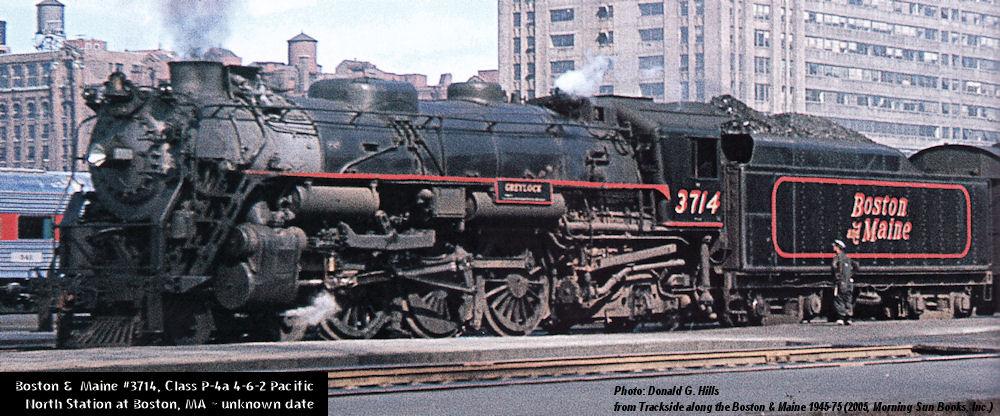
Some examples of engines in New England that might be usable for you. Keep in mind, these color photos date from late in the steam era, and the effects of deferred maintenance as diesels arrive are becoming visible. Still, you can see differences in dirt patterns and paint finishes on the locomotives.

https://www.pwrs.ca/announcement_images ... acific.jpg

https://www.railarchive.net/randomsteam/bm4113.htm

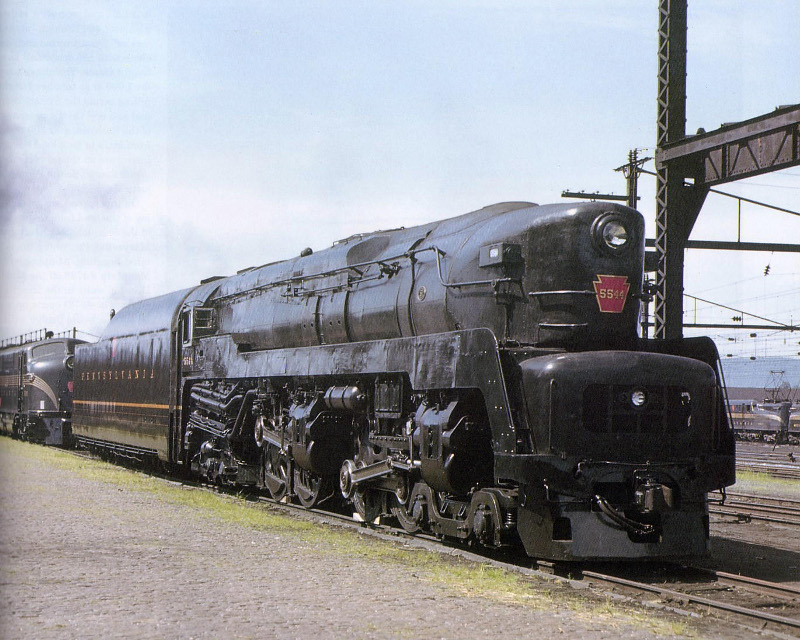
This Pennsylvania Railroad 2-10-4 shows a fair amount of neglect in keeping the engine clean. The most notable thing is how white much of the engine is from the heavy use of sand.

https://i.pinimg.com/originals/5e/9a/94 ... c00da1.jpg

How different an engine on the same road could look when it was clean!! Although it's hard to see, this photo also shows the dark green that the Pennsy used on its motive power. It's almost black, but not quite; you can see the difference when comparing parts of the engine that are green (shrouding, cab, tender tank) with those that are black (wheels, area below the running board on the firebox). The difference is also noticeable on the diesel behind it in the color of the carbody vs. the color of the pilot.

http://www.douglas-self.com/MUSEUM/LOCO ... r-T1-2.jpg

Author:  J3a-614 [ Sat Apr 27, 2019 1:20 am ]
Post subject:  Re: Boston and Albany USRA 2-10-2s

Oh, the Boston & Albany engines were sold to the Canadian National shortly after the arrival of the class A 2-8-4s in 1928. They became that road's class T-3-a, numbered in the 4200 series. Long before they were retired, they acquired feedwater heaters and all-weather cabs.

https://www.steamlocomotive.com/whyte/2 ... arceau.jpg

Image

Author:  Pat Fahey [ Sat Apr 27, 2019 9:31 am ]
Post subject:  Re: Boston and Albany USRA 2-10-2s

Hi
The B&A 2-10-2's before they when to the Canadian National they were also assigned via a transfer of power by the New York Central to the Big Four. They were transferred to the Big Four the CCC&St.L on March 1926, they were later sold to the CNR, August 1928.
Once the CNR railroad received the locomotives, their number got changed, received either new or modifications to the locomotives, to meet the requirements by the CNR.
The B&A 2-10-2 's were built to the USRA design, by America Locomotive Works or ( ALCO).
Here is a photo which is part of my slide collection, taken by George Hildreth, no date on the slide when taken.
Attachment:
File comment: The photo was taken by George Hildreth, Pat Fahey collection.
B&A Santa Fe type.on CNR.jpg
B&A Santa Fe type.on CNR.jpg [ 45.93 KiB | Viewed 11868 times ]

Author:  joe6167 [ Sat Apr 27, 2019 5:56 pm ]
Post subject:  Re: Boston and Albany USRA 2-10-2s

And if you're interested, here is the CNR diagram for these engines.

Image

Author:  daylight4449 [ Sun Apr 28, 2019 8:11 pm ]
Post subject:  Re: Boston and Albany USRA 2-10-2s

So we know they ended up on the Big Four before being sold off to Canadian National and eventually modified. That still brings up another question, but I'd assume these engines were just plain black with graphite smokeboxes throughout their careers then. Unfortunately internet searches have only revealed a few black and white photographs and little detail on what the Z1s actually were painted with, aside from the obvious white U.S. lettering with Boston and Albany along the top of the tender.

Author:  J3a-614 [ Sun Apr 28, 2019 11:37 pm ]
Post subject:  Re: Boston and Albany USRA 2-10-2s

Dylan, the photos you have are for the engines as delivered under United States Railroad Administration authority. When they would have been repainted, they would have had standard Boston & Maine lettering style, which would have been essentially the lettering practices of parent road New York Central.

However, it's important to remember that the NYC changed locomotive lettering around 1940 to a sans-serif style called "Century." Prior to that, the lettering would be a variation of Railroad Roman, as seen in the examples below.

http://4.bp.blogspot.com/-5DJtbLxdJOw/T ... Hudson.jpg

https://www.railarchive.net/nyccollection/ba1439_cw.htm

https://www.flickr.com/photos/alcomike/28441892918

https://sites.google.com/site/bostonalb ... 4-6-0/tank

https://sites.google.com/site/bostonalb ... -6-4/other

Image

Author:  Dennis Storzek [ Mon Apr 29, 2019 8:58 am ]
Post subject:  Re: Boston and Albany USRA 2-10-2s

The New York Central System Historical Society has, in recent years, been scanning a lot of their drawing holdings and making them available on CD. I'm not sure how much B&A material they have available, but they may have a locomotive lettering drawing in one of the collections. If nothing else, an NYC drawing from the proper period should give sizes and the typeface. Here is the link to the drawings web page:

https://nycshs.org/1988/01/02/official- ... on-cd-rom/

I'd try to make contact with someone in the organization who is familiar with the content of each CD.

Author:  daylight4449 [ Mon Apr 29, 2019 9:01 am ]
Post subject:  Re: Boston and Albany USRA 2-10-2s

J3a-614 wrote:
Dylan, the photos you have are for the engines as delivered under United States Railroad Administration authority. When they would have been repainted, they would have had standard Boston & Maine lettering style, which would have been essentially the lettering practices of parent road New York Central.

However, it's important to remember that the NYC changed locomotive lettering around 1940 to a sans-serif style called "Century." Prior to that, the lettering would be a variation of Railroad Roman, as seen in the examples below.

http://4.bp.blogspot.com/-5DJtbLxdJOw/T ... Hudson.jpg

https://www.railarchive.net/nyccollection/ba1439_cw.htm

https://www.flickr.com/photos/alcomike/28441892918

https://sites.google.com/site/bostonalb ... 4-6-0/tank

https://sites.google.com/site/bostonalb ... -6-4/other

Image


You do bring up a good point on the paint scheme, but that leads to another question... Where the B&A, and by extension the NYC, held onto those Z1s for what I'd consider a short period of time (about a decade) would they have bothered to reletter the tenders? Every picture I've seen showed those engines in B&A service, still with the USRA lettering. Where I'm shooting for that era, I want to make sure it's accurate. Railroad roman lettering is readily accessible, but if need be I can have some decals made up...

Author:  J3a-614 [ Tue Apr 30, 2019 10:21 am ]
Post subject:  Re: Boston and Albany USRA 2-10-2s

Well, Dylan, this comes down to what era are you representing? We know it completely cuts off for 1928, and for what it sounds like you're doing, it could cut off in 1926.

I'm pretty certain the engine would have been repainted at least once in that time period. That would almost certainly have been when the engine went in for heavy classified repairs, the counterpart of what we would now call a 1472.

A fellow named Felton Hill had this description of classified repairs in a forum run by Trains magazine a while back. Here's what he said--and let's hope it helps out!

Quote:
The following list is based on AAR descriptions from 1924. There are slight variations depending on the individual railroad

Class 1

New boiler or back end

Flues new or reset

Tires turned or new

General repairs to machinery and tender

Class 2

New firebox or one or more boiler shell courses new, or wrapper sheet new

Flues new or reset

Tires turned or new

General repairs to machinery and tender

Class 3

Flues new or reset (superheater flues may be excepted)

Necessary repairs to firebox and boiler

Tires turned or new

General repairs to machinery and tender

Class 4

Flues part or full set

Light repairs to boiler and firebox

Tires turned or new

Necessary repairs to machinery and tender

Class 5

Tires turned or new

Necessary repairs to boiler, machinery and tender including one or more pairs of refitted driver bearings

General Repairs to Machinery

Drivers removed

Tires turned or changed

Axle journals turned if necessary

All driving wheel boxes and rods overhauled and bearings refitted

Other repairs needed for the locomotive to perform a full term of service


Source:

http://cs.trains.com/trn/f/740/t/99731.aspx

Author:  J3a-614 [ Tue Apr 30, 2019 10:25 am ]
Post subject:  Re: Boston and Albany USRA 2-10-2s

One of the interesting things in that list is that a whole boiler change out was in Class 1, which is essentially light repair! Of note is that apparently relatively little else was done to machinery, auxiliaries, or the tender.

Class 5 is most like what is done in a 1472 today; from what I understand, that was typically about every five years or so--the railroads put a lot more running time on steam locomotives than we do now. It wouldn't surprise me that such intervals may have been shorter, depending on how hard the service was.

Curiously, the description for Class 5 doesn't specifically mention replacing tubes as was done in the others, but it was probably a given that job would be done as part of the "necessary repairs" to the boiler.

Author:  Howard P. [ Tue Apr 30, 2019 11:26 am ]
Post subject:  Re: Boston and Albany USRA 2-10-2s

The numbers run counter-intuitively, kinda like FRA track standard numbers-- Class 1 track is the lowest speed standard, Class 6 (and higher) is the fast stuff.

Class 5 steam loco repairs would not have included tube/flue replacement; that started at Class 4, as stated.

Running gear ("machinery") usually needed constant work, so Class 5 was a more common repair than a 4 or 3. In preservation-era steam locomotive restorations, Class 3 work was most common. Few locomotives, if any, received entire new fireboxes until very recently.

Howard P.

Author:  daylight4449 [ Tue Apr 30, 2019 2:57 pm ]
Post subject:  Re: Boston and Albany USRA 2-10-2s

J3a-614 wrote:
Well, Dylan, this comes down to what era are you representing? We know it completely cuts off for 1928, and for what it sounds like you're doing, it could cut off in 1926.


Well I want to model the Z1s as built, as I want to try and make an accurate representation of the engines. Where I've only seen the Z1s in USRA lettering, that's what I'll go for. I don't have my own O scale layout, seeing I deal in On30 primarily. That being said, just wait until I manage to track down a base engine to make an H30 4-8-0...

Page 1 of 2 All times are UTC - 5 hours [ DST ]
Powered by phpBB © 2000, 2002, 2005, 2007 phpBB Group
http://www.phpbb.com/