Converted in the Sacramento shops to simple and added superheat. Some of us still dream that she may once again run somewhere.
S'
David Dewey
Friends of the 1727

djdewey@cncnet.com
| Railway Preservation News https://www.rypn.org/forums/ |
|
| These two survived https://www.rypn.org/forums/viewtopic.php?f=1&t=6133 |
Page 1 of 2 |
| Author: | Bob Yarger [ Sun Jun 22, 2003 8:49 am ] |
| Post subject: | These two survived |
Just a link to some old drawings of compound steam locomotives on the Railroad Extra website. The SP Mogul below survives today at Dunsmuir, Cal., long ago converted to a simple locomotive. http://www.railroadextra.com/loco06.Html ryarger@rypn.org |
|
| Author: | Bob Yarger [ Sun Jun 22, 2003 9:06 am ] |
| Post subject: | Re: These two survived |
And this one is at Ashland, Wisconsin. http://www.railroadextra.com/loco07.Html ryarger@rypn.org |
|
| Author: | Ron Goldfeder [ Sun Jun 22, 2003 11:30 am ] |
| Post subject: | Surviving Compound Locos |
There are two formerly compound locomotives at the Museum of Transportation in St. Louis. These are Lake Street Elevated Railroad 0-4-4T #9, "Charles H." and Wabash 2-6-0 #573. Both are products of the Rhode Island Locomotive Works. The first was built in 1893 and the second in 1899. Both were cross compound types when built and later converted to simple locos. Museum of Transportation rdgoldfede@aol.com |
|
| Author: | David Dewey [ Sun Jun 22, 2003 6:02 pm ] |
| Post subject: | 1727 today *PIC* |
Converted in the Sacramento shops to simple and added superheat. Some of us still dream that she may once again run somewhere. S' David Dewey Friends of the 1727 djdewey@cncnet.com |
|
| Author: | Tom Shreve [ Sun Jun 22, 2003 7:22 pm ] |
| Post subject: | Klondike Mines Railway #3 |
As far as I know, the only non simpled Vauclain compound conventional locomotive in existance is Klondike Mines Railway #3, a 2-8-0 narrow gauge engine at the Dawson City Museum, Dawson City, Yukon Territory, Canada. It was set aside when the railway closed in 1913 and never ran again. Tom ironbartom@aol.com |
|
| Author: | Roger Mitchell [ Sun Jun 22, 2003 9:09 pm ] |
| Post subject: | Re: Surviving Compound Locos |
About the only non-articulated compounds that still survive in their original configuration in this country are the Manitou and Pikes Peak rack locomotives, one of which is still operational. Roger Mitchell Master Mechanic Fort Collins Municipal Railway n0mcr@netzero.net |
|
| Author: | Jim Templin [ Sun Jun 22, 2003 10:05 pm ] |
| Post subject: | Re: Klondike Mines Railway #3 |
Thsi is likely one of the most overlooked and unknown engines in the western hemisphere. It gets my nomination for the most significant, unaltered turn of the century locomotive left in North America. What is its actual physical condition? lorija799@aol.com |
|
| Author: | Tom Shreve [ Mon Jun 23, 2003 11:43 am ] |
| Post subject: | Re: Klondike Mines Railway #3 |
> What is its actual physical condition? The engine and three other locomotives are housed in a protective building in a state of arrested decay. I get my information from the book The Bonanza Narrow Gauge Railway by Eric L. Johnson, 1997. The three engines of the Klondike Mines Railway had been stored in their engine house until the second World War when the White Pass & Yukon tore it down to get to the #4 and spare parts. Tom ironbartom@aol.com |
|
| Author: | Jim Evans [ Tue Jun 24, 2003 1:46 am ] |
| Post subject: | Re: Surviving Compound Locos *PIC* |
> About the only non-articulated compounds > that still survive in their original > configuration in this country are the > Manitou and Pikes Peak rack locomotives, one > of which is still operational. What about the Baldwin 60000 in the Franklin Institute in Philadelphia. She's even in great shape! I don't know much about steam locomotives, but the description says: "As a means of obtaining the higher expansion necessary to give economy with steam of 350 pounds per square inch, Locomotive 60,000 was designed with three cylinders compounded, the high-pressure steam being first admitted to the middle cylinder. After expansion there, the steam passes through the receiver in the cylinder saddle to the two outside cylinders where further expansion takes place." I happened to think of the 60000 when I was browsing the internet and saw this photo: http://www.respree.com/cgi-bin/SoftCart ... ?E+scstore Here's some a link from the Franklin Institute: http://www.fi.edu/tfi/exhibits/trainfactory/about.html JimE Baldwin 60000 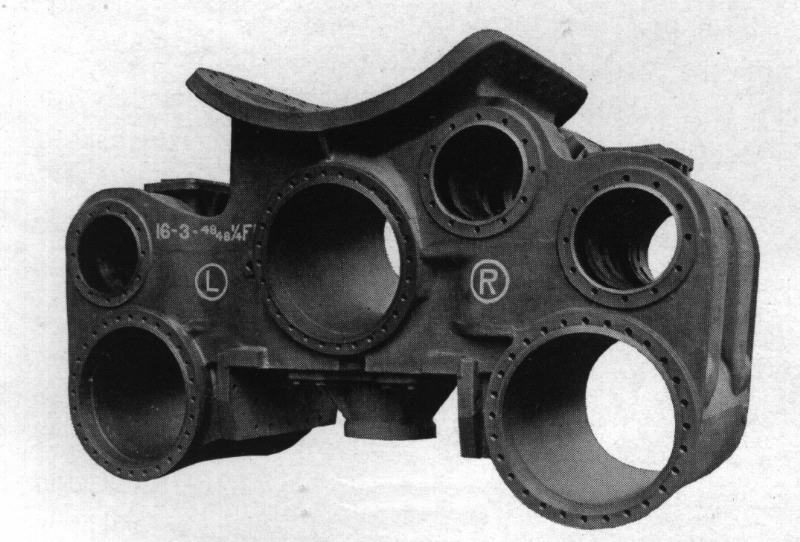 jrevans@accusort.com |
|
| Author: | Matt Janssen [ Tue Jun 24, 2003 1:40 pm ] |
| Post subject: | Re: Surviving Compound Locos *PIC* |
60,000 has had some pretty good running gear wear due to moving daily for 70 years, but this revolutionary locomotive is certainly worth studying. Don't forget Union Pacific 4-12-2 9000 at the Los Angeles Co. Fairplex, Pomona, CA. How about finding some really heavy straight track! Some of these other engines may be compound: Three Cylinder Steam  mjanssen@sunvalley.net |
|
| Author: | Bruce Manwiller [ Wed Jun 25, 2003 11:36 pm ] |
| Post subject: | Re: Surviving Compound Locos |
> Don't forget Union Pacific 4-12-2 9000 at > the Los Angeles Co. Fairplex, Pomona, CA. The UP 9000 is a three-cylinder simple locomotive, not a compound. bruceman@stargate.net |
|
| Author: | Matt Janssen [ Thu Jun 26, 2003 5:00 pm ] |
| Post subject: | Re: Surviving Compound Locos |
> The UP 9000 is a three-cylinder simple > locomotive, not a compound. Actually, Bruce, you are wrong. The 9000s were arranged with the center cylinder high pressure, outside cylinders low pressure. The ratio between high pressure and low pressure circuts was 2.066. Resuperheat for LP cylinders was not used. I suggest you reread Kratville's first book on the 9000 before making any more claims. mjanssen@sunvalley.net |
|
| Author: | buddy bob [ Fri Jun 27, 2003 8:29 pm ] |
| Post subject: | Re: Surviving Compound Locos |
> Actually, Bruce, you are wrong. The 9000s > were arranged with the center cylinder high > pressure, outside cylinders low pressure. > The ratio between high pressure and low > pressure circuts was 2.066. Resuperheat for > LP cylinders was not used. > I suggest you reread Kratville's first book > on the 9000 before making any more claims. Actually Matt you are wrong. Before quoting Kratville's book you had best look in a loco cylp. I think 1930 would be a good year. I will look it up if you need help after the weak end. NEVER take kratville as being right. regards bb staybolt2@netscape.net |
|
| Author: | Ray Dewley [ Sat Jun 28, 2003 7:09 am ] |
| Post subject: | stats and background info |
A book I have and steamlocomotive.com both show that the 9000's were simple expansion with the outside cyls @ 27 x 32" and the inner one 27 x 31" - the only one difference being one inch in stoke. The third cylinder was added because the belief at the time was that there would be too much piston thrust from two pistons for the desired design. The tests indicated that the 9000's could handle the same drag as the Mllets at higher speeds with less fuel consumption. Ray > Actually, Bruce, you are wrong. The 9000s > were arranged with the center cylinder high > pressure, outside cylinders low pressure. > The ratio between high pressure and low > pressure circuts was 2.066. Resuperheat for > LP cylinders was not used. > I suggest you reread Kratville's first book > on the 9000 before making any more claims. UPRR 9000's |
|
| Author: | buddy bob [ Sat Jun 28, 2003 9:59 am ] |
| Post subject: | Re: stats and background info |
> A book I have and steamlocomotive.com both > show that the 9000's were simple expansion > with the outside cyls @ 27 x 32" and > the inner one 27 x 31" - the only one > difference being one inch in stoke. > The third cylinder was added because the > belief at the time was that there would be > too much piston thrust from two pistons for > the desired design. The tests indicated that > the 9000's could handle the same drag as the > Mllets at higher speeds with less fuel > consumption. > Ray Yes ray is right most of the time he is. I found the info on the UP 9000. In the 1930 loco cylp. pg. 260-262 look it up for your self. Why is it we are so lazy we can't take the time to look up the real deal. And we just say what we think it must be. Hint read a good book to night. regards bb staybolt2@netscape.net |
|
| Page 1 of 2 | All times are UTC - 5 hours [ DST ] |
| Powered by phpBB © 2000, 2002, 2005, 2007 phpBB Group http://www.phpbb.com/ |
|