It is currently Mon Aug 24, 2026 1:32 pm

All times are UTC - 5 hours [ DST ]


Post new topic Reply to topic  [ 26 posts ]  Go to page 1, 2  Next
Author Message
 Post subject: Flexibility of Wooden Cars
PostPosted: Sat Jun 14, 2008 1:01 pm 

Joined: Sun Aug 22, 2004 7:07 am
Posts: 737
Location: Philadelphia Pa
Here is a question maybe someone from the Strasburg Railroad could answer:

What is the expected visible flexibility on a wooden passenger car?

Reason I ask this, recently I was on a tourist road with a beautiful, but old wooden parlor car. During the trip, which ran at speeds up to 25mph, I noticed very easily the car flexing...particularly at the main joints of the car (corners) and within the door frames, which would see a gap opening and closing around the door itself from about 1/2 to one inch as the car rocked. A look down the car, you could easily see the entire car flexing, side walls and all....and I wasn't the only one noticing this.

Now, I have ridden the SRR many times, and their cars don't show this type of flexing...then again, their cars have also been rebuilt a couple times.

Yes, I realize that wood does flex, but what are the limits when it comes to the safety and structual stability for a car that is over 100 years old that has seen mainly a cosmetic "restoration" and not a rebuilding.... what would be expected?

Thanks for your help.


Offline
 Profile  
 
 Post subject: Re: Flexibility of Wooden Cars
PostPosted: Sat Jun 14, 2008 2:10 pm 

Joined: Sun Aug 22, 2004 7:19 am
Posts: 6464
Location: southeastern USA
Guys like Guerra and Kutella can probably contribute more than I can, but in my experience the only reason a wooden car would flex to this extent is that it hasn't had its tension rods tightened in far too long. The frame on the cars is held together with mortise and tenons and similar jointery, and then tensioned to tightness with long metal rods with nuts on both ends - tightening the nuts draws the joints up tight and holds the frame rigidly together. If allowed to get loose, the wood starts flexing as you describe which wears away the joining parts of the frame, thus increasing looseness - you can see where this is going!

I like to see wooden cars not flex any more than the natural ability of the wood itself to flex - not because the frame is loose and working.

If memory serves, it was common for wooden passenger cars in the "old days" to go into the shops for paint and running maintenance about every two years, and about every decade for heavy work. With an overhaul or two, they might be expected to live in service for maybe 40-50 years before becoming economically unfeasable to repair. They lasted longer on marginal and shortlines because the shortlines could buy them in almost used up condition cheaper than fixing their used up cars, then weren't disposed of because the railroads were themselves facing imminent demise - which situation could linger for years.

Strasburg has set a standard for tourist railroads in wooden car rehabilitation. It isn't restoration or historically accurate, but truly practical. There's no way to operate a wooden car and preserve it - expect to compromise in terms of making irreversable changes and replacement of historic fabric to gradually build a replica of the original car over time, like Grandpa's axe.

dave

_________________
“God, the beautiful racket of it all: the sighing and hissing, the rattle and clack of the cars over the rails. These were the sounds that made America the greatest country on earth." Jonathan Evison


Offline
 Profile  
 
 Post subject: Re: Flexibility of Wooden Cars
PostPosted: Sat Jun 14, 2008 6:57 pm 

Joined: Sun Aug 22, 2004 5:15 am
Posts: 718
Location: Illinois
Thanks for the props Dave, however undeserved they may be. My guess is that we are probably talking about a passenger car with steel underfame and 2-4 trussrods under floor. That would typically have the visible truss rods we all recognize but also an 'overtruss' inside the car wall below the belt rail and above the floor line. Both of these work against each other to provide a rigid 'panel' for the sides. In addition there are usually vertical tie rods at each window post. Altogether this type of structure provides a relatively rigid carbody and holds the joints in alignment without working them or creating wear.

In the case of a boxcar which has no window openings, the over truss is omitted and each side is composed of panels with triangulaion so if you stripped away all the siding it would resemble the outline of a truss bridge complete with tie rods, vertical and sloping wood elements.

Back to the passenger car. One of the weaknesses is the ends and platforms which are usually only cantilevered out from the car body, maybe with steel beams under the platform but with little opportunity to create a true truss or rigid structure. In this case junior may have been witnessing very loose platform joints and one which I would say needs attention.

Perversely there is not much to be done here in the way of an easy fix. Even with mortise and tenon joints, it is tough to tighten up a loose one, although todays epoxies might provide some relief. Many carbuilders recognized this weakness and at each post and beam connection, rather heavy iron 'L' brackets were bolted to both horizontal and vertical elements.

Bob Kutella


Offline
 Profile  
 
 Post subject: Re: Flexibility of Wooden Cars
PostPosted: Sat Jun 14, 2008 7:07 pm 

Joined: Sun Aug 22, 2004 7:07 am
Posts: 737
Location: Philadelphia Pa
Yes, that is true and I thought about the tension rods.

It concerned me to see the movement I did of this car...full of people, I can only imagine that in time, something bad is going to happen.

I wish there was a polite way to say to the proper people at said railroad that they may want to investigate the structual stability of the car, but you know how that can cause problems.

Of course, this same railroad had equipment stored on sidings fouling switches and crews adjusting knuckles that were literally less than a foot apart, so I wonder how well they care for their railroad as a whole.


Offline
 Profile  
 
 Post subject: Re: Flexibility of Wooden Cars
PostPosted: Sat Jun 14, 2008 7:20 pm 

Joined: Sun Aug 22, 2004 7:07 am
Posts: 737
Location: Philadelphia Pa
The movement was visible throughout the car, at locations where interior walls were once located, but removed...if you put your foot on the sidewall, under the windows, it would move with the flexing of the car. If you just looked at the sidewalls, you could see them moving. Window frames as well showed similar, but less severe movement as described about the door frame.


Offline
 Profile  
 
 Post subject: Re: Flexibility of Wooden Cars
PostPosted: Sat Jun 14, 2008 11:46 pm 

Joined: Sun Aug 22, 2004 8:51 pm
Posts: 2055
Location: Southern California
My feeling is similar to that posted by Dave from southeastern USA.

The car should not be working at the joints, but should be tight. A joint that works is separating and coming togeather; if this is severe it can catch a patron's clothing or body. A working joint can damage itself and become even looser fitting. The car should be kept tight by taking up the slack in the truss rods; placing additional washers as necessary.

_________________
Brian Norden


Offline
 Profile  
 
 Post subject: Re: Flexibility of Wooden Cars
PostPosted: Sun Jun 15, 2008 12:10 pm 

Joined: Wed Aug 25, 2004 9:44 am
Posts: 154
I'd concur with most of the previous comments. I find it hard to believe that you'd actually see a gap of one inch opening and closing in the door frame - that sounds to me like the car is about to fall apart. On our wooden cars, you can see some flexing in the body from one end to the other, of perhaps a few degrees of angle, as the trucks pass over low spots in the track, but there's no noticeable looseness within the end bulkheads. They're a main source of strength for the whole structure.

I would have been tempted to pull the air.

_________________
Randall Hicks
Visit Hicks Car Works!
_________________________
Confucius remarked: "There is in the world now really no moral social order at all."


Offline
 Profile  
 
 Post subject: Re: Flexibility of Wooden Cars
PostPosted: Sun Jun 15, 2008 2:58 pm 

Joined: Sun Aug 22, 2004 7:07 am
Posts: 737
Location: Philadelphia Pa
I am not exaggerating when I talk about the way this car flexed. The ends of the car were NOT tight. You could clearly see the joints flexing at the top corners of the car at those important bulkheads.

As I said, I know wood cars flex, it's to be expected, but this did concern me during my trip...and like I said, I was not the only one to notice this...several passengers commented about it to each other, who most likely had NO knowledge of railroads and equipment...they thought it was normal...I kept my mouth shut.


Offline
 Profile  
 
 Post subject: Re: Flexibility of Wooden Cars
PostPosted: Sun Jun 15, 2008 4:20 pm 

Joined: Sun Aug 22, 2004 1:51 pm
Posts: 12152
Location: Somewhere east of Prescott, AZ along the old Santa Fe "Prescott & Eastern"
Unfortunately, the list of operations running wooden "parlor cars" is horribly short. I'm 98% certain I can guess the specific operation from the description alone on the first guess--maybe second.

And if I'm right: I would ask to bear in mind the likely reception of someone from outside the organization telling "them" about this. I wish I had the greatest confidence that "appropriate" measures would be taken, but I don't.

And besides--assuming once again that the car in question is the one I think it is--I could make the case that said car is one of the few cases where retirement for the sake of preservation of the "original fabric" would be much better than the probable repair measures, a la the now-retired PRR "7002", 1223, and the wooden PRR cars the Strasburg used to run. Furthermore, I could suggest that a "newfangled" substitute similar to Strasburg's newly-built parlor and dining cars, or even a new "Hello Dolly"-style kitbash, might be called for in such a case.


Offline
 Profile  
 
 Post subject: Re: Flexibility of Wooden Cars
PostPosted: Sun Jun 15, 2008 6:24 pm 
Site Admin

Joined: Sat Aug 28, 2004 1:15 pm
Posts: 1502
Location: Henderson Nevada
Wooden cars flex, more so as they age and loosen up. I have seen a 40' wooden streetcar torque almost 15 degrees on bad track. It that case the body twist was taken up throughout the car body. In that case it was an aged car on bad track. The owning group limited operation of that and sister wooden cars soon afterward to limit wear.

Strasburg replaces the side trusses with high grade plywood, so their cars are much more rigid than a typical wooden car which retains its original constuction.

I have seen window and door openings distort. I would be much more concerned if I saw a frame member move that much.

_________________
Randy Hees
Director, Nevada State Railroad Museum, Boulder City, Nevada, Retired
http://www.nevadasouthern.com/
https://www.facebook.com/FriendsOfNevadaSouthernRailway


Offline
 Profile  
 
 Post subject: Re: Flexibility of Wooden Cars
PostPosted: Sun Jun 15, 2008 9:21 pm 

Joined: Sun Aug 22, 2004 7:23 am
Posts: 492
Location: Strasburg, PA
There's probably not a lot one could say to the O&O that isn't already known ...

Mr. Burkhart, our Car Shop Foreman, could comment on this better than I, but our cars are a lot more rigid than when built. Aside from the screwed-and-glued plywood substrates already mentioned, the wood twin center beams were replaced on the B&M cars probably during the 1920's and 30's. The steel I-beams that replaced them are riveted to the cast steel platform castings (original) that tend to stabilize the whole platform-centerplate-truss anchor system. One may see tortional twisting on manky track, but that is about it.

Some of our cocooned cars that may make an appearance some day, tend to be more primitive in their substructure than the B&M cars, with the original wood frames and opposing trusses mentioned in previous posts.

Probably the "truest" wooden car that we have and a personal favorite is Ma & Pa No 20.

_________________
Steve


Offline
 Profile  
 
 Post subject: Re: Flexibility of Wooden Cars
PostPosted: Sun Jun 15, 2008 11:59 pm 

Joined: Sun Aug 22, 2004 7:07 am
Posts: 737
Location: Philadelphia Pa
Again, yes, the end bulkheads were showing similar movement...heck the dang door is within said bulkhead, kinda gives you your answer right there.

And Mr. Mitchell; I'm sure you are correct in your assumption of the operation in question, and what the current status of the car SHOULD be....it would fit right in there at the RMPA....and your thoughts echoed mine in voicing concern.

The trackage operated on was NOT in bad shape, much better than many I have ridden, and the average of 25mph was easily under their actual speed limit for trackage conditions.

I think its safe to say even EBT's Coaches are in better shape and tightness than this car, and EBT has easily 1/10th the funds and ridership said operation does....and I'm not knocking the EBT.


Offline
 Profile  
 
 Post subject: Flexibility of Boeing 737s
PostPosted: Mon Jun 16, 2008 2:43 am 

Joined: Sat Feb 05, 2005 1:05 am
Posts: 488
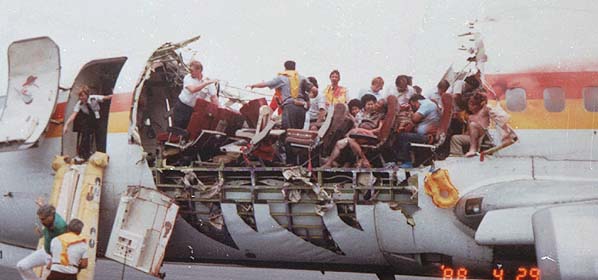
REMEMBER THIS?
Image


[url=http://the.honoluluadvertiser.com/2001/Jan/18/118localnews1.html]USA Today(January 18, 2001)

As an Aloha Airlines jet began landing on Maui, passenger Matt Austin noticed the luggage racks rattling and swaying when the thrust reversers came on.

It didn’t startle him. He had seen that happen before on other older Aloha jets. But Austin remembered the name painted across the plane’s exterior: Queen Lili‘uokalani. It was a 19-year-old Boeing 737.
[/url]

Loose as a goose transportation equipment is not a new phenomenon. Everybody that flew Aloha Airlines regularly knew the old dogs. When the thrust reversers came on after touch down, the fuselage would go into resonance and the upper luggage racks would sway back and forth 6" to 8". (If you sit in the back and watch, all 737s do this to some extent. The older they are the more they sway.)

If you start writing disaster scenarios on old wooden passenger cars, just imagine the offending car with 2 steel heavy weights on both ends:
1. Draft gear gets pulled on the front of the wooden car, dynamites the train, then the back two cars telescope loosey goosey into the front two cars.
2. Train dynamites from the back end and you have a break-in-two --- except from the middle of the wooden car........
3. ad infinitum

I would write a letter to the FRA with times, dates and places and let them play the bad guy. That's what they are there for, good at and sometimes even enjoy it.

Forget the fact that an in-train disintegration of a wooden passenger car with fatalities would pretty much ground all wooden passenger equipment. One dead body is too many for a recreational or hobby experience.


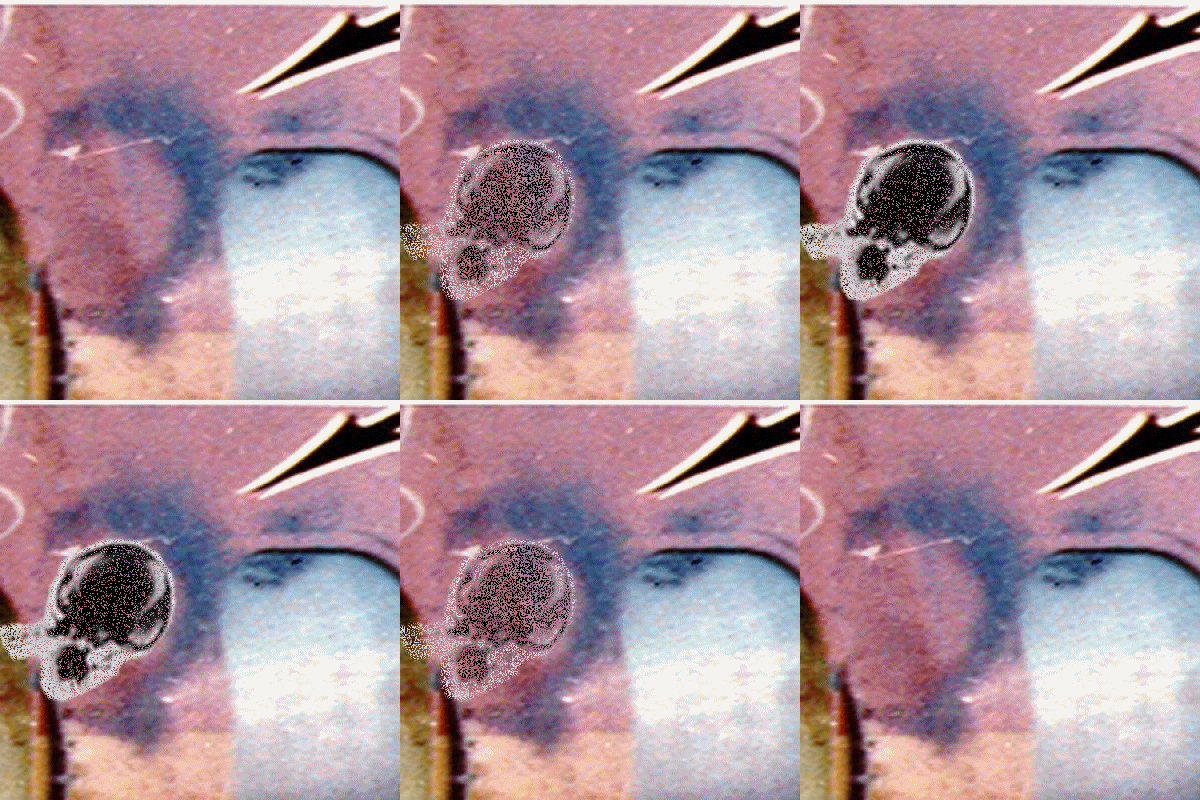
Click on this link for all the gory details of "one trip too many" of a worn out passenger transport.Image


Offline
 Profile  
 
 Post subject: Re: Flexibility of Wooden Cars
PostPosted: Mon Jun 16, 2008 6:46 am 

Joined: Wed Aug 25, 2004 6:27 am
Posts: 143
Wooden passenger cars were originally built sort of like a bridge truss with various designs being used. Typically there are two sets of truss rods. One set, visible under the car, is anchored at the ends of the car with the angle ending near the bolster and the center of the rods bearing on queen posts to prevent the car from sagging in the middle. The other set, one on each side runs the length of the car inside the wall just below the window sill. The queen posts are near the bolsters and the rods angle down to the end of the car to help prevent the end of the car from sagging.

The biggest problem with a wood structure like this is that it expands and contracts with climate change. Additionally, wood shrinks over time with the greatest shrinkage occurring in new wood. In a climate like Strasburg has, with high humidity in the summer and reasonably low humidity in the winter, the car tends to loosen up in the winter and tighten up in the summer. Overall this cycle has the effect of accumulated loosening. Most cars have tension bars throughout the car, both horizontal and vertical. These can be tightened as the wood shrinks though most on old cars are rusted and difficult or impossible to tighten.

Clerestory is a beautiful structure but a disaster structurally. Most clerestories I have seen have steel reinforcing bars in the shape off the roof line that attach to the side walls. These help, but don't really have much structural strength.

We substituted plywood for all the diagonal truss work which made the structure of the car more like a solid girder bridge. Of importance is to avoid any structure joints at the top and bottom of the window posts since this is a weak point where the stress is quit high when subjected to longitudinal movement such as hard couplings. We still use tension rods and other than the plywood, the cars are pretty much the same as the originals.

I would not go so far as to say the car in question is unsafe, but if joints are opening as far as an inch, it is time to check the structure. There is no doubt that it would not fare well in any kind of a mishap. In the end, wooden cars are just that - wood, and therefore they are not as strong as steel cars and will lose any contest with steel equipment. It is for this reason that I believe wooden cars must be maintained to the utmost to make up for the inherent deficiencies.

Safety aside, any car that continually flexes will basically eat itself up. Additionally the flexing joints will allow water to get to the structure causing it to rot. I would be surprised if the car in question was only loose. Rarely is a car that loose that the structure has not been compromised with water which can rapidly become a major safety issue. I would hope those responsible would investigate the situation to ensure that an incident does not occur purely from neglect.

_________________
Linn W. Moedinger


Offline
 Profile  
 
 Post subject: Re: Flexibility of Boeing 737s
PostPosted: Tue Jun 17, 2008 4:10 pm 

Joined: Tue Dec 14, 2004 5:45 pm
Posts: 297
I'm sorry, but am I the only person here whose sensibilities are offended by the posting of a picture of a blood stain on an airplane along with the superimposition of a skull? Is this really necessary to include with the discussion?

_________________
Andy Nold


Offline
 Profile  
 
Display posts from previous:  Sort by  
Post new topic Reply to topic  [ 26 posts ]  Go to page 1, 2  Next

All times are UTC - 5 hours [ DST ]


You cannot post new topics in this forum
You cannot reply to topics in this forum
You cannot edit your posts in this forum
You cannot delete your posts in this forum
You cannot post attachments in this forum

Search for:
Jump to: