It is currently Wed Aug 12, 2026 7:41 pm

All times are UTC - 5 hours [ DST ]


Post new topic Reply to topic  [ 19 posts ]  Go to page Previous  1, 2
Author Message
 Post subject: Re: Rubicon
PostPosted: Thu Oct 15, 2009 1:19 pm 

Joined: Mon Aug 23, 2004 1:05 am
Posts: 1140
Location: San Francisco
J R,

Please tell us more about the picture of the H K Porter fireless cooker you posted.

I am aware that they built them but have never seen one in person.

As you are interested in this sort of critter; there is a compressed air version at the Edaville, USA in South Carver, Mass. The little guy was used on the industrial tracks of the Plymouth Cordage Company in Plymouth, Massachusetts. It is 30" gauge if I recall rightly.

They went fireless because the dust from the manila was explosive when it reached the levels found in their plant. i wonder what they employees breathed?

Ted Miles


Offline
 Profile  
 
 Post subject: Re: Rubicon
PostPosted: Thu Oct 15, 2009 2:52 pm 

Joined: Mon Aug 23, 2004 9:18 am
Posts: 728
Location: Wall, NJ
Ted:
If you send an email to jrmay@monmouth.com I can provide some more details. In short, it was built in 1930 by HK Porter for Burton Explosives. At some point it ended up at Apache Powder where it was retired about 1970. There were a lot of these engines at Apache so today they are spread all over the country in private collections.
J.R.


Offline
 Profile  
 
 Post subject: Re: Rubicon
PostPosted: Thu Oct 15, 2009 6:05 pm 

Joined: Tue Nov 21, 2006 12:04 am
Posts: 665
Location: Northeast Ohio
Is that the same Porter that was in St. Marys, PA a few years ago?


Offline
 Profile  
 
 Post subject: Re: Rubicon
PostPosted: Mon Mar 28, 2016 5:52 pm 

Joined: Sun Jan 25, 2015 11:24 pm
Posts: 115
To expand on the OP, the "Rubicon" is one of three similar locomotives. I actually wrote a paper on them in High school. Here I've pulled some excepts from said paper to outline their story for those who are interested.

(Hang in there, this is a long post)

Quote:
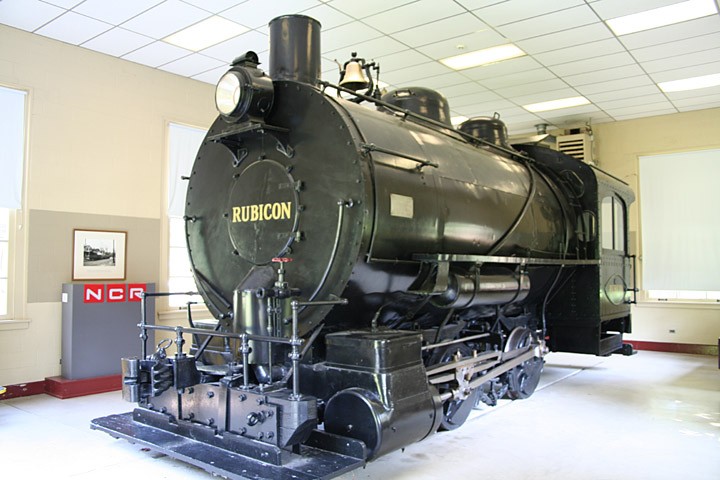
...As the the National Cash Register Co. ("The Cash" for short) grew, it developed the need for switchers to serve the various plants and buildings on the property. However, the president of "The Cash", Mr. Patterson, disliked the smoke and grit of normal steam locomotives. So in 1909, he contacted the Lima Locomotive works, who, using his requirements, designed and built a fireless steamer for him: The "Rubicon".The "Rubicon" was the first fireless steam locomotive in the United States, and was soon joined at "The Cash" by her sisters: the "South Park" built in 1910, and "Dayton" built in 1913.

...After the great 1913 flood, the three standard-gauge locomotives were loaned to the city of Dayton to aid in cleanup efforts. They ran throughout the city on the streetcar lines, since the streetcars were unable to run as a result of the standing water.

...The locomotives became an everyday part of life at the NCR plant. They were well liked by "The Cash" and surrounding Dayton citizens. But by 1964, the 3 engines were showing their age, and it took constant repairs, as well as a full time machinist and steam mechanic, to keep them running. The fact that many suppliers of steam locomotive parts had long been closed didn't help; near the end "The Cash" had to cast their own drivers for the engines.

...The 3 steamers were replaced by a single GE 50 tonner, and all three were donated to preservation. All 3 survive today in various locations.


The "Rubicon" survives indoors at Carillon Park, in Dayton, Ohio.
Picture:
http://train-photos.com.s3.amazonaws.com/10455.jpg

The "South Park" at St. Louis Museum of Transport.
Picture:
http://jmasser.rrpicturearchives.net/pi ... G_2766.JPG

And the "Dayton" in Duluth, Georgia
Picture:
http://www.thecorememory.com/TUPopUp.ht ... 27&5=1&6=0


To answer some questions about the locomotives earlier in the thread:
Quote:
What was the purpose of the smokebox door on the Rubicon? Seems an unusual feature for a fireless engine.


You can see in the picture of the "South Park" I included above that behind the "smokebox" door ("front panel" might be a better term) of the engine is where the exhaust pipe is located, between the front panel and steam reservoir. I assume the door was there so that the pipe could be inspected without removing the jacketing that otherwise covered the spaced where the exhaust pipe was. As a note, all three had 2 inch magnesia insulation.

Quote:
There are air tanks on the locomotive. But no compressor? Or did I miss something. Is the compressor hidden behind the smoke box door? Kind of a wild idea in my mind.


The trick is that there isn't an air compressor on the locomotive. The air tank was refilled when the locomotive had its reservoir refilled with the hot water/steam mix. Since the air was only used for sanding (Brakes were mechanical, applied using a wheel in the cab) I'm sure its limited quantity of air was more than enough for the 4 or so hours the engine could operate until it needed "recharging".


Anyways, I hope this post on these three "canned steamers" was worth bringing up a nearly 7 year old thread.


Offline
 Profile  
 
Display posts from previous:  Sort by  
Post new topic Reply to topic  [ 19 posts ]  Go to page Previous  1, 2

All times are UTC - 5 hours [ DST ]


You cannot post new topics in this forum
You cannot reply to topics in this forum
You cannot edit your posts in this forum
You cannot delete your posts in this forum
You cannot post attachments in this forum

Search for:
Jump to: