It is currently Sat Aug 22, 2026 3:33 am

All times are UTC - 5 hours [ DST ]


Post new topic Reply to topic  [ 24 posts ]  Go to page Previous  1, 2
Author Message
 Post subject: Re: Firebox Steel
PostPosted: Wed Mar 24, 2010 10:42 pm 

Joined: Wed Aug 25, 2004 10:35 pm
Posts: 33
Location: Shelton, Washington
John
I have looked in my ASME Section IX, and can not find the F No. or A No. for 6018 SMAW rod. Can you please check your copy, as I might have missed it. These two numbers are essential for writing an approved welding procedure needed to construct a boiler under ASME Section I
Regards, Nathan


Offline
 Profile  
 
 Post subject: Re: Firebox Steel
PostPosted: Thu Mar 25, 2010 1:52 pm 

Joined: Mon Jan 17, 2005 9:06 pm
Posts: 2567
Location: Thomaston & White Plains
I think John's point was that he'd like to see 6018 electrode produced, as it is not now produced. Correct, John?

Wow, 11018 wire....haven't touched that since I welded subs together. That stuff had to go back in the rod oven after 4 hours "out", and "new" hot wire was then issued to you.

It would seem to be highly obvious that the weld metal tensile strength should match the base plate tensile strength as closely as possible. Everything moves much more in harmony that way.

And that xx18 series rod always runs so nicely.

Howard P.
Not Always a Diesel Guy, CT

_________________
"I'm a railroad man, not a prophet."


Offline
 Profile  
 
 Post subject: Re: Firebox Steel
PostPosted: Thu Mar 25, 2010 8:49 pm 

Joined: Wed Aug 25, 2004 10:35 pm
Posts: 33
Location: Shelton, Washington
Howard;
That is sort of my point. The real problem is that the SMAW rod manufactuers use the same spool of wire for both 6011 and 7014. I suspect that ASAB would take a batch of 7018 rod and print 6018 on the side. It would still meet the specifications of both, and if you practice enough, you can make real pretty beads with 6011.

One of the real issues is that the recent batch of threads of late has been people wanting to alter the current Boiler Codes to suit problems that don't OR SHOULDN'T exist. The repair procedures of a competent "R" stamp shop being used on a historic or unusual boiler should get a quick review of the traveler form by the Authorized Inspector, who should flag 11018 being used on SA285 C.

Perhaps part of the problem is lax enforcement of the third party inspection concept by the FRA. Was some of this work done by Dingus' Welding and Trailer Hitch Repair?

Regards, Nathan


Offline
 Profile  
 
 Post subject: Re: Firebox Steel
PostPosted: Thu Mar 25, 2010 11:53 pm 

Joined: Sun Aug 22, 2004 8:35 pm
Posts: 374
Nathan,

Very good,there is no mention of 6018 in the code. Another poster said in short that it was my desire to have 6018, which is also correct! It has been mentioned also of qualifying such a rod IF such a thing existed. So, COULD 6018 be a code rod IF it existed? The answer to that is yes and it could and would be qualified quickly. What we see in the code is generally the items "readily found" in the open market that would be or are considered "acceptable".

Now, Nathan, I think it is your post above where you say the rod manufactures pull the same metal off a spool and simply stamp it or mark it 6011 or 7014. I have to respectfully disagree and explain why.

First, feel free to read this:

http://en.wikipedia.org/wiki/Shielded_metal_arc_welding

Go to Electrodes. You can read the explanation of what the numbers on the electrode mean. Rather than going over the whole thing, I wish to focus on the first two or three digits in an electrode number. For this example, E6011 and E7014 and E11018, since they have been called out. In all three of these cases, each electrode has a different Tensile strength. The tensile strength of each is 60,000 psi, (E6011) 70,000 for the E7018 and 110,000 for the E11018. Though all three are a mild steel alloy electrode, the core or base material is not the same. If they were....ultimately a E6011 would have a final tensile strength of 110,000 lbs because the E11018 was made from the same spool.

In our ASME S Stamp shop, we require the test results of the electrodes before we use them or accept them in our shop. For example, I prefer ESAB "E7018 H4R A-1" The A-1 qualifies the rod as the premier of the rod that was made in that batch. It is fresh, it is controlled tighter in the manufacturing process and the coating has less chance of failure (cracking during application) The ESAB box has a detailed sticker, (in addition to the normal box sticker) that correlates the box with a set of paper work, much like MTR'S. The paper work that goes with that box details exactly the alloy mix of the electrode, the tensile pull tests of the material in it's pre-electrode condition, post electrode condition and post weld condition, which all three areas must collaborate with-in a tight tolerance in terms of psi.

So, I would have to conclude, if all electrodes are equal, in terms of the roll they are pulled from, then we would have to only identify the coating on the electrode and would therefore have a much smaller selection of usable electrodes.

In conclusion: I wish we could have an ESAB E 6018 H4R A-1 electrode fully qualified. Does that help?

If any of you want to try a PERFECT electrode. Go ask for ESAB E 7018 H4R A-1 (special order item) and try it out.....you will never go back! I promise.

John E. Rimmasch
Wasatch Railroad Contractors

wrrc.us

_________________
John E. Rimmasch
Wasatch Railroad Contractors


Offline
 Profile  
 
 Post subject: Re: Firebox Steel
PostPosted: Fri Mar 26, 2010 12:37 am 

Joined: Wed Sep 01, 2004 10:05 pm
Posts: 38
Location: Martinsburg, WV
John is right about the ESAB 7018H4R A-1. It is perfect every time. We have used it extensively in firebox repairs and it never fails to satisfy. I'm suprised no one has talked about the changes in the code concerning these plates. I was told by a National Board member that the code wants to replace SA-285-C with SA-515. When I started flanging firebox patches years ago, the plate recommended to use for flanging is SA-516 - it is an aluminum killed steel, has a finer, more consistent grain structure than SA-515 - so is best suited to cold flanging with the McCabe Pneumatic Flanging Machine. What has not been mentioned here is that SA-516 is available in a Grade 55 and Grade 60 - as well as 70. We have flanged about 35 sheets in the past 3 years using the Grade 60 - it is more readily available in stock than the Grade 55. It is a superior quality pressure vessel plate. It forms like butter and really likes to be welded with John's ESAB 7018. In the past, we flanged many firebox sheets and patches using SA-516-70 for use in new boilers and for repairs in old. We shopped the CMTR's for a lower tensile result and have had excellent service from those sheets as well. We will usually stress relieve the plate when delivered and again after forming and any fabrication welding on the plate. Design the patches to put your weld between rows of staybolts and the field weld does not need post weld stress relief.


Offline
 Profile  
 
 Post subject: Re: Firebox Steel
PostPosted: Fri Mar 26, 2010 12:42 am 

Joined: Wed Sep 01, 2004 10:05 pm
Posts: 38
Location: Martinsburg, WV
Oh, and John; sign me up for a couple hundred pounds of that E6018! Mr. L.D. Porta always said if he could get some of that made it would be the most absolutely perfect rod for boiler repairs. He talked about a product in Germany that was very close.


Offline
 Profile  
 
 Post subject: Re: Firebox Steel
PostPosted: Fri Mar 26, 2010 9:12 pm 

Joined: Wed Aug 25, 2004 10:35 pm
Posts: 33
Location: Shelton, Washington
John;
I based my response on some 8 year old tests showing the weld metal deposits of 6011 and 7018 rod to be so close in tensile and yield strenths as to be almost indeterminate. If I recall, 6011 was only a couple of thousand psi lower than 7018. Yes there is a very big difference in the last two numbers, as many welding procedures are based on what the flux coaing in doing (i.e at the mill, 7024 only works flat, period). Perhaps we need to drop below the 60 and have a 5518??? Perhaps this would then allow a weld metal to have almost exactly the same qualities as the parent metal?
Is ESAB willing to submit its 6018 rod to the ASME for inclusion in ASME Section IX as an approved SMAW rod? I think the process for submittal to adoption make take a couple of years.
Regards, Nathan


Offline
 Profile  
 
 Post subject: Re: Firebox Steel
PostPosted: Sat Mar 27, 2010 8:48 am 

Joined: Sat Feb 05, 2005 1:05 am
Posts: 488
John E. Rimmasch wrote:
I prefer ESAB "E7018 H4R A-1" The A-1 qualifies the rod as the premier of the rod that was made in that batch. It is fresh, it is controlled tighter in the manufacturing process and the coating has less chance of failure (cracking during application) The ESAB box has a detailed sticker, (in addition to the normal box sticker) that correlates the box with a set of paper work, much like MTR'S. The paper work that goes with that box details exactly the alloy mix of the electrode, the tensile pull tests of the material in it's pre-electrode condition, post electrode condition and post weld condition, which all three areas must collaborate with-in a tight tolerance in terms of psi.


Uhhh, John,
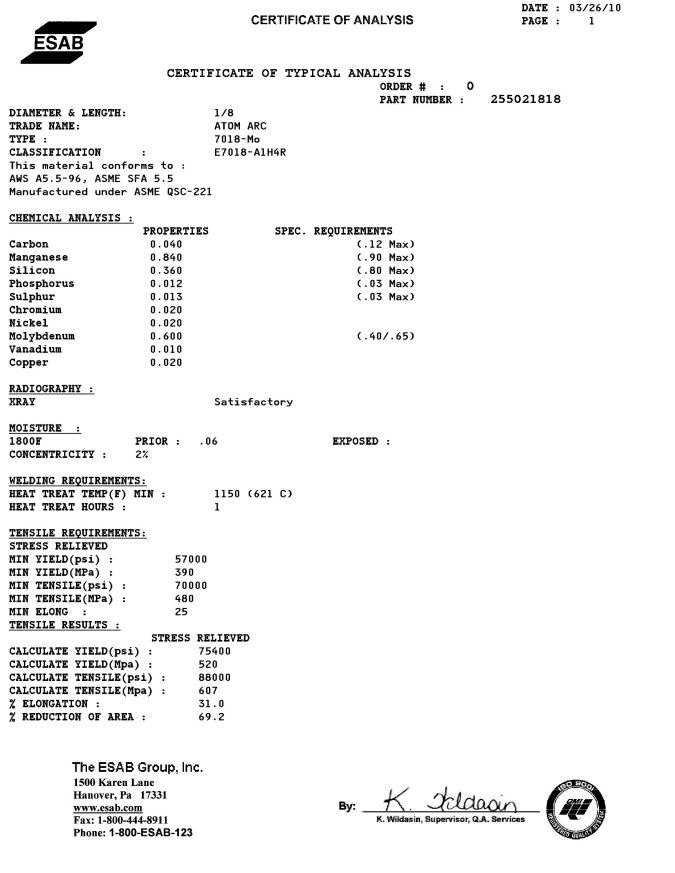
According to ESAB your 7018 super rod has 88,000 psi TS and 75,400 psi YS.
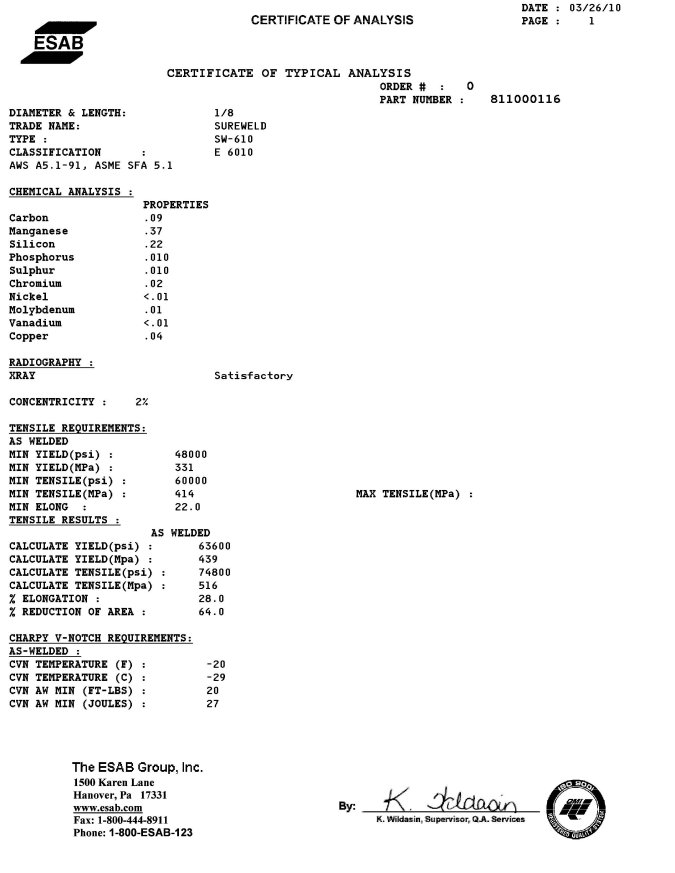
The ESAB 6010 has 74,800 psi TS and 63,600 psi YS.
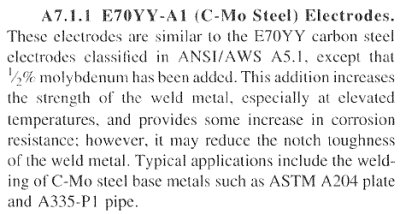
(see ESAB certifications below)

ASME Section IIC, SFA-5.5
A-1 means it has 0.5% molybdenum added.
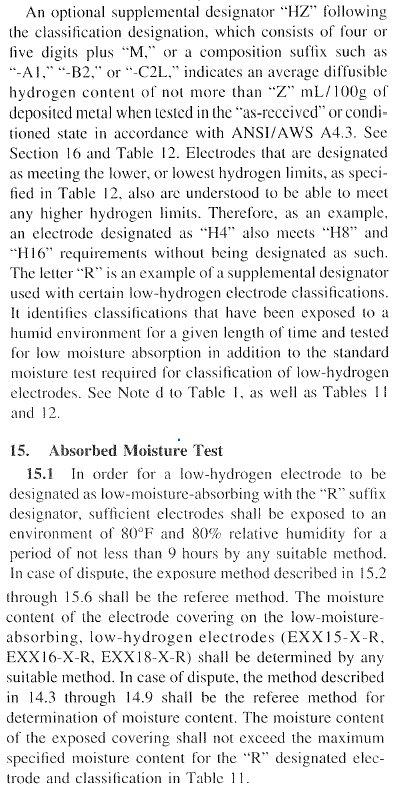
H4 means the rod produces an average diffusible hydrogen content of not more that "4"mL/100g of deposited metal.
R means the rod has been exposed to 80F temp at 80% relative humidity for 9 hours and still passed the H4 test.
Sticker with MTRs costs a truckload of extra money and is usually special order.

Image
Image
Image
Image


Offline
 Profile  
 
 Post subject: Re: Firebox Steel
PostPosted: Mon Apr 12, 2010 7:00 am 

Joined: Sat Feb 05, 2005 1:05 am
Posts: 488
This is the Specification S-1 from the ASME Section II 1935 edition.
Grades are seperated into Flange and Firebox quality.
Notice the main difference is a tighter specification on the Manganese, Phosphorous and Sulphur content and also more rigorous mechanical tests for the Firebox quality.
Elongation is expected to be greater than 25%

Condolences for Mr. Gillespie.


Attachments:
S1-1935a.jpg
S1-1935a.jpg [ 158.19 KiB | Viewed 5171 times ]
S1-1935b.jpg
S1-1935b.jpg [ 177.86 KiB | Viewed 5173 times ]
S1-1935c.jpg
S1-1935c.jpg [ 158.13 KiB | Viewed 5167 times ]
Offline
 Profile  
 
Display posts from previous:  Sort by  
Post new topic Reply to topic  [ 24 posts ]  Go to page Previous  1, 2

All times are UTC - 5 hours [ DST ]


You cannot post new topics in this forum
You cannot reply to topics in this forum
You cannot edit your posts in this forum
You cannot delete your posts in this forum
You cannot post attachments in this forum

Search for:
Jump to: