It is currently Sun Sep 27, 2026 10:04 pm

All times are UTC - 5 hours [ DST ]


Post new topic This topic is locked, you cannot edit posts or make further replies.  [ 279 posts ]  Go to page Previous  1 ... 8, 9, 10, 11, 12, 13, 14 ... 19  Next
Author Message
 Post subject: Re: ATSF 4-6-4 #3463
PostPosted: Sun May 27, 2012 7:54 pm 

Joined: Sun May 15, 2005 2:22 pm
Posts: 1543
What would be the details of a modern steam locomotive for this commuter service application? I am wondering about weight, horsepower, boiler design, wheel arrangement, fuel, steam circuit, etc. What role would computers play with this locomotive?


Offline
 Profile  
 
 Post subject: Re: ATSF 4-6-4 #3463
PostPosted: Sun May 27, 2012 8:46 pm 

Joined: Thu May 24, 2012 1:37 pm
Posts: 2492
With respect to the 'commuter' locomotive: I am tempted to say that the likeliest answer would involve Cyclone. Multiple ultrasupercritical engines, positive-displacement expanders, energy storage... computerized management in a bunch of typical ways. Like a multiple-genset engine on steroids. VERY careful charge and power management, as there is more than usual gain to be had from regenerative braking energy recovery, especially if it can be used for more rapid intermediate-speed acceleration...

NOTE that one place you do NOT want 'computerized' action is in the primary valve drive. Over the years I've seen all sorts of fancy variable-duration/timing/displacement setups that supposedly use rotary encoders or Inductosyns or LVDTs to synthesize the valve timing. With nothing but handwaving to describe what happens when, not if, the signals get corrupted and admission or exhaust are mistimed at high momentum. Not one in ten of those people even understand why the signals ought to be Gray coded. Remember that railroading can be a place where diesel-electrics are sent out with three out of 16 powerpacks defective...

Another place I see pipe dreams is in automated solid-fuel firing of unattended large boilers (this was actually part of the ACE 3000 business model!). Any sophomore studying process control can design an efficient MU system (ideally DPU, not 'runs', imho) for trailing steam, or a full suite of autonomous controls, alarms, etc. for unattended firing. But what happens after a few months or years when some of the controls fail to work as intended -- or if anything happens and plaintiff's bar pulls the 'nobody was there when it happened' argument up in front of a jury. Many, perhaps all, states require an attendant for any 'power boiler' of locomotive size; the only real way 'out' of the situation is to have multiple smaller steam generators, and don't try solid fuel on those unless you love science fiction...

Indeed, I would NOT think solid fuel firing would work for commuter service, even on shorter runs, unless really large subsidies over a guaranteed long period of time were made available for the fuel. (And even there, I'd use SRC process on the fuel, especially if I were dedicated to the idea of GPCS...)

I thought the Australian attempt at a 'regularly scheduled steam' service, with the modified R-class Hudsons, was an interesting and sustainable service model for a reciprocating locomotive. But I cannot imagine a regular commuter service run with reciprocating steam locomotives. (Edit: I mean by this a service where all the trains, or a significant portion of them, are run with steam: inbound in the morning, outbound at night, serviced at the outbound end, etc.)

_________________
R.M.Ellsworth


Last edited by Overmod on Sun May 27, 2012 9:36 pm, edited 1 time in total.

Offline
 Profile  
 
 Post subject: Re: ATSF 4-6-4 #3463
PostPosted: Sun May 27, 2012 9:09 pm 

Joined: Sun May 15, 2005 2:22 pm
Posts: 1543
So are you saying that the ATSF locomotive modernization concept would not be applicable to commuter service?


Offline
 Profile  
 
 Post subject: Re: ATSF 4-6-4 #3463
PostPosted: Sun May 27, 2012 9:13 pm 

Joined: Sun Aug 22, 2004 7:19 am
Posts: 6464
Location: southeastern USA
Ron, without cutting into Bob's musings above, I don't think there's been a design worked out yet, or we'd likely be seeing a real "prototype" on the drawing board, looking for a sponsor. Let's let them do their development work before we ask them what they have developed. We're much more likely to get an accurate answer that way.

dave

_________________
“God, the beautiful racket of it all: the sighing and hissing, the rattle and clack of the cars over the rails. These were the sounds that made America the greatest country on earth." Jonathan Evison


Offline
 Profile  
 
 Post subject: Horse drawn trains... was Re: ATSF 4-6-4 #3463
PostPosted: Sun May 27, 2012 9:35 pm 
Site Admin

Joined: Sat Aug 28, 2004 1:15 pm
Posts: 1504
Location: Henderson Nevada
The horse drawn railroad pictured a page ago is the Society for the Preservation of Carter Railroad Resources (SPCRR) project at Ardenwood Historic Farm in Fremont California. It happens to be your friendly moderator's home railroad.

We have been using draft horses to pull narrow gauge trains for 27 years. The horse in the photo was Spike... we lost him almost 10 years ago... We currently have Jiggs, Red, and Goliath... Jiggs, the senior horse is 28, and is retiring this year. Spike, at about 2,200 lbs was rated at 3,300 lbs of tractive effort... (based on current Humane Society standards) or 8 of our narrow gauge cars. We have never pulled more than 3 at a time (Spike, for a NRHS fan trip)

Quote:
"Noo, Noo, THIS is the original 'green' locomotive!!"

http://www.pbase.com/spcrr/image/93303829

Oh, my, oh, my, what to we want to call it, a "biomotive?"

Actually, how about Jake, or Harry, or whatever name you have for such a pet?


Jiggs was the "horse of flesh" at Railfair 1999 in Sacramento... pulling a horse car owned by the San Jose Trolley group.

For our group's needs, running a 1/2 mile long shuttle, 5-8 times a day the horses are cheaper than a gas Plymouth locomotive (we have two) I give our railroad a unique identity. We have 19 cars, the oldest from 1874, the newest 1929, with 14 built before 1900... The railroad is a bit over a mile, with stub switches, and a 24 degree minimum radius... we host visiting steam locomotives once a year.

The eat about half a bail of hay and a couple of cups of grain a day... We don't need no bio hockey pucks...

By the way, The Niles Canyon Railroad, home of the Pacific Locomotive Association and Golden Gate Railroad museum, with 4 istandard gauge steam locomotives s about 4 miles away.


Randy

_________________
Randy Hees
Director, Nevada State Railroad Museum, Boulder City, Nevada, Retired
http://www.nevadasouthern.com/
https://www.facebook.com/FriendsOfNevadaSouthernRailway


Offline
 Profile  
 
 Post subject: Re: ATSF 4-6-4 #3463
PostPosted: Mon May 28, 2012 8:33 am 

Joined: Sun Aug 22, 2004 7:58 am
Posts: 728
Quote:
Southcoast Rail in Massachusetts is slated to spend $2.4 Billion on commuter service restoration to cities in SE Mass. The head of the State EPA has decreed that clean new technology in locomotives will be given priority. If anybody is really serious in the claims about "new" steam being better than Diesels, here is a chance to prove it. They just have to bid the power and land the contract. If the locomotives can't make it in commuter service where they are never more than 80 miles from the shop and come in for maintenance every evening, then they would have no chance with Amtrak or Class Ones. So there is the opportunity.
Now who can come up with a working product?
PC


Hopefully, once 3463 is modified and (hopefully) tests verify she is achieving the desired results and reliability, they will make arrangements with one of the larger commuter rail agencies to allow the engine to be used for at least a couple of months of regular daily service.

This would open the door to future business should they go on to designing "new steam". At the very least, it would bring their project much publicity and would prove it's not just a dream.

I, too, agree this sort of service would be an excellent starting point should "new steam" be built.

Depending on which commuter operation might buy the engines, the acceleration rate and tractive effort of an engine similar to the big Hudson would be close to perfect. 130 mph wouldn't be required, but normal passenger speeds would be. They would need to set up temporary water/ bio-coal facilities and would need an area of the agency's shops where the locomotive could be serviced.

They would minimize the need for specialized support facilities, while racking up considerable mileage.

Jumping directly into the Amtrak/ freight world would require too much of a leap of faith, but the sort of government or quasi-government agencies that run commuter operations, particularly with the strong incentive for "green" motive power, might be the ideal customers.

I wish these guys the best of luck. It's going to be pretty interesting following their progress.

Steve Hunter


Offline
 Profile  
 
 Post subject: Re: ATSF 4-6-4 #3463
PostPosted: Mon May 28, 2012 9:41 am 

Joined: Sun May 20, 2007 10:27 am
Posts: 229
Location: New Haven Ct area
Well I have yet to read the entire discussion, so please excuse this if it has already been mentioned, however in reading this I have to wonder if the true reason behind this program could be to use the locomotive simply as a great sales platform to sell their biocoal?

Seriously what power plant engineer who already has a special place in his heart for steam power and works at a large fossil plant will say no to the sales guy offering to bring a steam locomotive onto the plant grounds all the time sponsoring a free company wide picnic? The only hitch is that the biocoal sales man now gets to hock his product. Heck once the salesman has finished demonstrating this to the local power plant maybe he turns around and offers free steam train rides to the towns people all the time showing all sorts of posters on the dangers the current coal burned at the local plant. and signs showing why they should lobby the plant to burn their bio coal. It sounds to me to be just the demonstration piece. I know Union Pacific has found that a steam locomotive makes an ambassador unlike anything else that can be taken from town to town and generate large sums of enthusiasm.

I could see anyone who burns oil right now being very interested in such technology at $4/gallon. In reading brief bits on that bio coal, it looks like they take forrest waste etc.. and turn it into those bricks. I don't know about other parts of the country but I do know in the Northeast right now people have to pay a decent amount of money per pound to dispose of biomass such as logs, trees etc... that could otherwise be perfectly good fuel, and at the same time these people also pay $4/gallon to heat their homes with oil. Makes me think there is a huge market there.

Now however for the political/economic aspect behind all of this as it can't go unmentioned. In the past 3 years a new technology called hydraulic fracking has come online and is doing numbers on the coal powered generation side of the business. I used to work in that industry and was laid off as a result of the cheap natural gas. I have now started to see ads for auctions of some of the plants I used to work in. I think the break even price between coal and natural gas was $3/mmBTU. In 2008 Natural gas was at $13, today it is at $2.50 or so! This makes the economics of competing any fuel against natural gas very tough.

The next major question is if the "customer" for most of this technology gets reelected. I have a feeling that will make a huge difference. If one believes the oil and gas industry, then the feds are blocking permits for lots of new drilling on federal lands as well as off shore. It would not surprise me for example if the East and West costs hold huge reserves of oil. If this is true then just as the Oil/Gas industry did to the price of natural gas with heavy drilling so too will they do to the price of oil if truly turned loose. I suspect that the time frame to get this Locomotive running will likely be about 4yrs. In 4yrs the price of natural gas has gone down to about 1/5th of its peak. Now one must ask what will happen to the price of oil in 4more years? If it goes up by a factor of 5, this thing may be very sought after everywhere. On the other hand if it goes down by a factor of 5, this will be a dud. I could be wrong but I have a sneaky suspicion if the politics in Washington turn from protect the environment, to jobs and prosperity, oil could fall and fall hard. If that happens the key market for this technology could disappear rather quickly. Of course this is just the level of uncertainty facing each industry right now.

But as I said if one thinks of this first and foremost as a sales piece for biocoal that can harvest energy from existing and plentiful nation wide biomass waste streams this project may just be the modern day equivalent of Timken buying a large locomotive and equipping it with needle roller bearings and going on a cross country tour.

Think about it, if you lived in a town where the majority of the homes were heated with $4/gallon would the whole town show up and newspapers come out for a guy with a biocoal fired boiler on the back of a truck in the same numbers as they would if a historic steam locomotive was coming through town?


Offline
 Profile  
 
 Post subject: Re: ATSF 4-6-4 #3463
PostPosted: Mon May 28, 2012 10:28 am 

Joined: Sun May 20, 2007 10:27 am
Posts: 229
Location: New Haven Ct area
Well I posted my comments above prior to reading everything and it looks like I was right. It sounds like using this as a platform to sell a new fuel is the #1 goal of the project. From this stand point if it is able to do this any added knowledge of modern steam principals should hopefully emerge as a welcomed byproduct.

As far as I can tell as I said before railroads like the UPRR clearly believe that Steam is a big attention grabber and great sales platform. If done correctly this project not only will have an ability to be a great fuel sales platform but think of all the other technologies that it will help sell. For example the field of computational fluid dynamics has been improving quite a bit in recent years, and led to some significant improvements in all sorts of combustion systems. However how many competent engineers have tried to apply these new tools to steam locomotive design? It wouldn't surprise me in the least if there is room for at least some small incremental improvements that someone could tout. Who can't see the sales reps of a company that specializes in selling fluid dynamic simulation software not wanting to put out short 5-10min sales demos showing how their product helped improve a 1937 steam locomotive and make her more efficient? It is hard to think of many engineering types who wouldn't click on the link to that video when it showed up in their email in box. It seems like to me that this will be one very neat project. The other thing about selling up the idea of modernizing this engine that can't be overlooked. Is think of someone in the general public attending a demo on this locomotive. Wouldn't you think they if the average guy was considering using it to heat his home he would prefer to see the biocoal powering an advanced steam engine of the future, as opposed to a smoky relic of the past? Just my $0.02 but if they could get this thing traveling the country that would be really cool.


Offline
 Profile  
 
 Post subject: Re: ATSF 4-6-4 #3463
PostPosted: Mon May 28, 2012 3:36 pm 

Joined: Fri Mar 05, 2010 3:41 am
Posts: 3971
Location: Inwood, W.Va.
Some other takes on this by people in economics and environmental weblogs, including some who are apparently rail enthusiasts as well:

http://www.smartplanet.com/blog/cities/ ... 0-mph/3286

http://www.dailykos.com/story/2012/05/2 ... y-Aerobus-

http://www.theregister.co.uk/2012/05/28 ... r_130_mph/

http://www.redorbit.com/news/science/11 ... ent-power/

http://www.mndaily.com/blogs/newsstand/ ... ndly-train

http://reneweconomy.com.au/2012/hot-new ... ughs-36754

http://www.tgdaily.com/sustainability-f ... ss-transit

http://www.gizmag.com/csr-project-130-s ... ive/22670/

http://cjonline.com/news/2012-05-22/his ... ck-new-use

http://cjonline.com/news/2012-05-26/ful ... hugs-along

Some of this stuff is enviro-geeky, most of it is just newswire type postings, but it's notable, at least for me, for the interest it brings. If anybody wanted a project that would get attention, this certainly qualifies. Of course, with the added attention comes added visibility, fine if things work out, but if they don't. . .well, nothing compares with falling on your face in front of millions of people. . .


Offline
 Profile  
 
 Post subject: Re: ATSF 4-6-4 #3463
PostPosted: Mon May 28, 2012 4:34 pm 

Joined: Sun May 15, 2005 2:22 pm
Posts: 1543
If this proposal leads to new motive power that the railroads will convert to because it is more cost effective, I see no problem with it. But this kind of has the feeling of a traffic circle. If CSR has the torrefied fuel production process fully developed as they claim, then they ought to be able to tell us the cost for using it to pull trains. And yet, they are absolutely vague about those details.

So I am not convinced that this proposal is about finding a cheaper, better way of doing something, as driven by market economics. But what it clearly is about is eliminating the use of fossil fuels, and that objective has generally proved to come at a cost. So, I expect that the cost of green steam will be higher, despite what the CSR website claims. I also would not be surprised if this proposal receives massive public funding. It fits that template perfectly.

Many people do not believe there is a good reason to eliminate the use of fossil fuels, so they will not want to spend more to meet that objective. Therefore, I believe that the only way for this to come to fruition is for it to be imposed by regulation, under the premise that it is for the greater good of society to eliminate the use of fossil fuels.


Offline
 Profile  
 
 Post subject: Re: ATSF 4-6-4 #3463
PostPosted: Mon May 28, 2012 5:52 pm 

Joined: Sat Jul 02, 2005 7:16 am
Posts: 2129
Ron Travis wrote:
Therefore, I believe that the only way for this to come to fruition is for it to be imposed by regulation, under the premise that it is for the greater good of society to eliminate the use of fossil fuels.


I think you hit it exactly, Ron. And if that were to happen, the resulting locomotives might not look very much like traditional steam locomotives.

PC

_________________
Advice from the multitude costs nothing and is often worth just that. (EMD-1945)


Offline
 Profile  
 
 Post subject: Re: ATSF 4-6-4 #3463
PostPosted: Mon May 28, 2012 11:20 pm 

Joined: Fri Mar 05, 2010 3:41 am
Posts: 3971
Location: Inwood, W.Va.
". . .if that were to happen, the resulting locomotives might not look very much like traditional steam locomotives."--Preston Cook

Thinking about this a little bit, I wondered what a commuter engine--or any modern steam locomotive--might look like.

In most general terms, I can think of several things that will stand out. One is that the "new" production model, if we're talking about a commuter engine as such, will not have 84-inch drivers. Those are way to tall for service like that; they put the horsepower range too high. A more suitable diameter would likely be in the 69 or 70-inch range, giving plenty of acceleration; Pennsy's G-5 4-6-0s, which were specifically built for commuter service, indeed built to mimic a train of MP-54 MU cars, had 68-inch drivers.

Other things to consider would be that the locomotive would have to be bidirectional, possibly arranged for push-pull operation; not that far-fetched, Great Western of Great Britain and a French road had locomotives so fitted. The engineer ran the train from a cab in what would later be called a "control trailer," while the fireman stayed on the locomotive. David P. Morgan said this reminded him of Camelback practice.

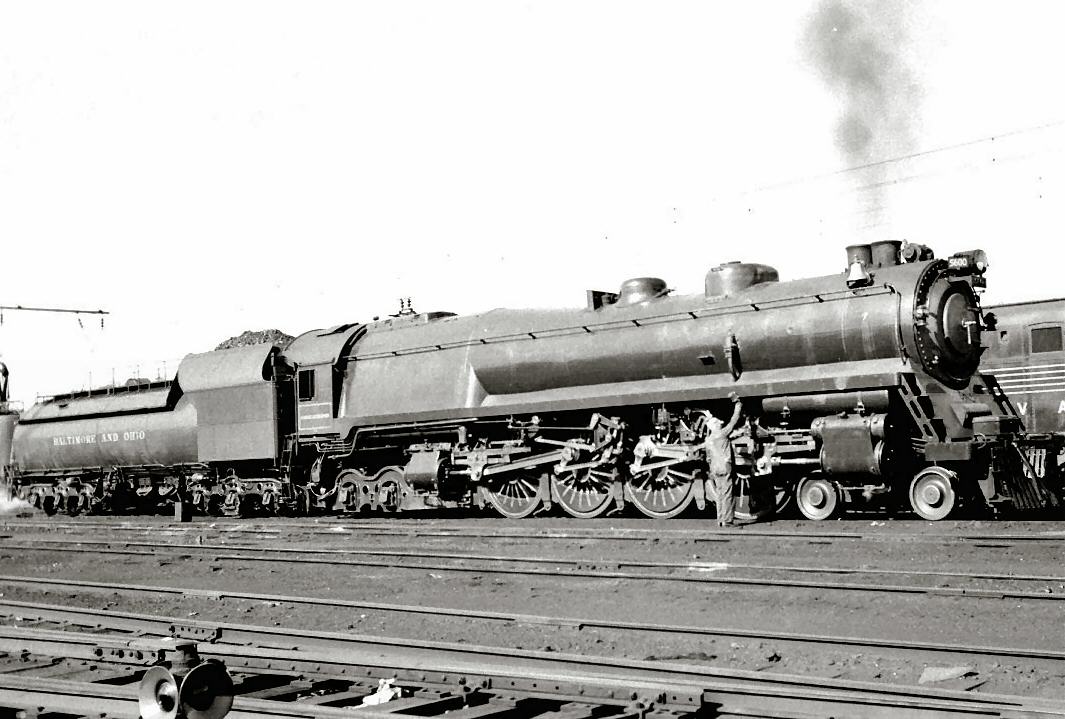
Another thing to consider is the possibility of using Bill Withuhn's balanced compound drive, first published in that famous Trains article in the 1970s (Did We Scrap Steam Too Soon?), and which was also one of the features of the proposed ACE-3000. This was a four-cylinder locomotive with all cylinders outside, but with a pair of crank axles and inside connecting rods to link and synchronize what would otherwise by a duplex drive engine with outboard cylinders, like the B&O's experimental 4-4-4-4 type, the George H. Emerson.

http://en.wikipedia.org/wiki/Baltimore_ ... _Class_N-1

Hmm, if the engine came out looking something like that, I don't think any of us would complain too loudly about appearances.

And Withuhn is on the project; very likely he will at least lobby for that balanced compound drive.

http://www.trainweb.org/tusp/ult.html

http://www.trainweb.org/tusp/ace_det.html

See Fig. 35 for details on the Withuhn drive:

http://www.google.com/patents/US4425763 ... &q&f=false

An interesting observation: While looking for that patent link, I found other material on the ACE-3000, including at least one alternate history site that wasn't strictly railroad oriented. That's fascinating, considering the project didn't do much except run some interesting mileage with the 614 on coal trains. This, again, is evidence that steam has a great hold on the imagination. It certainly suggests a steam program, as a PR tool, is not something to just dismiss without at least some semi-serious thought.

http://www.alternatehistory.com/discuss ... p?t=166229


Offline
 Profile  
 
 Post subject: Re: ATSF 4-6-4 #3463
PostPosted: Tue May 29, 2012 12:18 am 

Joined: Fri Mar 05, 2010 3:41 am
Posts: 3971
Location: Inwood, W.Va.
Jeff, that engine was a one-off experimental job, and carried the name of the B&O's chief locomotive designer of that time. It incorporated a number of features that were trademarks of Emerson, including a water-tube firebox and the divided or "duplex" drive that would later be adopted by the Pennsylvania in those T-1 4-4-4-4s and its huge Q-2 4-4-6-4s.

The water tube firebox was an attempt to get away from the problems of staybolts. Basically, the boiler forward of the firebox was pretty conventional, other than that it ended at the rear tube sheet. Projecting back from the rear tube sheet would be three drums, which may or may not have had a connecting double-walled rear sheet with more water space. Connecting the three drums--two at the bottom, one at the top--would be lots of water tubes, taking the place of the stayed side sheets, while the lower two drums would be considered the counterparts of the foundation ring, and the upper drum a counterpart to the crown sheet. No staybolts in any of this, unless there was a water sheet at the rear of the the three drums (this would be the door sheet on a conventional boiler). The problem with this was that even with cast frames, locomotive boilers are subject to all kinds of twisting, shaking, shocks, and hugely variable steam demand, and as a result, the Emerson fireboxes could leak worse than regular ones.

The duplex drive was an attempt to reduce dynamic augment by using two sets of lighter machinery instead of the typical large set of a 4-8-4. In the case of the Emerson, the layout included having the second set of cylinders back near the firebox to keep the wheelbase shorter. This turned out to have problems due to ash and dust in things like crosshead guides, and was part of the reason Baldwin and the Pennsy would opt for a Mallet-like layout on the T-1 and Q-2. The Emerson was also noted as being a slippery engine, both for starting and for stopping (!), but once it got moving, it was incredibly fast.

It's ironic--and sad--that its service life was as short as it was (only 5 years, and retired about the same time as the designer)--but the same could be said of a number of other promising engine designs that didn't pan out, and even some that did (NYC Niagaras, CP G-5 4-6-2s and the last 2-10-4s on that road).

http://www.steamlocomotive.com/duplex/

Scroll down on this one for info and a couple of pretty good pix:

http://sbiii.com/rr3.html

Addendum: More pix, courtesy of Norheast.Railfan.net:

http://www.northeast.railfan.net/images/bo5600sb.jpg

http://www.northeast.railfan.net/images/bo5600sa.jpg

Continuing: Other experimentals on the B&O, starting with KK-1 No. 7400, and KK-2 No. 7450; these were identical 2-6-6-2s built by Baldwin in 1930. They were built for a deliberate comparison between conventional (7450) and water-tube (7400) fireboxes, and also to test the idea of high-speed simple articulation. Firebox test was apparently inconclusive, at least to Emerson, and the engines suffered from instability at speed; more suspension work was required to use an articulated in higher-speed service.

http://www.rr-fallenflags.org/bo/bo-s7400.jpg

http://www.northeast.railfan.net/images/bo7400sa.jpg

http://www.northeast.railfan.net/images/bo7450sa.jpg

http://www.northeast.railfan.net/images/bo7450s.jpg

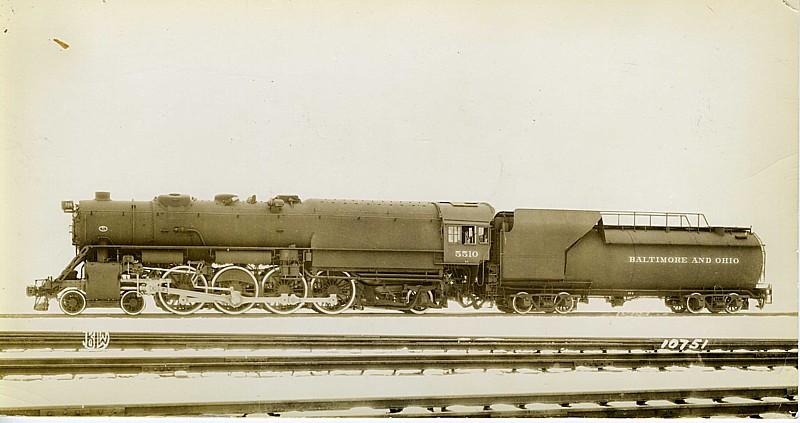
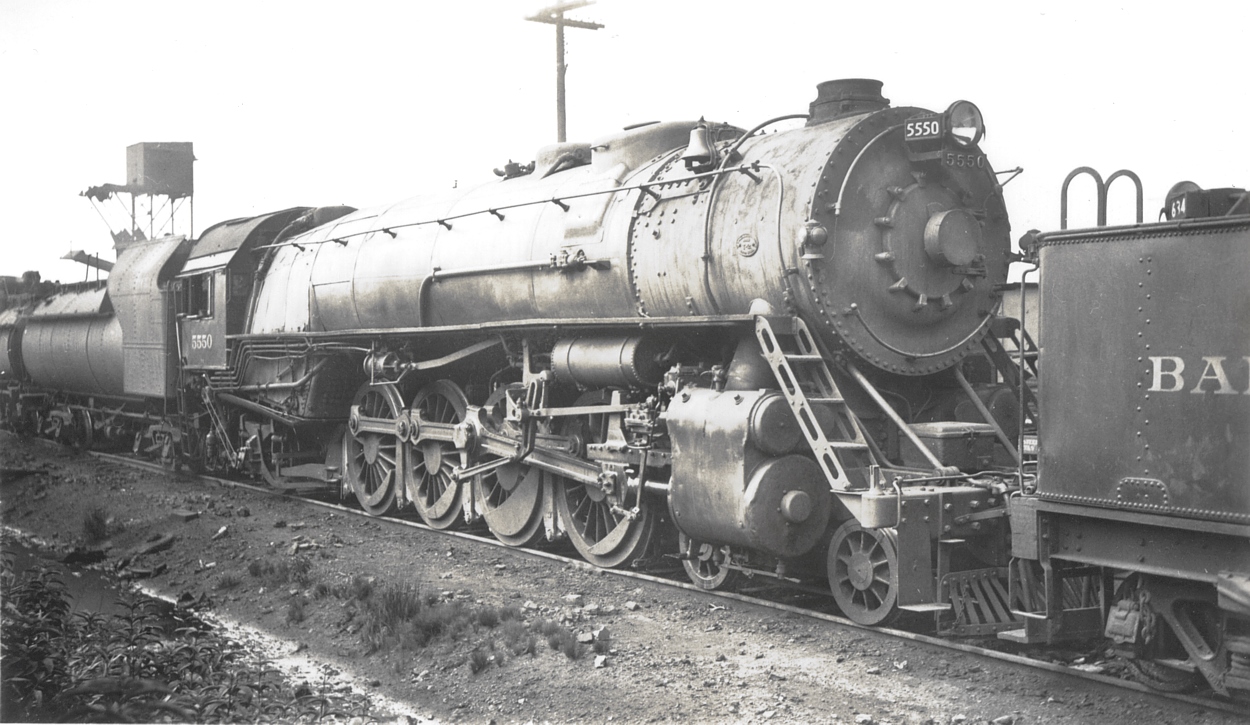
Concurrent with the two 2-6-6-2s, the B&O also got a pair of 4-8-2s, No. 5510 (T-1) and 5550 (T-2). No. 5510 had a water-tube firebox, and 5550 had a conventional firebox. The difference is apparent in the firebox contours in the builder's photos--and take note of the spoked wheels under the tenders!

http://www.northeast.railfan.net/images/bo5510sa.jpg

http://digital.denverlibrary.org/cdm/re ... 2/id/48319

http://www.northeast.railfan.net/images/bo5550s.jpg

http://www.northeast.railfan.net/images/bo5550sa.jpg

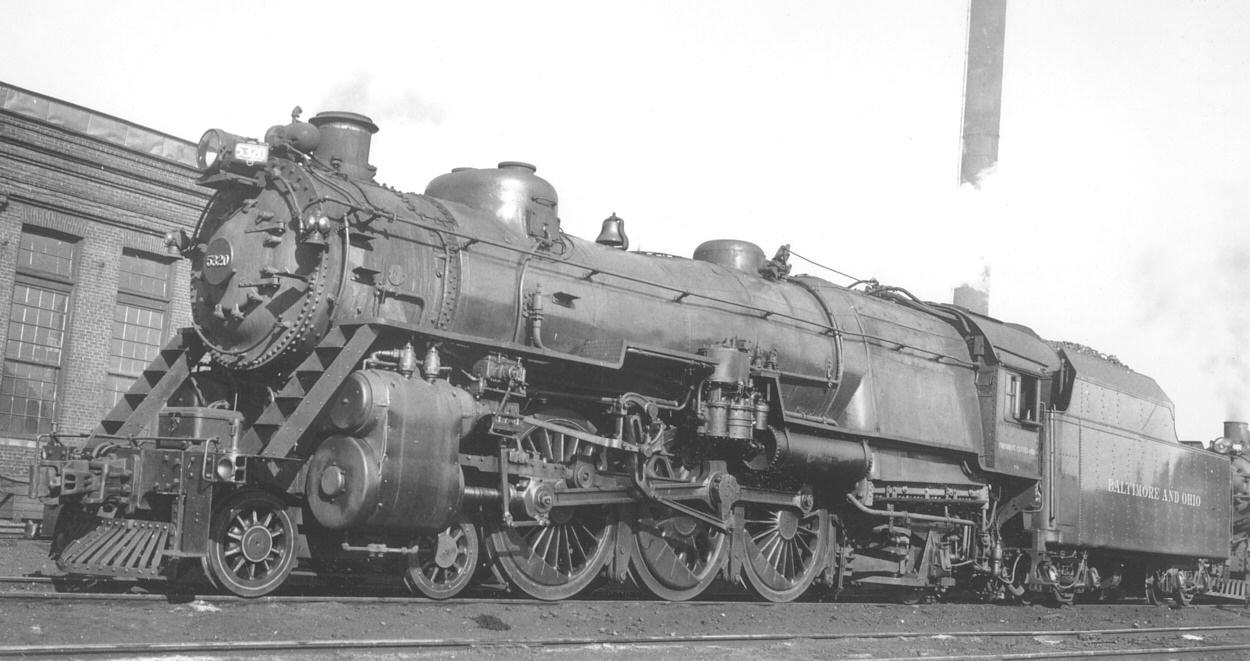
No 5320, class P-9; the 21st President class engine, with a water tube firebox and poppet valves; later converted to piston valves as class P-9a, then lost its water-tube firebox to become a P-7, like the others, except for:

No. 5320, which got the boiler originally intended for the class W 4-8-4, which would really have been a 4-2-2-2-4--it was supposed to have individual steam motors on its axles! As a result, the last of the original P-7 4-6-2s became the second P-9a!

http://www.northeast.railfan.net/images/bo5320sc.jpg

http://www.northeast.railfan.net/images/bo5320sb.jpg

There were other experimentals on the B&O, but we'll close out with two of the most graceful--the Lady Baltimore (4-4-4) and the Lord Baltimore (4-6-4), both built for short, fast lightweight trains, in concept and time similar to early Zephyr motor trains, early Rock Island Rockets, and the like--but with steam power. An interesting story--the Lady and the Lord were supposed to have streamlined jackets, and one of them was near completion when the B&O's president, the legendary Daniel Willard, stopped in the shops to check up on them. Supposedly the old former engineer, with a career that went back to woodburning engines in New England, and impeccably dressed in suit, coat, and derby hat, shook his umbrella at the shroud and shouted out, "Take it off!" He further continued to say a locomotive should look like a locomotive, not a monstrosity! The end styling of these two lightweights, and some of the others as well, was inspired by clean British practice, complete with the latch and dog smokebox doors. The long pilots, though were inspired by older locomotives, and incorporated a retractable coupler behind those slats; actually, a practical thing, as the clean pilot might keep an errant auto from being impaled on the coupler.

Images courtesy of Richard Leonard:

http://www.railarchive.net/gmogallery/photo510.htm

http://www.yesteryeardepot.com/BO-1.JPG

http://www.rr-fallenflags.org/bo/bo-s2.jpg

Have fun.


Last edited by J3a-614 on Tue May 29, 2012 11:19 am, edited 2 times in total.

Offline
 Profile  
 
 Post subject: Re: ATSF 4-6-4 #3463
PostPosted: Tue May 29, 2012 9:08 am 

Joined: Mon Oct 11, 2004 8:42 am
Posts: 441
Location: Haslett, Michigan USA
Two items from the Michigan press last week struck me as having connections with this concept.

The first was the announcement of the first trips this season of the coal-burning ex-C&O ferry Badger from Ludington. Its operators are locked in a death battle with USEPA over the use of ash ejectors. They are operating under some sort of grandfather exemption that allows them to discharge ash to the lake, and this is being protested noisily by the hate-coal movement. Passengers and politicians are being met by a geek dressed in a badger suit, distributing bags of coal dust. (Supposedly the governor's bodyguards weren't eager to have him approached by someone in a mask and baggy dress, so the governor didn't get any coal.)

If the torrefacted wood is available, there is someone who might want to buy a thousand tons right now, if it will work on chain grates. (Ride the last coal-burning reciprocating steam passenger liner while you can, before it's converted to natural gas, Dieselized, or outlawed. The 3463 isn't the only significant steam artifact in danger of getting modernized for further use.)

This also makes me recall that someone once proposed to send a truckload of some kind of wood pellets from up north for us to experiment with in Pere Marquette 1225. That never happened, but I bet other operators would be willing to try a load of these wooden hockey pucks if they didn't make ash and clinker.

The other news item? It was reported that a Steampunk gathering convened in Dearborn last week. For some reason, this made me think of this project.

Aarne H. Frobom
Sac du Bricquettes, Michigan


Offline
 Profile  
 
 Post subject: Re: ATSF 4-6-4 #3463
PostPosted: Tue May 29, 2012 9:52 am 

Joined: Fri Aug 27, 2004 4:02 pm
Posts: 1883
Location: Back in NE Ohio
I've shoveled a lot of "real estate" into the fireboxes of various steam locomotives in my life. That said, in reading what is being said in non-railroad, non-rail enthusiast circles about things that burn coal, I have to say the tide is quickly turning against the continued use of coal generally. Anyone who is truly intellectually honest has to admit that the coal industry ad campaign for "clean coal" is blowing more smoke up people's behinds than a big steam engine on a steep grade with a load of bad coal in it's tender. Pairing the words "clean" and "coal" is one big propaganda lie, and barring a quantum leap in technology that I don't see anywhere on the horizon, will continue to be.

We need to recognize and get out ahead of this change in attitude. I would strongly suggest, and in fact privately have to some, that any group working towards an initial restoration a steam locomotive to operating, seriously consider as part of the restoration, a conversion of locomotive to burn some kind of bio-fuel. My personal bias is to use waste vegetable oil. Most fast food restaurants and commercial frying operations - like potato chip factories - have to pay to have their waste fry oil taken away (those of you in the Mid-Atlantic have probably seen trucks from a company called Valley Proteins, this is one of the things they do, they make it into ingredients for cosmetics, among other things, and they get paid on both ends). So if your steam operation is willing to remove it for free, reprocess and use it, its a win-win for the frying operation and your railroad. If nothing else it will take away one probable objection of the NIMBY's to your project. Also, doing so just might make your project eligible for grant money that it might not otherwise qualify for - say for building the waste vegetable oil reprocessing facility.


Offline
 Profile  
 
Display posts from previous:  Sort by  
Post new topic This topic is locked, you cannot edit posts or make further replies.  [ 279 posts ]  Go to page Previous  1 ... 8, 9, 10, 11, 12, 13, 14 ... 19  Next

All times are UTC - 5 hours [ DST ]


You cannot post new topics in this forum
You cannot reply to topics in this forum
You cannot edit your posts in this forum
You cannot delete your posts in this forum
You cannot post attachments in this forum

Jump to: