It is currently Sat Aug 22, 2026 1:29 pm

All times are UTC - 5 hours [ DST ]


Post new topic Reply to topic  [ 23 posts ]  Go to page Previous  1, 2
Author Message
 Post subject: Re: 1904 St. Louis transportation exposition
PostPosted: Mon Jan 07, 2013 9:48 pm 

Joined: Fri Mar 05, 2010 3:41 am
Posts: 3971
Location: Inwood, W.Va.
"Since this was 1904, what in the world would the B&O "Historic Exhibit" have had on display?"--CJVRR

I don't know specifically what would have been at the Exposition of 1904, but it very likely would have consisted of most of what would have been at the Chicago Exposition of 1893, which was famous (for us) as the fair which also showed off New York Central 999 following that run to 112 1/2 near Batavia, New York. That show consisted of a lot of what later was at the Centennial Exhibition in 1927, which eventually became the nucleus of the B&O Railroad Museum in the 1950s. Equipment likely would have included the Thatcher Perkins (which carried the number 117 for many years as an exhibit), No. 25 (the currently operable William Mason), and No. 600 (J. B. Jervis, the big 2-6-0 that had been intended as a mountain passenger locomotive). The Hayes Camel 4-6-0 would likely have been there, perhaps the 0-8-0 Memnon, along with early original engines like the Atlantic and the Adriatic. It's also likely the Pangborn models (full sized wooden replicas of other early equipment) would have been represented. And that "largest locomotive in the world" is none other than a brand new Old Maude, then No. 2400, built by Alco that year for the B&O and the first Mallet in America.

Too bad Old Maude didn't make it into preservation; indeed, the whole historic collection was threatened for a time by none other than George Emmerson, the B&O's chief mechanical officer of the time, noted for his championing of water tube fireboxes and for designing and building the very first duplex-drive locomotive. Seems he didn't think too much of the older equipment, seeing it only as so much scrap metal that could be melted down. There is reason to believe his scrapping of Old Maude and the last of the B&O's original Howard Street Tunnel electrics got the attention of then president Daniel Willard, and lead to the preservation of the remaining historical artifacts.

Now, if only some others later had held on to the last T-3 4-8-2 (last locomotive built at Mount Claire), and an EM-1 2-8-8-4, and what the heck, let's include a Big Six 2-10-2 and a Q-4 2-8-2, these last two representative of standard power on "the mother of American railroads."


Offline
 Profile  
 
 Post subject: Re: 1904 St. Louis transportation exposition
PostPosted: Mon Jan 07, 2013 10:08 pm 

Joined: Sun Aug 22, 2004 1:51 pm
Posts: 12151
Location: Somewhere east of Prescott, AZ along the old Santa Fe "Prescott & Eastern"
Quote:
(last locomotive built at Mt. Clare)


Fixed that for ye......


Offline
 Profile  
 
 Post subject: Re: 1904 St. Louis transportation exposition
PostPosted: Mon Jan 07, 2013 10:12 pm 

Joined: Fri Mar 05, 2010 3:41 am
Posts: 3971
Location: Inwood, W.Va.
Arrgh!--Thanks anyway!!


Offline
 Profile  
 
 Post subject: Re: 1904 St. Louis transportation exposition
PostPosted: Mon Jan 07, 2013 10:28 pm 

Joined: Sun May 15, 2005 2:22 pm
Posts: 1543
What is the story on that “Mallet Mountain Climber” shown alongside the “Rocket” in one photo?


Offline
 Profile  
 
 Post subject: Re: 1904 St. Louis transportation exposition
PostPosted: Mon Jan 07, 2013 10:33 pm 

Joined: Sun Aug 22, 2004 1:51 pm
Posts: 12151
Location: Somewhere east of Prescott, AZ along the old Santa Fe "Prescott & Eastern"
Ron Travis wrote:
What is the story on that “Mallet Mountain Climber” shown alongside the “Rocket” in one photo?


J3a-614 wrote:
And that "largest locomotive in the world" is none other than a brand new Old Maude, then No. 2400, built by Alco that year for the B&O and the first Mallet in America.


Offline
 Profile  
 
 Post subject: Re: 1904 St. Louis transportation exposition
PostPosted: Mon Jan 07, 2013 11:26 pm 

Joined: Fri Mar 05, 2010 3:41 am
Posts: 3971
Location: Inwood, W.Va.
"What is the story on that “Mallet Mountain Climber” shown alongside the “Rocket” in one photo?"

Working from memory, this was the first Mallet for service in America (original operating territory was Sand Patch), and while it turned out to be a progenitor of the semi-articulated type (both the true compound Mallet and the later simple version), this particular engine was something of a one-off job. She was powerful enough to replace double-headed 2-8-0s on that line, and successfully demonstrated the Mallet concept for American railroads.

The B&O's first "production" Mallets were its class LL-1 0-8-8-0s, some of which became EL-5 2-8-8-0s. These machines, in both original and rebuilt forms, spent a lot of time with other EL-class engines as helpers out of Rowlesburg, W.Va.

Reportedly, one other series of Mallets was inspired by the Old Maude (which was named for a cantankerous cartoon mule of the period), and those were the 0-6-6-0s of the Denver & Salt Lake. All of those, and some later versions of the same, were later rebuilt as 2-6-6-0s--and some of them ran on successor Denver & Rio Grande at least into the late 1940s.

As for Old Maude herself, she was eventually renumbered to No. 7000 if I recall correctly, and wound up at the end in hump service at Keyser, W.Va. She was scrapped around 1940 or the late 1930s--a historically significant machine that one would argue should have been preserved.

http://www.calvertcentral.com/articulated.html

New in 1904; classification on the B&O was DD-1. B&O used a classification system somewhat similar to that of the Pennsylvania Railroad, in that a locomotive of two units would have the classifications of the two units as separate locomotives. The DD-1, for instance, was two 0-6-0s (class D), the LL-1 was two 0-8-0s, and the various EL classes were a 2-8-0 and an 0-8-0, just as Pennsy's electric GG-1 was a pair of 4-6-0s.

http://www.northeast.railfan.net/images/bo2400sa.jpg

http://abpr.railfan.net/abprphoto.cgi?j ... anColl.jpg

Supposedly In service about 1931, but the flat ground in the background and the engine's overall polished appearance, including white tires, suggests the B&O Centennial exhibition (The Fair of the Iron Horse) in 1927; looks like she's would be in hump service by this time with those footboards, and she now has electric lights. This is about how she would have looked at the time of her retirement:

http://www.northeast.railfan.net/images/bo2400s.jpg

Class LL-1--and take note of that number, and the puny power reverse cylinder in front of the firebox:

http://www.rr-fallenflags.org/bo/bo-s2401ago.jpg

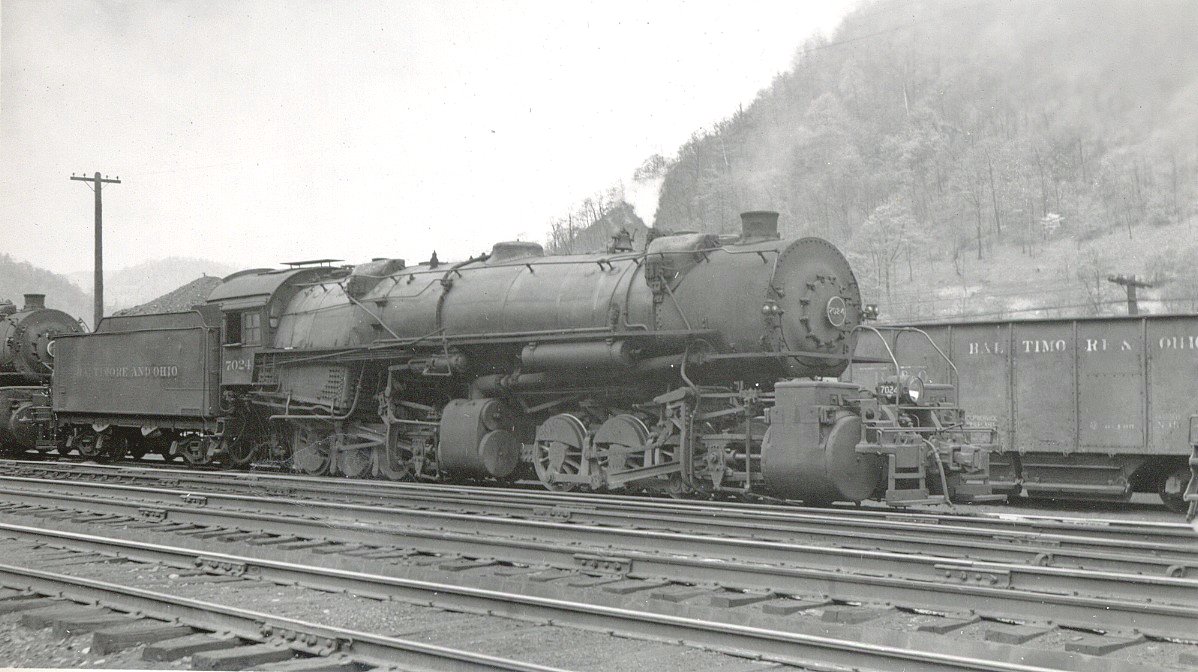
An impressive locomotive, but not one to win any beauty contests:

http://www.northeast.railfan.net/images/bo7024s.jpg

http://www.northeast.railfan.net/images/bo7046sa.jpg

Some got leading trucks, but not all:

http://www.northeast.railfan.net/images/bo7049s.jpg

http://www.northeast.railfan.net/images/bo7040sa.jpg

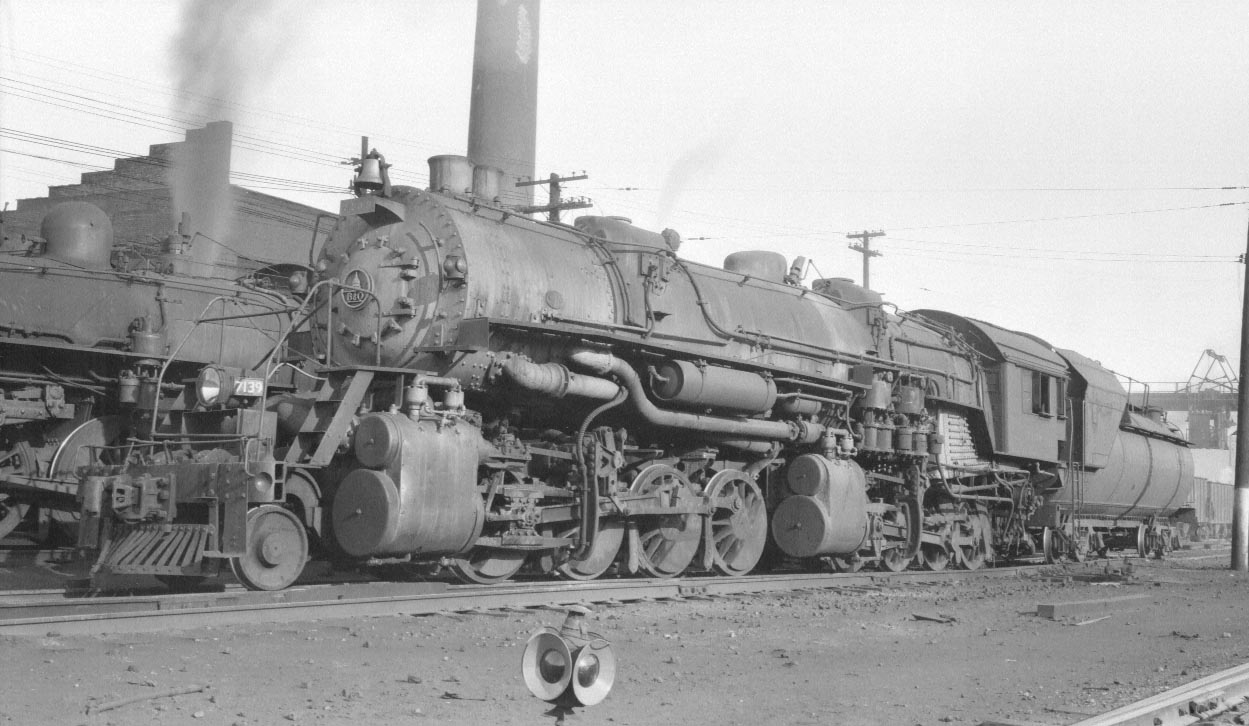
The workhorse Mallets on the B&O were a series of quite similar locomotives in classes EL-1, EL-2, EL-3, and EL-5, plus some former Seaboard Air Line 2-8-8-2s that were rebuilt to 2-8-8-0s, in class EL-6. All were originally compounds, and most were rebuilt as simples in the 1920s--but again, not quite all:

No. 7122 is a compound EL-3:

http://www.northeast.railfan.net/images/bo7122s.jpg

No. 7137 is also an EL-3, but is now a simple engine, as is 7139:

http://www.northeast.railfan.net/images/bo7137s.jpg

http://www.northeast.railfan.net/images/bo7139s.jpg

No. 7311 and 7304 are former SAL 2-8-8-2s, their heritage showing in different proportions (including 63-inch drivers, high compared to the 57-inchers of B&O's own), and a different, squarish cab. Both have also been rebuilt to simple operation. With their higher drivers, these were the fastest articulateds on the B&O until the coming of the fabulous EM-1 2-8-8-4s in 1944 and 1945:

http://www.northeast.railfan.net/images/bo7311s.jpg

http://www.northeast.railfan.net/images/bo7304s.jpg

Turns out there is a book on the Old Maude (or Old Maud--both spellings seem to be in use):

http://www.amazon.com/Americas-Pioneer- ... 0977793109


Offline
 Profile  
 
 Post subject: Re: 1904 St. Louis transportation exposition
PostPosted: Tue Jan 08, 2013 12:05 am 

Joined: Tue Aug 02, 2005 1:25 pm
Posts: 6482
Alexander D. Mitchell IV wrote:
Quote:
(last locomotive built at Mt. Clare)


Fixed that for ye......


She was also the LAST "new" 4-8-2 to be put into service on U.S. rails.

Les


Offline
 Profile  
 
 Post subject: Re: 1904 St. Louis transportation exposition
PostPosted: Wed Jan 09, 2013 4:00 pm 
User avatar

Joined: Mon Sep 24, 2012 7:16 pm
Posts: 546
Location: Rochelle Illinois
Thanks for posting this. What I would have given to been there to see such a wonderful display.

A little side note about Chicago Bridge and Iron during WW II:

http://www.thezephyr.com/prairieshipyard.htm

Quote:
The Chicago Bridge and Iron Company's main business was building pressurized tanks of various types and shapes all over the world. Many a town had a water tower which had been constructed by CBI. They had a reputation for quality workmanship and efficiency.

The company had been chosen to build the LSTs because of their reputation and skills, particularly welding. There was another reason why the military had decided to produce boats in the interior of the country. The coastal shipyards were busy building the large vessels such as aircraft carriers, battleships, cruisers and destroyers. There was no alternative but to use the inland waterways for the production of smaller ships. The Bureau of Ships estimated there was a need for 500 smaller craft of various kinds. . . .


The Illinois River had been dredged to a depth of 9 1/2 feet so it could accommodate this type of ship. It also connected to the Mississippi River and the port of New Orleans from which the vessels could go to any theater of the war.


The site for the Seneca shipyard had been selected because there was a solid sandstone base under it. After clearing the top soil and creviced limestone, the underlying foundation would be strong enough to bear the weight of all that steel.

It was a wedge-shaped piece of pasture and corn land of 200 acres on the bank of the Illinois River. The shipyard stretched for three-fourths of a mile along the river side. The shipbuilding was arranged so there were 15 berths parallel to the river. As the ships were completed they were moved to a central way and then prepared for launch.

Each LST was 327 feet in length and weighed 5,500 tons. Sections were fabricated and hoisted into place. Then the pieces were welded together. Very little scaffolding was used in the construction of the ships because that cost time and money. Speed was of the essence at the time they were being built.


Image

Image

We have visited that site where the shipyard used to be.

Image

My wife and son at the monument in Seneca Illinois.

Steve

_________________
"Those who don't know history are destined to repeat it"

Edmund Burke (1729-1797)


Offline
 Profile  
 
Display posts from previous:  Sort by  
Post new topic Reply to topic  [ 23 posts ]  Go to page Previous  1, 2

All times are UTC - 5 hours [ DST ]


You cannot post new topics in this forum
You cannot reply to topics in this forum
You cannot edit your posts in this forum
You cannot delete your posts in this forum
You cannot post attachments in this forum

Search for:
Jump to: