It is currently Fri Aug 21, 2026 9:35 pm

All times are UTC - 5 hours [ DST ]


Post new topic Reply to topic  [ 38 posts ]  Go to page Previous  1, 2, 3  Next
Author Message
 Post subject: Re: Today's Operating Rules in the preservation environment
PostPosted: Thu Mar 07, 2013 5:03 pm 

Joined: Thu Sep 22, 2011 4:29 pm
Posts: 1899
Location: Youngstown, OH
Why should employees on our hypothetical 3 mile short line have to learn signal rules? I volunteered for a small tourist railroad that did not even have grade crossing signals, let alone train movement signals. Having a signal indications class and test for that would be absurd on that railroad. Why teach rules that refer to a dispatcher when there is no dispatcher? On some small railroads the engineer IS the dispatcher, movement director, tower operator, superintendent and chief bottle washer all rolled into one. If the entire railroad is within yard limits any rules that cover operations outside of yard limits would not apply.

If I was charged with creating a rulebook for a tourist railroad, I would probably start with NORAC, find the rules that apply to our operation and throw out the rest. Then think if there are any special operational aspects of our railroad that need to be codified and add those rules. K.I.S.S. !!!

_________________
From the desk of Rick Rowlands
inside Conrail caboose 21747


Offline
 Profile  
 
 Post subject: Re: Today's Operating Rules in the preservation environment
PostPosted: Thu Mar 07, 2013 5:14 pm 

Joined: Thu May 05, 2011 8:36 am
Posts: 159
They don't need to learn signal rules. I have been on a NORAC property that doesn't have any signals on it, and we didn't take a signals test. Same on the dark teritory properties that I have been on. The K.I.S.S method can be applied to industry standard just as easily as some made up rule book. Now if the entire railroad is in Yard limits that's fine, but if you're not using the standard what does yard limits mean? How does the made-up book differ from the NORAC or the GCOR? Both of them are very clear as to what yard limits are. Are you just talking the rule out of the rule books word for word?

_________________
Brett Goertemoeller
Chief Operations Officer
American Steam Railroad


Offline
 Profile  
 
 Post subject: Re: Today's Operating Rules in the preservation environment
PostPosted: Thu Mar 07, 2013 5:46 pm 

Joined: Thu Nov 22, 2007 5:46 am
Posts: 2611
Location: S.F. Bay Area
brettcog2000 wrote:
I would like to preface this reply by saying that I am not trying to be combative with anyone. There are two schools of thought on this issue, and I just happen to be in the school that believes standardization of rules and operating practices is a good thing.

But only some schools are accredited :)

Consider the distinction between actual trainers who take bottom-line responsibility for the volunteers getting it... and those who evade that responsibility... and those who don't train and theorycraft from an easy chair. As "combative" goes, merely being strident with ones opinion does not, by itself, equate to a credential, though they sometimes overlap. (far from always, alas.)

How do I spend my limited training time?
1. Timetable/Train order rules? Because it's in GCOR? On a 10 mph railroad with good sight lines?
2. How to entertain customers, handle bad ones, and represent our organization to the public?

Quote:
Here again, I don’t think that the simplicity of the rules is an issue. It’s not that hard to teach to your lowest common denominator and still get the class through. There are some things that you are going to hit harder in rules class than others. Even with a dumbed down rule book. It’s the nature of the beast. I still fail to see how difficulty in getting “employees” to understand can be used as an excuse for not using standard accepted practice. How hard is it to say (for example) Don’t come in hammered and don’t do or sell drugs? NORAC and GCOR both have rules on that, and I’m sure that EVERYONES rule book addresses substance use/abuse. Point being, that there are certain cardinal rules that everyone has to follow....and they are the same reguardless of what flavor of rule book you are using.

Agreed the fundamentals need to be in there. Nobody is saying otherwise!

I am discontent with your use of the term "dumbed down". You have it backwards. A shorter, more concise rulebook presumes that a person can think, and can consider the obvious effects of their actions. Whereas a "dumbed down" rulebook has to spin out every possibility in chapter and verse, and of course every boring chapter and verse must be memorized and tested.

Consider the two rules. How you would teach each of these alternate rules in a class? You have 20 minutes of class time. Which rule is more inclusive and why? Which would you rather a volunteer memorize?

Are volunteers better served by the guy who wrote:
14. Before coupling onto or moving cars, check to see that all persons in, under, or about the cars are in the clear and that all blocks, hoses, and electrical cords are removed. A blue flag, light or sign indicates that workmen are in, under, or around the car, engine or train upon which it is displayed. A car bearing this indication must not be coupled or moved or have the trolley pole or pantograph raised until the flag, light, or sign has been removed by the persons who placed it there.


--- *** OR *** ---

Are volunteers better served by the guy who wrote:
5.13 Blue Signal Protection of Workmen

This rule outlines the requirements for protecting railroad workmen who are inspecting, testing, repairing, and servicing rolling equipment. In particular, because these tasks require the workmen to work on, under, or between rolling equipment, workmen are exposed to potential injury from moving equipment.

Blue Signal Protection of Workmen

As used in this rule, the following definitions apply:

Workmen. Railroad employees assigned to inspect, test, repair, or service railroad rolling equipment or components, including brake systems. Train and yard crews are excluded, except when they perform the above work on rolling equipment not part of the train or yard movement they are handling or will handle.

"Servicing" does not include supplying cabooses, engines, or passenger cars with items such as ice, drinking water, tools, sanitary supplies, stationery, or flagging equipment.
"Testing" does not include an employee making visual observations while on or alongside a caboose, engine, or passenger car. Also, testing does not include repositioning the activation switch or covering the photo-electric cell of the marker when the rear of the train is on the main track. The employee inspecting the marker must contact the employee controlling the engine to confirm that the train will remain secure against movement until the inspection is complete.
Group of Workmen. Two or more workmen of the same or different crafts who work as a unit under a common authority and communicate with each other while working.

Rolling Equipment. Engines, cars, and one or more engines coupled to one or more cars.

Blue Signal. During the day, a clearly distinguishable blue flag or light, and at night, a blue light. The blue light may be steady or flashing.

The blue signal does not need to be lighted when it is attached to the operating controls of an engine and the inside of the engine cab area is lighted enough to make the blue signal clearly distinguishable.

Effective Locking Device. When used in relation to a manually operated switch or a derail, a lock that can be locked or unlocked only by the craft or group of workmen applying the lock.

Car Shop Repair Area. One or more tracks within an area where rolling equipment testing, servicing, repairing, inspecting, or rebuilding is controlled exclusively by mechanical department personnel.

Engine Servicing Area. One or more tracks within an area where engine testing, servicing, repairing, inspecting, or rebuilding is controlled exclusively by mechanical department personnel.

Switch Providing Direct Access. A switch that if used by rolling equipment could permit the rolling equipment to couple to the equipment being protected.

A. What a Blue Signal Signifies

A blue signal signifies that workmen are on, under, or between rolling equipment and requires that:

Rolling equipment must not be coupled to or moved, except as provided in "Movement in Engine Servicing Area" and 'Movement in Car Shop Repair Area" of this rule.
Rolling equipment must not pass a blue signal on a track protected by the signal.
Other rolling equipment must not be placed on the same track so as to block or reduce the view of the blue signal.
a. However, rolling equipment may be placed on the same track when it is placed on designated engine servicing area tracks or car shop repair area tracks, or when a derail divides a track into separate working areas.
Rolling equipment must not enter a track when a blue signal is displayed at the entrance to the track.
Blue signals or remote control blue signals must be displayed for each craft or group of workmen who will work on, under, or between rolling equipment.

Protection Removed. Blue signals may be removed only by the craft or group who placed them. Remote control display may be discontinued when directed by the craft or group that requested the protection. When blue signal protection has been removed from one entrance of a double-ended track or from either end of rolling equipment on a main track, that track is no longer under blue signal protection.

B. How to Provide Protection

When workmen are on, under, or between rolling equipment and exposed to potential injury, protection must be provided as follows:

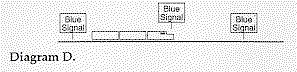
On a Main Track. A blue signal must be displayed at each end of the rolling equipment.

On Other than a Main Track. One of these three methods of protection or a combination of these methods must be provided:

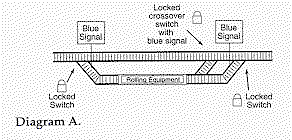
Each manually operated switch that provides direct access must be lined against movement onto the track and secured by an effective locking device. A blue signal must be placed at or near each such switch. In addition, any facing point crossover switch must be lined against movement and secured by an effective locking device.
Image
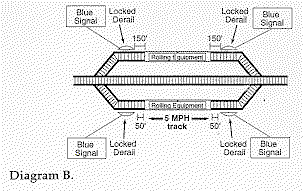
2. A derail capable of restricting access to the track where work will occur must be locked in derailing position with an effective locking device and:

a. Positioned at least 150 feet from the rolling equipment to be protected.

or
b. Positioned at least 50 feet from the end of rolling equipment on a designated engine servicing track or car shop repair track where speed is limited to not more than 5 MPH.
A blue signal must be displayed at each derail.
Image
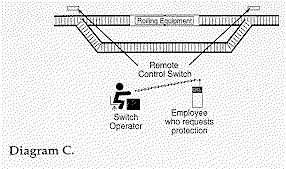
3. Where remote control switches provide direct access, the employee in charge of the workmen must tell the switch operator what work will be done. The switch operator must then:

a. Inform the employee in charge of the workmen that the switches have been lined against movement onto the track and devices controlling the switches have been secured.
b. Not remove the locking devices unless the employee in charge of the workmen says it is safe to do so.
c. Maintain for 15 days a written record of each notification that includes:
Name and craft of the employee in charge of the workmen requesting protection
Identification of track involved.
Date and time the employee in charge of workmen is notified that protection was provided
Date, time, name, and craft of the employee in charge of workmen who authorized removal of the protection
Image
C. Blue Signal Readily Visible to Engineer

In addition to providing protection as required in 'On a Main Track" and "On Other than a Main Track," when workmen are on, under, or between an engine or rolling equipment coupled to an engine:

A blue signal must be attached to the controlling engine.
A blue signal must be visible to the engineer or employee controlling the engine.
The engine must not be moved.
Image
D. Protection for Workmen Inspecting Markers

Blue signal protection must be provided for workmen when they are:

Replacing, repositioning, or repairing a marker, and the rear of the train is on any track.

or
Inspecting a marker by repositioning the activation switch or covering the photo-electric cell, and the rear of the train is on other than a main track.
E. Protection for Emergency Repair Work

If a blue signal is not available for employees performing emergency repairs on, under, or between an engine or rolling equipment coupled to an engine, the employee controlling the engine must be notified and appropriate measures taken to provide protection for the employees.

F. Movement in Engine Servicing Area An engine must not enter a designated engine servicing area until the blue signal protection is removed from the entrance. The engine must stop short of coupling to another engine.

An engine must not leave a designated engine servicing area unless the blue signal is removed from the engine and the track in the direction of movement.

Blue signal protection removed to let engines enter or leave the engine servicing area must be restored immediately after the engine enters or clears the area.

An engine protected by blue signals may be moved on a designated engine servicing area track when:

An authorized employee operates the engine under the direction of the employee in charge of workmen.
The blue signal has been removed from the controlling engine to be repositioned.
Workmen have been warned of the movement.
G. Movement in Car Shop Repair Area When rolling equipment on car shop repair tracks is protected by blue signals, a car mover may reposition the equipment if:

Workmen have been warned of the movement.
An authorized employee operates the car mover under the direction of the employee in charge of workmen.
7.8 Coupling or Moving Cars on Tracks Where Cars are Being Loaded or Unloaded

Before coupling to or moving cars on tracks where cars are being loaded or unloaded, crew members must be sure that all of the following have been removed or cleared:

Persons in, on, or about cars
Platforms
Boards
Tank car couplings and connections
Conveyors
Loading or unloading spouts and similar appliances or connections
Vehicles
Other obstructions
Properly close or secure plug-type and swinging doors on cars.

In addition:

Be careful to avoid damage to freight of partly loaded cars.

Do not handle cars that are improperly or unevenly loaded if load could shift or fall from the car, or if the car could derail or overturn.
Return any car placed for loading or unloading to the location it was found if it has not been released for movement.
Do not pull empty cars from an unloading facility until any major accumulation of debris is removed.

sorry for the wall of text but I hope I've made my point.


Offline
 Profile  
 
 Post subject: Re: Today's Operating Rules in the preservation environment
PostPosted: Thu Mar 07, 2013 8:26 pm 

Joined: Thu Aug 19, 2010 11:08 am
Posts: 220
Location: Whitefield, ME
First, I'm curious; is the blue signal rule above from the GCOR? if iit is, it is way more wordy and involved than the comparable NORAC rule.

As I said when I first posed the question above, we use NORAC, and are quite happy with the results. You really needn't teach every rule. I would think that most museums are not signaled and therefore operate under some equivalent of DCS (form D control system). You can skip the entire section on ABS.
I feel that when you do your rules review, it is best to focus on relevant situations that apply to your operation. If someone understands that they will need to recall the information in the future, they are more likely to remember it. For a long time I was a "twice-a-monther", and I know it can be difficult to retain the rules, but it is critical for volunteers to remember the bigger picture.. we are still carrying passengers who must be kept safe at all times.
I think many of you have the right idea when it comes to applying various rules in a safe manner. Best wishes on continued safe operations to all of you in the upcoming year.

Steve Piwowarski


Offline
 Profile  
 
 Post subject: Re: Today's Operating Rules in the preservation environment
PostPosted: Thu Mar 07, 2013 11:31 pm 

Joined: Sun Aug 22, 2004 1:51 pm
Posts: 12150
Location: Somewhere east of Prescott, AZ along the old Santa Fe "Prescott & Eastern"
stephenpiwowarski wrote:
As I said when I first posed the question above, we use NORAC, and are quite happy with the results. You really needn't teach every rule.


This is contrary to what others upthread are saying.

They're claiming that if it's IN the book YOU USE, they HAVE to LEARN it and BE TESTED on it. Others seem to be saying you can ignore entire "not applicable" sections. Does the Gospel According To Saint NORAC /GCOR explicitly say "if this section is not applicable you are free to ignore it"?

This is not like buying a car repair manual and being able to rip out the pages that don't apply to you (let's see, I don't need the section on automatic transmissions, I don't have air conditioning, and I have the inline four, not the V-6, so....). I also don't get to say "I'll never parallel park in rural Pennsyltuckey so I don't need to learn that stuff."


Offline
 Profile  
 
 Post subject: Re: Today's Operating Rules in the preservation environment
PostPosted: Fri Mar 08, 2013 1:43 am 

Joined: Mon Aug 23, 2004 12:37 pm
Posts: 451
Location: Missoula MT
robertmacdowell wrote:


I am discontent with your use of the term "dumbed down". You have it backwards. A shorter, more concise rulebook presumes that a person can think, and can consider the obvious effects of their actions. Whereas a "dumbed down" rulebook has to spin out every possibility in chapter and verse, and of course every boring chapter and verse must be memorized and tested.

Consider the two rules. How you would teach each of these alternate rules in a class? You have 20 minutes of class time. Which rule is more inclusive and why? Which would you rather a volunteer memorize?

Are volunteers better served by the guy who wrote:
14. Before coupling onto or moving cars, check to see that all persons in, under, or about the cars are in the clear and that all blocks, hoses, and electrical cords are removed. A blue flag, light or sign indicates that workmen are in, under, or around the car, engine or train upon which it is displayed. A car bearing this indication must not be coupled or moved or have the trolley pole or pantograph raised until the flag, light, or sign has been removed by the persons who placed it there.


--- *** OR *** ---

Are volunteers better served by the guy who wrote:
5.13 Blue Signal Protection of Workmen

This rule outlines the requirements for protecting railroad workmen who are inspecting, testing, repairing, and servicing rolling equipment. In particular, because these tasks require the workmen to work on, under, or between rolling equipment, workmen are exposed to potential injury from moving equipment.

<snip to the nth power>[


sorry for the wall of text but I hope I've made my point.


At one point I gave thought to generating a rules book for the railroad I was involved with and it would have been a selection of some (but not all) rules from the 1967 edition of GCOR--which lists the blue flag rule above as this:

"INSPECTION AND REPAIR PROTECTION

Rule 26. A blue flag or blue light, displayed at one or both ends of an engine, car or train, indicates that workmen are under or about it; when thus protected it must not be coupled to or moved. Other equipment must not be placed on the same track,so as to intercept the view of the blue signals, without first notifying the workmen. Each class of workmen will display the blue signals tand the same workmen are alone authorized to remove them.

When emergency repair work is to be done under the engine, or under or about cars in a train and a blue signal is not available the engineer must to notified by a member of the crew and protection given those engage in making the repairs. Train or engine must not be moved, nor air brakes applied or released until all employes are out from under or from between cars, and the engineer so advised by the same employe."


This is far more clear and obvious than what I assume is a current version of NORAC. Frankly, the modern code looks tailor made to let management whack an employee for some infraction or other--when it is the very complexity and CYA nature of the code that renders it ineffective, or so cumbersome as to negate its utility.

Were I writing a rules book today, I know which model I would NOT use.

Michael Seitz
Missoula MT


Offline
 Profile  
 
 Post subject: Re: Today's Operating Rules in the preservation environment
PostPosted: Fri Mar 08, 2013 2:11 am 

Joined: Sun Aug 22, 2004 11:54 pm
Posts: 2605
"Simplify the bloated, picayune lawyer-talk in GCOR/NORAC. "

That would be nice, but it's not likely, whether you use those rules or not. I can see the day when there are no rule books, you'll just cart around a copy of 49CFR 200-399 with you.

One of the people who used to post here once gave a speech , that among other things expressed surprise at how many lawyers and how few railroaders work at the FRA. My copy is one of my treasured possessions.

You need to understand one of the principal purposes for administrative rule making is to allow legislators to pass noble sounding laws, but allow specialists to write the rules.

Specialists are of course experts, and experts are people who know more and more about less and less.

There is plenty of evidence that federal rules are diminishing in quality, because the principal requirement to work at a federal agency today seems to be the possession of a law degree and an absence of any actual experience, in addition to the barrage of equally bad legislation in recent years.

It's important to understand how many of the elite law school graduates (present company excepted) see themselves as philosopher kings completely capable interjecting themselves in any other profession. This attitude was driven home to me a few years ago when I ran across an acerbic bromide in the Connecticut Law Review called "The Most Dangerous Profession" written about accounting, by one Rebecca Roiphe, now a law professor in Gotham.

I'm pretty sure similar folks who crafted the tedium that is 49CFR242 did wonderfully in moot court but couldn't throw a switch to save their lives.


Offline
 Profile  
 
 Post subject: Re: Today's Operating Rules in the preservation environment
PostPosted: Fri Mar 08, 2013 9:38 am 

Joined: Thu May 05, 2011 8:36 am
Posts: 159
Alexander D. Mitchell IV wrote:
stephenpiwowarski wrote:
As I said when I first posed the question above, we use NORAC, and are quite happy with the results. You really needn't teach every rule.


This is contrary to what others upthread are saying.

They're claiming that if it's IN the book YOU USE, they HAVE to LEARN it and BE TESTED on it. Others seem to be saying you can ignore entire "not applicable" sections. Does the Gospel According To Saint NORAC /GCOR explicitly say "if this section is not applicable you are free to ignore it"?

This is not like buying a car repair manual and being able to rip out the pages that don't apply to you (let's see, I don't need the section on automatic transmissions, I don't have air conditioning, and I have the inline four, not the V-6, so....). I also don't get to say "I'll never parallel park in rural Pennsyltuckey so I don't need to learn that stuff."


I'm sorry to say this, but.....this is one time when I will come right out and say that you really don't know what your talking about (in this case). You don't have to teach every rule. And no matter how you try and justify it....they don't teach every single rule in the book. Never have, and never will. It's the responsibility of every "Employee" or "Member" in the operations department to know the rules. It takes years and years to learn every rule in the book....
Now if the museums are trying to teach every rule in the rulebook, and make the guys spit it back verbatum....I can see why NORAC and GCOR would not be a good fit. Now I understand where some are coming from.


And to Mr. Macdowell, the only rule that I have had to memorize and spit back in the past 15 years is the rule for restricted speed. I have never been asked to write another rule verbatum.

_________________
Brett Goertemoeller
Chief Operations Officer
American Steam Railroad


Offline
 Profile  
 
 Post subject: Re: Today's Operating Rules in the preservation environment
PostPosted: Fri Mar 08, 2013 12:08 pm 

Joined: Sun Aug 22, 2004 1:51 pm
Posts: 12150
Location: Somewhere east of Prescott, AZ along the old Santa Fe "Prescott & Eastern"
brettcog2000 wrote:
I'm sorry to say this, but.....this is one time when I will come right out and say that you really don't know what your talking about (in this case).


Quite possible. But I'm not the one saying this:

Quote:
Remember that if you put it in print and say that it is your rule book, you are expected to adhere to ALL of the rules! What I mean by this is that you can not then pick and choose which ones you want to follow. Remember the lawyers and ambulance chasers. If something happens the question will be why didn't you follow all of the rules in your "book". Do not put it in your book if you are not going to use it!

I've seen an issue on an operating freight railroad where they adopted "Norac" as their rule book. When the FRA man visited he asked where the dispatcher was. Problem was, they didn't operate on dispatcher rules, but it is in the NORAC book, so it became expected of them.


This is not the only such anecdote I've heard about either the FRA nor other Federal or state inspectors, in railroad and non-railroad environments. We can make up anecdotes about an FRA guy insisting there needs to be a "dead man's pedal" or alerter system on a horse-drawn car or steam locomotive, but it's probably happened or is coming shortly.

If the FRA doesn't know you exist, carry on and make 'em up as you go, as far as I'm concerned. ("That's a joke, boy, A JOKE!!") Drag in outside regulators, however, and watch the fun.

I once showed up at a location where a crew had taken upon themselves to pull out a baggage car from a storage track, using one of the stored locomotives, before the rest of the folks (including the locomotive and car owner's representative). I watched as, stoically and calmly, the loco owner rep stood there, gears churning in his accountant head as he looked quizzically at where the car was now, and then he finally went up to the guy who had started up the locomotive and switching, and said, "You do realize that if the FRA ever gets wind of what just happened when I wasn't looking, we're up to at least $40,000 in fines? Maybe fifty grand?" The trackage was in a nice little "gray area" where they had been arguing whether or not the FRA had oversight or not; at the time, they had to assume "yes" unless otherwise proven.


Offline
 Profile  
 
 Post subject: Re: Today's Operating Rules in the preservation environment
PostPosted: Fri Mar 08, 2013 12:26 pm 

Joined: Sun Aug 22, 2004 11:54 pm
Posts: 2605
"you are expected to adhere to ALL of the rules!"

If they apply. Consider cab signals, which are absent from entire railroads. You can't comply with nonapplicable rules.


Offline
 Profile  
 
 Post subject: Re: Today's Operating Rules in the preservation environment
PostPosted: Fri Mar 08, 2013 3:20 pm 

Joined: Sun Aug 22, 2004 7:19 am
Posts: 6464
Location: southeastern USA
I think we're getting out into the fringes of sensibility here.......if you don't have cab signals, don't have any rules in your book that deal with them. No problem?

Machiavelli encouraged a Wise Prince to never decree any law that was not necessary, was unenforceable, or that the prince did not have the motivation or ability to enforce. Surely we can still see the wisdom in that approach?

dave

_________________
“God, the beautiful racket of it all: the sighing and hissing, the rattle and clack of the cars over the rails. These were the sounds that made America the greatest country on earth." Jonathan Evison


Offline
 Profile  
 
 Post subject: Re: Today's Operating Rules in the preservation environment
PostPosted: Fri Mar 08, 2013 9:35 pm 

Joined: Fri Mar 05, 2010 3:41 am
Posts: 3971
Location: Inwood, W.Va.
Hot Metal wrote:
If I was charged with creating a rulebook for a tourist railroad, I would probably start with NORAC, find the rules that apply to our operation and throw out the rest. Then think if there are any special operational aspects of our railroad that need to be codified and add those rules. K.I.S.S. !!!


Dave wrote:
I think we're getting out into the fringes of sensibility here.......if you don't have cab signals, don't have any rules in your book that deal with them. No problem?

Machiavelli encouraged a Wise Prince to never decree any law that was not necessary, was unenforceable, or that the prince did not have the motivation or ability to enforce. Surely we can still see the wisdom in that approach?


I've seen a real precedent for this. About a year ago, I saw a copy of an East Broad Top operating rule book from about 1950 or so at a local book store in Hagerstown, Md. (wish I'd had the money for it at the time!). It was essentially the standard rule book you would have seen on any railroad, except that it was greatly edited down to just timetable and train order operation on a single track line. No rules about automatic block signal indications, no rules for double or multiple tracks, no radio rules, no CTC or cab signal rules--all things you would find in books for a Class I. Volume was very thin in comparison because it didn't have what the EBT didn't need.

Sounds like a good approach for a tourist road, even if your operation is essentially just a "yard limit" type of run.


Offline
 Profile  
 
 Post subject: Re: Today's Operating Rules in the preservation environment
PostPosted: Sat Mar 09, 2013 1:21 am 

Joined: Thu Nov 22, 2007 5:46 am
Posts: 2611
Location: S.F. Bay Area
Yeah, I could maybe see that, and perhaps that's exactly what WRM did to produce their 8-page rulebook. But it still takes a lot of writing and condensing. When I was involved in SMRS rulebook #1, we didn't cut or edit nearly enough, and we ended up with a monster.

This is where our needs differ from Class I's. We want a simple small rulebook. Because you want people to carry it. And read it. You want language that draws people in and makes them think about the rule, not make their eyes glaze over!

Roll back to the 2 rules I quoted. (previous WRM rulebook, and GCOR 6th Ed.) Pick one. Now, read it.

See what I mean? It just happened just now. You actually read the short rule. You did not read the other one.

Now, tell me again. Do you want your volunteers to carry and read your rulebook?


Offline
 Profile  
 
 Post subject: Re: Today's Operating Rules in the preservation environment
PostPosted: Sat Mar 09, 2013 1:59 am 

Joined: Mon Aug 23, 2004 12:59 pm
Posts: 650
robertmacdowell wrote:
This is where our needs differ from Class I's. We want a simple small rulebook. Because you want people to carry it. And read it. You want language that draws people in and makes them think about the rule, not make their eyes glaze over!

I think this is exactly why in California we give aspiring drivers a Driver's Handbook to study and be examined on rather than the California Vehicle Code. The Handbook is more of a commentary on the law, and is probably a lot better teaching tool.


Offline
 Profile  
 
 Post subject: Re: Today's Operating Rules in the preservation environment
PostPosted: Sat Mar 09, 2013 3:28 am 

Joined: Mon Aug 23, 2004 3:01 pm
Posts: 1755
Location: SouthEast Pennsylvania
Tyburn RR followed the New Hope & Ivyland RR's original example and abridged a Reading Company rule book, with some revisions to agree with current parts of Title 49 of the Code of Federal Regulations. Mnagement did want some changes. They had the entire book printed in CAPITAL LETTERS, so the employees would know that the rules were being SHOUTED at them. The other 2 didn't make it into print. They wanted different rule numbers than anyone else, so Tyburn employees wouldn't learn anything useful at another railroad, and they were uncomfortable with the idea that the Engineer should stop the train if he ceased receiving radio instructions from the crew. They did not want the engineer to be blamed if something went wrong.


Offline
 Profile  
 
Display posts from previous:  Sort by  
Post new topic Reply to topic  [ 38 posts ]  Go to page Previous  1, 2, 3  Next

All times are UTC - 5 hours [ DST ]


You cannot post new topics in this forum
You cannot reply to topics in this forum
You cannot edit your posts in this forum
You cannot delete your posts in this forum
You cannot post attachments in this forum

Search for:
Jump to: