It is currently Thu Oct 01, 2026 2:05 am

All times are UTC - 5 hours [ DST ]


Post new topic Reply to topic  [ 9 posts ] 
Author Message
 Post subject: Can anyone help me identify these tender trucks?
PostPosted: Sun Mar 07, 2021 11:53 pm 

Joined: Mon Jun 03, 2019 8:46 pm
Posts: 26
Location: Centreville, VA
Hi all,

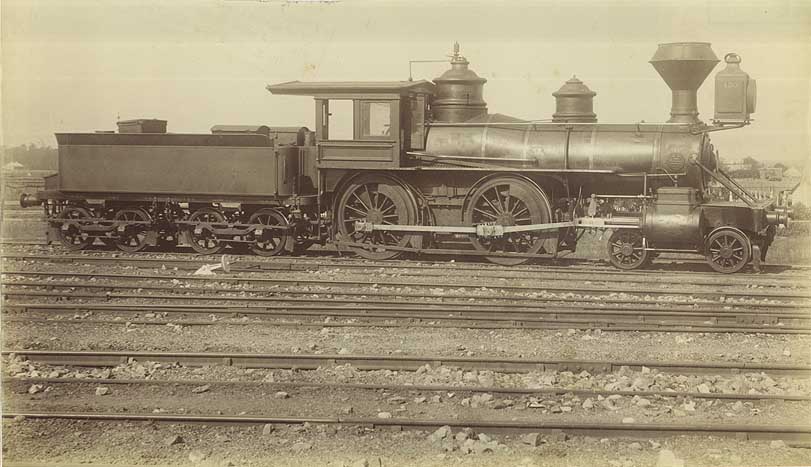
I recently discovered this photograph online and I was wondering if anybody was familiar with the type of trucks underneath this locomotive's tender? I tried searching around the web for pictures of locomotives with similar designed tender trucks, but I found nothing. Unfortunately, I was also unable to find any information relating to this specific locomotive so I don't know which road it operated on or it's heritage. If anybody has any information about the tender trucks, including the possible manufacturer, please let me know. Also, for my own curiosity, if anybody can identify this locomotive, please let me know.

Thanks,

Nick

Image

_________________
Your friendly neighborhood Ferroequinologist.


Offline
 Profile  
 
 Post subject: Re: Can anyone help me identify these tender trucks?
PostPosted: Mon Mar 08, 2021 7:14 pm 

Joined: Sun Apr 02, 2017 3:13 am
Posts: 136
A very similar loco was imported by the NSWGR to Australia in 1877, numbered U130. Built by Baldwin. Doesn't have the "upside down" springing tender bogies.

Image


Offline
 Profile  
 
 Post subject: Re: Can anyone help me identify these tender trucks?
PostPosted: Tue Mar 09, 2021 1:03 am 

Joined: Mon Jun 03, 2019 8:46 pm
Posts: 26
Location: Centreville, VA
Thanks for the reply. This locomotive could very well be a Baldwin product of the same time period as there are quite a few similar characteristics. Unfortunately, as I stated earlier, I don't know very much about this locomotive so I can't confirm anything. Honestly, I was hoping that identifying the trucks, which are quite unique, would shed light on the identity of this engine. Alas, the search continues.

If anybody has a photograph of a locomotive with a similar tender truck design, that would be immensely helpful in unravelling this mystery.

Thanks again,

Nick

_________________
Your friendly neighborhood Ferroequinologist.


Offline
 Profile  
 
 Post subject: Re: Can anyone help me identify these tender trucks?
PostPosted: Tue Mar 09, 2021 1:04 pm 

Joined: Sun May 15, 2005 2:22 pm
Posts: 1543
I cannot identify those trucks as to manufacturer. However, it seems to me that there were lots of truck design variation in that era that resulted in many differing truck types being produced with a lot of hand work in very small production runs. Some of this development was done by locomotive manufacturers, but I suspect much was done by the railroads who owned the locomotives. Furthermore, articles of those production runs were likely rebuilt and modified over their time in use.

I have seen quite as few photos of trucks similar to the ones in the photo of #12, in that they have an elliptical spring being used as an equalizing lever. If they cannot be identified as to a manufacturer of just a commonly used design pattern, maybe they will at least show up in other photos. The photo posted is quite clear in the detail showing on the outside of the trucks. So, it is possible that another photo will show a perfect match. I will take a look at some books I have covering the Civil War era and into the 1880s

In the case of this truck, the mechanism showing on the sides is fairly easy to understand, but the rest of the frame, bolster, and cross transom are not shown, and there could be some unusual details with those features.

I assume that the weight is transferred to the tops of the elliptical springs by a truck bolter that is almost completely hidden. Just the outer tip of it may show above the upward arch of the spring. The spring transfers its loading by swing hangers up to the heavy bar at the highest elevation in the side frame view. The heavy bar then transfers its suspended load to the top of each journal box.

There appears to be a an iron bar frame in a rectangle pattern that carries the brake hangers, and likely serves some additional structural purpose, but that is not clear to me. The frame appears to have large radiused bends at each corner. Assuming that the four wheels are free to move up and down independently with the spring flexing, it would seem that the large rectangular frame would have to flex-twist in order to accommodate the up/down travel of the wheels.

Also, I have seen photos of quite a few 4-4-0s with two different types of pony truck wheels, typically spoked and plate wheels. Sometimes it appears that the two wheels on the sides of such trucks are also a different diameter. That appears to be the case with the photo of the locomotive #12. Especially if you look at the enlarged version of the photo, you can see a significant difference in the diameter of the spoked wheel and the plate wheel. The size difference appears to be a design feature because the truck frame appears to be parallel with the tops of the rails. So the frame mounting for the two diameters of wheelsets must be at different elevations on the truck frame.


Offline
 Profile  
 
 Post subject: Re: Can anyone help me identify these tender trucks?
PostPosted: Tue Mar 09, 2021 3:46 pm 

Joined: Mon Jun 03, 2019 8:46 pm
Posts: 26
Location: Centreville, VA
Thank you so much for your detailed observations. After further examination of the image, it does appear that the pilot wheels are indeed of different diameters with the spoked wheel being the larger of the two wheel sets.

Any photographs that you could provide of a locomotive with a similar design to #12 would be very much appreciated!

Thanks again,

Nick

_________________
Your friendly neighborhood Ferroequinologist.


Offline
 Profile  
 
 Post subject: Re: Can anyone help me identify these tender trucks?
PostPosted: Tue Mar 09, 2021 9:58 pm 

Joined: Wed Nov 23, 2016 7:05 pm
Posts: 283
Scroll down and have a look at L&F engine of 1863 here - http://lexhistory.org/wikilex/lexington-frankfort-railroad. I'd say it looks very much like a Baldwin product of 1863-1866. Hard to see the sand dome top ring, but it may be like the style on LVRR "Consolidation", the reputed first of the type built in 1866 or L&F's "Woodford". At first I thought it might be 5 foot gauge, but now I'm leaning toward standard (or maybe 4'9"). Drivers look like 56" or 57", a small chance they're 60" if the people are short.

I agree with Ron - there were many master mechanics with their own ideas on tender truck design and this was probably a small lot or one-off trial design. I've never seen any exactly like these. One interesting feature is the long plate attached to the bottom of the body sills above the center of the truck equalizing bar - this may be an indication that there's a swing motion to these trucks, or it may be that the equalizing bars are just too darn close to the side sill when the tender is fully loaded and leaning. Either way there must have been a tendency for the equalizing bar to try and embed itself into the sill in certain conditions and they needed to provide a hard smooth surface to prevent that and keep the truck free.

I don't see any real reason for there to be much flex in the truck frame as Ron said though - there's plenty of movement provided for in the equalization. Here's a quick sketch of a level version vs. the EQ in full rotation on a still-level frame.
The continuous bar frame is really just to keep the journal boxes and wheelsets in proper relation to the bolster/centerplate laterally and longitudinally, but not vertically.


Attachments:
truck eq.png
truck eq.png [ 81.17 KiB | Viewed 6090 times ]

_________________
G.
______________________________________
Radio crackles - "What the #^(& did we just hit, over?"


Last edited by TrainDetainer on Wed Mar 10, 2021 6:28 pm, edited 1 time in total.
Offline
 Profile  
 
 Post subject: Re: Can anyone help me identify these tender trucks?
PostPosted: Wed Mar 10, 2021 1:32 pm 

Joined: Mon Jun 03, 2019 8:46 pm
Posts: 26
Location: Centreville, VA
So, after scouring the Baldwin locomotive records for a couple of hours, I have narrowed down some possible locomotives that fit the criteria you lined out. Here is the list including builders numbers:

- Memphis, Clarksville, & Louisville Railroad #12 c/n 1191 (Formerly a U.S. Military Railroad engine.)
- Louisville, Cincinnati, & Lexington Railroad #12 "Gill" c/n 1227 (Interestingly, Was formerly owned by the Louisville & Frankfort Railroad mentioned earlier in the thread.)
- Western Railway of Alabama #12 c/n 1496
- Union Pacific #12 c/n 1540 (probably not this engine as it was renumbered very early on in it's career.)
- Oil Creek & Allegheny River Railroad #12 c/n 1556

All these locomotives were constructed between 1863 and 1866 based off of the information provided in my copy of the records.

Hopefully, I can find some photographs of these locomotives in order to campare them to mystery #12.

Thanks,

Nick

_________________
Your friendly neighborhood Ferroequinologist.


Offline
 Profile  
 
 Post subject: Re: Can anyone help me identify these tender trucks?
PostPosted: Wed Mar 10, 2021 8:39 pm 

Joined: Sun May 15, 2005 2:22 pm
Posts: 1543
Baldwin locomotive named "The Consolidation" built for Lehigh and Mahanoy Railroad in 1866, and it shows the same truck design as on the photo above of #12. The Consolidation can be seen down a little ways from the top of this roster of Lehigh Valley RR. There are many interesting, early locomotives shown in this roster starting at the beginning at the top of the page.

https://scotlawrence.github.io/LValltimeroster/

It is also shown in John White’s book called American Locomotives (1997 edition), page 431-436. The section includes many drawings of The Consolidation, including the tender truck details. There is even a cross section of the trucks showing the bolster timber extending what appear to be short iron fingers that bear on the tops of the elliptical spring arches.

Also, in White’s book on page 406 is locomotive named, "Santiago De Cuba" with a good photo of the same tender trucks. It was built by Baldwin in 1866. The photo is printed rather small, but it is obvious that the resolution is very high, so it could be copied and enlarged to better study the details.

Also, page 358-365 shows locomotive named, "Talisman," 4-4-0, built 1857 by New Jersey Locomotive and Machine Company, with an excellent detail drawing of the same tender trucks.

Page 231 shows a photo of the tender for the Cleveland and Pittsburgh Railroad by Baldwin in 1860 with the same tender trucks. Photo is a direct side view of high resolution.

On the front dust jacket, there is a color lithograph of locomotive named, "Tiger" built by Baldwin in 1856 for Pennsylvania Railroad.

I would have to study these drawings and photos of these locomotives since there are some indications that the tender trucks are not precisely identical, but they are at least very close.

So, I would conclude that this truck design was quite common starting around 1860. It may have been built mostly by Baldwin, but maybe other builders as well. This is the first book I checked, and I have some others by George Abdill. One is about Civil War era railroads. As I recall, there seemed to be quite a few 4-4-0s in that book that showed elliptical springs on the sides of tender trucks in various arrangements.

One variation is to have one elliptical spring over each journal box with the spring arch facing down. Then there is an equalizing lever on hangers on the ends of the springs nearest to each other. The far ends of the springs are on hangers with their lower ends fixed to the truck frames. This is basically the pattern commonly used on later day steam locomotive driver equalization.

The other three Abdill books are post-Civil war, but just packed with photos of engines from circa 1860-1880. I just have to figure out where I have those books stored.


Offline
 Profile  
 
 Post subject: Re: Can anyone help me identify these tender trucks?
PostPosted: Wed Mar 10, 2021 10:41 pm 

Joined: Sat Jan 18, 2020 1:12 am
Posts: 42
Before he was an author, George B. Abdill was an Oregon boy and then a working railroader for the Southern Pacific in Oregon. Some of his books were the first I encountered on railroads and the first I owned. I remember at the time wondering why an Oregon railroader collected so many photos from other places and wrote about them. His interest in and collection of early locomotive photos was impressive.

He ended up in Roseburg, Oregon where for the purposes of this post it helps to know (if I remember correctly from stopping in there) he served for a time as the curator of the Douglas County Museum which retains whatever remains of his collection.

So any of his photographs published in his books may in fact still exist there and be available for higher resolution research.


Offline
 Profile  
 
Display posts from previous:  Sort by  
Post new topic Reply to topic  [ 9 posts ] 

All times are UTC - 5 hours [ DST ]


You cannot post new topics in this forum
You cannot reply to topics in this forum
You cannot edit your posts in this forum
You cannot delete your posts in this forum
You cannot post attachments in this forum

Jump to: