It is currently Fri Aug 21, 2026 10:58 am

All times are UTC - 5 hours [ DST ]


Post new topic Reply to topic  [ 12 posts ] 
Author Message
 Post subject: The Brockton Boiler Explosion. *PIC*
PostPosted: Sun Feb 15, 2004 12:33 pm 

As excerpted from the April 1905 HSB Journal "The Locomotive"

At a few minutes before eight o'clock, on the morning of March 20, 1905, a terrible boiler explosion occurred at Brockton, Mass., in the factory of R. B. Grover & Company, manufacturers of the Emerson shoe. The explosion and its effects were awful, beyond all description. The entire country was profoundly shocked, and Brockton itself was overwhelmed with horror and grief.

On Monday morning, March 20, without the slightest warning, boiler No. 2 exploded with extreme violence, destroying the boiler house, and also blowing down, instantly, the entire Denton Street wing of the main building, and a considerable part of the Calmar Street section. Fire broke out within a few minutes of the explosion, it being caused, in our opinion, the open gas jets which were necessarily used in the process of shoe manufacturing. The ruins burned fiercely, partly because the wood work was very dry, partly because of the escape of the gas, and of the naphtha that was used in the manufacturing processes, and partly (we are informed) because the floors were more or less saturated with oily matters. We do not desire to give the impression that the factory was regarded as a poor fire risk, however, for we understand that it was insured by the fire companies at a rather low rate, indicating that they did not anticipate any very serious fire. The building was also furnished with automatic sprinkling apparatus, but this, of course, was rendered useless by the breaking of the pipes, when the building fell. The entire building was quickly destroyed by the flames, including the "new building," which remained standing, as well as the part that was thrown down by the explosion.

At time of the explosion there were about 400 persons working in the factory, 200 of whom were in the part of the building which collapsed. Many of the 200 who were thrown down with the ruins were imprisoned by the wreckage, and were killed by the flames, before they could be extricated by the rescuing party. The scenes at the ruins were heartrending, and beggar description. Let us pass them over reverently. We should like to record the fact, however, that there were many notable exhibitions of heroism, both on the part of the dying and of the rescue party. It is not on the Battlefield alone that heroism is seen. The flames were roaring fiercely, and the time that the work of rescue could be continued was all too short. Numbers of those who were badly hurt begged the rescuers to pass them by, and save others. Many who could not be reached cried out messages of love and remembrance for their friends that would shortly know them no more. Concerning the deeds of the rescue party, we desire particularly to mention those of the Rev. Father J. M. Keleher, pastor of St. Margaret's Church, and of his curate, Rev. Father James O'Rourke. The former risked his life repeatedly in aiding in the rescue, while many of his parishioners were burned to death before him. Father O'Rourke was among the first at the scene. He rescued seven persons, and continued at work until he was overcome by the smoke and the exertion, and was physically unable to do more. Of the 200 persons in the collapsed part of the building, no less than 58 died, either in the ruins or after being removed, and 117 others were injured. Most of the bodies in the ruins were burned beyond recognition, and identification had to be effected, in many cases, by the aid of buttons or trinkets, after the fire had been controlled. Even by these means it was found to be impossible to identify more than 17 or 18 of the bodies, and the remainder were buried by the city of Brockton, public burial services being held on the day of the funeral at five different places simultaneously, including the churches and the City Theater.

The exploded boiler was of the horizontal tubular type, was built in 1891 by E. Kendall & Sons of Cambridgeport, Mass., and had been inspected and insured during this entire period. It was first inspected in the boiler-maker's shop on October 10, 1891, when it was thoroughly examined in every respect, and was also subjected to a hydrostatic test of 150 pounds to the square inch. It was 72in. in diameter and 17 feet long, and was built of four courses of plates, the plates being 3/8 in. thick, one plate to a course. The heads were ½ in. thick, and there were 140 three-inch tubes. The seams were double-riveted lap seams. (We shall return to this point subsequently.) The boiler gave way at the longitudinal riveted seam on the rear course of plates, this course and the rear head being torn from the rest of the shell, the rear sheet being found near its original position, while the head was carried forward for a distance of 42 feet. The remaining portion of the boiler, consisting of the three forward courses of plates, the front head, and the tubes, was projected in a direction nearly parallel to Denton Street, to a distance of 211 feet.

The last internal inspection of the boiler was made on December 28, 1904, at which time no defects were found; and the inspector, after a thorough examination, pronounced the boiler perfectly safe for continued service. So far as the records show (and all the testimony given by employed of the Grover Company corroborate these records) the boiler was not in service at any time since that last inspection, until it was fired up on Sunday, March 19, the day before the explosion; the larger boiler (No. 1) being then put out of service. The inspector having reported, on December 28th, that the boiler was in good condition and free from defects, why did it explode practically as soon as it was fired up again? In cases of this sort we generally hear a great deal said about low water, and the carelessness of the engineer. In the present instance there was but little talk of this nature. There is no evidence that the engineer was negligent in any respect, and there is, on the contrary, plenty of evidence that there was a proper quantity of water in the boiler. The condition of the fusible plug alone would be sufficient evidence on this point. The Massachusetts law requires that every boiler shall be provided with a fusible plug, filled with tin or some other substance melting at a low temperature; this plug being so situated that it will be covered with water (and therefore prevented from melting) so long as the water in the boiler is at a safe level, but will be uncovered (and therefore exposed to the heat of the furnace without protection) when the water level falls to a dangerous point. In case the water in the boiler becomes dangerously low, the fusible plug is supposed to melt and permit the steam in the boiler to escape; the pressure being thereby reduced, and the engineer's attention directed to the fact that the boiler has too little water. This boiler was provided with such a plug, and after the explosion the plug was found to be in good condition, and unmelted.

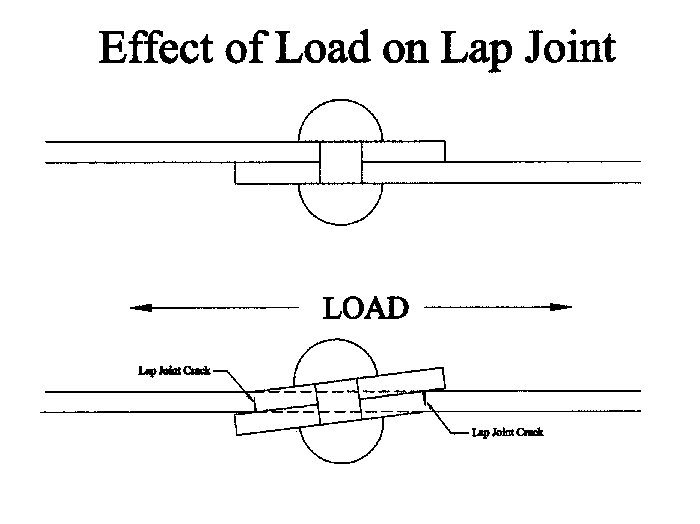
The real cause of the explosion appears to have been a defect that is technically known as a "lap-joint crack" in the outer sheet, where that lapped over the inner one, in the rear course of the boiler. "Lap-joint cracks" are well-known sources of danger in boilers, and they are diligently sought for by inspectors. They may occur in either the inner or outer lap of the joint, and they invariably start from the interior surface, where the two plates are in contact, then extending into and through the plate, until its strength is practically destroyed. When a crack of this character has developed to such an extent that the plate is actually perforated at some point, it is possible for the inspector to detect the defect. It is common, however, for such a crack to penetrate the plate quite deeply and uniformly, for a considerable distance along the joint, before actual perforation takes place at any point. Detection is then a matter of the greatest difficulty, and (as we confidently believe was the case in the present instance) it may even be actually impossible. We have no positive evidence that the crack in the Brockton boiler existed at the time our inspector made his last visit; but even if it be admitted, for the sake of argument, that it did exist at that time, unless there was an actual perforation of the plate the crack could not be seen either from the inside of the boiler or from the outside; and unless the crack had actually perforated the plate at some point, or had ran into a rivet hole somewhere, its presence could not have been betrayed by even the slightest leakage. If there were any known way of detecting these hidden cracks, insurance inspectors and state inspectors alike would hail its discovery with joy.

The inquest, which was called by District Attorney Asa P. French, technically for the purpose of determining how Richard Sprigings, one of the identified victims, came to his death, but really in order to investigate the cause of the explosion and find out who was to blame for it, was held at Brockton, on March 29th, Judge F. M. Bixby presiding. Fifteen witnesses were examined in all. Three of them, comprising the medical examiner, the city marshal, and an employee in the fated factory, testified as to the death of Richard Sprigings. Three other witnesses told about the exploded boiler. In this group was the man who made the boiler, the man who bought it, and the man who last inspected it. Then came five boiler experts, including two state inspectors of steam boilers and three inspectors of boiler insurance companies, who told of the characteristics of the type of boiler which exploded-i.e., the lap-seam boiler. They corroborated one another in all essential points, chief of which was the liability of the development of the "lap-joint crack," and the impossibility of discovering it by any known test. The last four witnesses testified as to the condition of the engineer on the morning of the explosion, and as to the amount of steam pressure in the boiler as shown by the gauge a few minutes before the explosion. At the conclusion of the inquest, District Attorney French made the following statement: "No evidence has been presented to me to show the criminal responsibility of any person for this explosion, which caused such a large loss of life, and in which the public is so deeply interested. The explosion was due to a danger peculiar to this class of boilers, a danger in the structural form of the boiler, almost impossible of detection, and therefore a defect all the more dangerous because so subtle. To paraphrase an old saying, I would say that the person morally responsible for this explosion and the loss of life is the man who devised this particular type of boiler." (That is, the lap-joint boiler.)


Image


 Post subject: Re: The Brockton Boiler Explosion. *PIC*
PostPosted: Sun Feb 15, 2004 3:27 pm 

I seem to be in a contrary mood today, but here are a couple of photos of SP loco boiler explosions with double rivet lap seams. Probably the 10 wheelers talked about in an earlier posting. It’s interesting to note that the initial failure was at right angles to the seam and the failure propagated across the boiler course which would indicate that the lap seam was actually stronger than the metal of the course. Where the failure followed the seam, it followed the rivet holes indicating that the forces exceeded the tensile strength of the metal rather than the failure mode you are concerned with. The photo on the right is the result of another SP engine exploding in 1912 in San Antonio, TX, killing twenty-six people (1912 seems to have been a bad year for the SP!). The photo is on a different page and the caption included does not refer to the photo on the right. Again, a double riveted lap seam boiler in which the failure followed the rivet holes rather than the area of bending you describe. While the failure mode you describe seems to intuitively likely, perhaps its not as bad as expected in real life. Photos are from “Train Wrecks” by Robert C. Reed of 1968.

Ed


Image


 Post subject: Re: The Brockton Boiler Explosion.
PostPosted: Sun Feb 15, 2004 4:32 pm 

Unless I misunderstand the photos it seems the seam which is at right angles to the failure is the girth seam rather than the longitudinal seam which is the seam in question in the current lap seam discussion.

dave

irondave@bellsouth.net


 Post subject: Re: The Brockton Boiler Explosion.
PostPosted: Sun Feb 15, 2004 5:34 pm 

> Unless I misunderstand the photos it seems
> the seam which is at right angles to the
> failure is the girth seam rather than the
> longitudinal seam which is the seam in
> question in the current lap seam discussion.

> dave I didn't see anything in the account of the Brockton explosion to indicate that it had been subjected to periodic hydro tests since it's manufacture. The account says it was test to 150psi at the time of manufacture. I wonder what the maximum operating pressure was? More to the point, I wonder if the boiler had been hydrotested to 125% of working pressure in Dec. 1904 when it was inspected? If the cracks in the sheets at the joint had been starting to form at that time, what is the chances that the hydro test would have caused a noticable failure of the joint and thus prevent the catastrophic failure that resulted understeam?


jamesbane@hotmail.com


 Post subject: Re: The Brockton Boiler Explosion.
PostPosted: Sun Feb 15, 2004 7:36 pm 

My timely question regarding lap seams in service today: is there a reliable NTD technique which can demonstrably detect hidden cracking and undercutting? It seems obvious to me that annual visual inspection of the outer surfaces of the seam may leave some serious situations undiscovered.

dave

irondave@bellsouth.net


 Post subject: Let's just trot out every boiler explosion
PostPosted: Sun Feb 15, 2004 8:06 pm 

of the last 200 hundred years and make damn sure that no body boils enough water to make tea. This is what the rivited/historic boiler opponants do,"my goodness, boilers failed in the past, so in order to prevent future events, the best course is to eliminate boilers"

By this line of evidence presentation, we can prove that sailing ships are inherently dangerous, because 1 in 6 voyages didn't come home, consumption of water causes cholera, and being in public gives you polio.

And, by the way, you have proved my point: boilers with hidden flaws from the factory failed YEARS ago and didn't make it into the preservation era.

When you take into account that there were hundreds of thousands (millions?) of boiler in every day service, most of which hadn't been inspected nor cared for by qualified people, this event was inevitable, especially in veiw of the unregulated era.

Furthermore, many of these old reports include little footnotes about whether or not the operator was known to be sober or not. The historians among you should realize that we had prohibition not because of moralizing zealots, but because big business couldn't find sober help.

Since you are digging thru the archives, go up through the 30's and 40's, and you will note that the majority of catastrophic events happened around the turn of the century, most were human error, and those that were due to a fault in the boiler itself occured to old boilers that were poorly designed during the late 19th century.

And, yes, my UT man tells me that it can detect flaws between joints, and if that ain't good enough, he's got a portable xray rig.


 Post subject: Re: The Brockton Boiler Explosion.
PostPosted: Sun Feb 15, 2004 9:34 pm 

> My timely question regarding lap seams in
> service today: is there a reliable NTD
> technique

Perhaps the NDT to detect such a defect would be X-Ray.


 Post subject: Re: Let's just trot out every boiler explosion
PostPosted: Sun Feb 15, 2004 11:08 pm 

Rev, I've been following the arguments but I think you are pleading before the wrong court.

As far as I can see no one here is arguing that lap seems are inherently unsafe, or need to be banned. Folks are arguing that lap seams are inherently mechanically weaker than other seams, which I do not beleive is seriously disputed. And yes, they are obsolete, in the sense that they were superceded by other types of boiler construction of greater inherent mechanical strength. But to say that something is obsolete is not a swear word here--heck, we're preservationists, everything we deal with is obsolete by the time we get our hands on it, up to and including early-model EMD 567s.

What I'm trying to say is, I don't think you'll find the outright "ban the lap-seams" crowd here--just people advocating that lap-seam boilers be handled in a manner and with a care that their mechanical propoerties demand. The opponents upon which you are training your argument are unlikely actually to be found among the readers here.

eledbetter@rypn.org


 Post subject: Thanks, Eric........
PostPosted: Sun Feb 15, 2004 11:34 pm 

> Rev, I've been following the arguments but I
> think you are pleading before the wrong
> court.

> As far as I can see no one here is arguing
> that lap seems are inherently unsafe, or
> need to be banned. Folks are arguing that
> lap seams are inherently mechanically weaker
> than other seams, which I do not beleive is
> seriously disputed. And yes, they are
> obsolete, in the sense that they were
> superceded by other types of boiler
> construction of greater inherent mechanical
> strength. But to say that something is
> obsolete is not a swear word here--heck,
> we're preservationists, everything we deal
> with is obsolete by the time we get our
> hands on it, up to and including early-model
> EMD 567s.

> What I'm trying to say is, I don't think
> you'll find the outright "ban the
> lap-seams" crowd here--just people
> advocating that lap-seam boilers be handled
> in a manner and with a care that their
> mechanical propoerties demand. The opponents
> upon which you are training your argument
> are unlikely actually to be found among the
> readers here.

Again, point taken.......

If you will allow, I will offer a coupla more observations, then I will shut up.

as to the Brockton explosion

1.A fusible plug not being melted out isn't necesarily an indication the boiler wasn't run low. Old plugs turn to unmeltable oxide, and they were still playing with the mix at the turn of the century. And they were still plying with it till fairly recently. Thats why you need to change 'em out with regularity.

2. Note that the inspectors mentioned were likely either employed by the boiler owner or their insurer, and had a vested interest in deflecting blame from themselvelves or the entity that they represent.

3. This was a plant boiler, likely an HRT, which is a cylinder with a fire underneath and brickworks around it to direct the fire and flue gases back thru the tubes. Since the fire acted directly on the shell itself, there were a lot more heating and cooling dynamics acting on the shell than in an internally fired boiler. If you look at a lot a plant boiler explosions of the era, a lot of the structural failures that took place (seam cracks, ect.) were to these stresses and to mud burns. i think it is fairly telling that the boiler hadn't been fired in a long time.

As to the SP boiler explosion, shell failures of this sort look more like a "grooving" factor rather than weakness in the joint construction.

A qualified, conscientious operator will not knowingly operate an unsafe boiler, so the real goal is education and qualification, not arbitrary rule propagation.


 Post subject: Re: Thanks, Eric........
PostPosted: Mon Feb 16, 2004 8:00 am 

What Erik said......

And agreed that the propagation of rules results more in the propagation of loopholes rather than the elimination of problems.

Which still leaves us with the problem of proving an unreinforced lap seam has no hidden defects, and some case-specific rational basis for periodic retesting.

If radiographics works best, are there good qualified mechanical radiologists out there familiar with examining seams other than welds?

dave

irondave@bellsouth.net


 Post subject: Re: Thanks, Eric........
PostPosted: Mon Feb 16, 2004 8:17 am 

> A qualified, conscientious operator will not
> knowingly operate an unsafe boiler, so the
> real goal is education and qualification,
> not arbitrary rule propagation.

The rules adopted by the FRA address lap seams and point out that they need to be specifically inspected once per year. There was much debate over this but nobody questioned the fact that the longitudinal lap seam has an inherent weakness.

As to inspection, there does not seem to be an absolutely certain method to detect this defect. Radiography and UT may be capable of finding a crack but they also might miss it. This was the concensus of NDE people asked on the subject.

In the real world, how many people are going to RT or UT their lap seam every year? This is coupled with the fact that once a crack develops, it can propogate very quickly.

Our industry cannot afford a failure of this nature. It could put steam out of business. The owner/operators are responsible for the safety of the equipment. Put another way, we are being trusted to do our job. In the hysteria following a major incident, I am not sure that situation would continue.

Anyone who operates this old equipment is at risk. There are a million things that can go wrong. Even with the best inspection, good design, and an aggressive maintenance program, stuff happens. Let's not even talk about human error - last time I looked we were all human and somewhat less than perfect.

There is a reason that repairs are done with third party oversight. Two heads are better than one. The best policy is to follow the regulations, recommendations and practices. If you vary from them, have plenty of data to back up the decision.

From a liability standpoint, the lap seam is a disaster. It is known to have a weakness. A defect developing from that weakness may or may not be detected even with aggressive inspection. I am not a lawyer but that doesn't look so good to me.

Imperical data seems to indicate that the smaller the diameter the less likely the problem. Regardless, longitudinal lap seams should be taken very seriously because, if one lets go, it would be almost impossible, in retrospect, to justify that the boiler was kept in service with that seam.

Strasburg Rail Road
linnwm@supernet.com


 Post subject: Re: Thanks, Eric........
PostPosted: Thu Feb 19, 2004 3:36 am 

Linn is correct. Lap seams are inherently inferior to the more symmetrical butt seam with inner and outer welts. When you couple existing lap seams with the advanced age of these types of surviving boilers there is almost no way you can justify operating them in a public arena. Their history of failure is so overwhelming no qualified engineer could overcome it in a court battle resulting from a catastrophic failure.

More importantly, the rigid inspection, calculation and documentation of current boiler conditions required to complete the Form 4 Maximum Allowable Working Pressure is an exercise of immense responsibility and should only be entrusted to qualified professional engineers who have proven by their licensure that they can be entrusted with "public safety". The FRA rule mandates this work be done by a "competent" person, but does not define competency. Furthermore, my impression of the federal inspectors in this region suggest they are not competent to pass judgement on steam locomotive boiler safety either.

The fact that most Form 4 Cards in the Tourist and Heritage railroad industry are completed over the signatures of non-engineers and otherwise inexperienced people is an indication of the cavalier treatment afforded most old and questionable locomotive boilers. In most states that regulate the practice of engineering (all states now) the completion of a Federal Form 4 Specification card constitutes the practice of engineering and requires the signature and stamp of a qualified, licensed professional engineer. While you can't go to federal prison for filling out a Form 4, you most certainly can go to state prison because you have to practice engineering in the eyes of the state in order to fulfil the federal mandate.

The recent revision of the federal rules governing steam locomotives was supposed to clarify the issues surrounding locomotive boiler inspection and qualification for service. However, my experience tells me this is still a wide open business with the prevailing practices being both unaccountable to current codes and slipshod in general. My recent attempts to network somewhat with people involved in these types of activities has shown almost no concensus on methodologies and little understanding of the utter fundamental importance of proper inspection and NDE as they relate to careful, iterative development of MAWP based on current boiler condition.

There is far too much focus placed on simple plate thickness geometries which leaves no room for pondering the wider implications of overall structural integrity (i.e. is the limiting MAWP in a predictable location or does it turn up in some unpredicted location. If so, why?). I have seen situations where massive replacements of plates are underway to repair extensive, repetitive cracking. Yet, no one, least of all the federal authorities expresses the slightest curiosity about why such cracking has occurred in the first place. Treatment of the symptoms of serious embrittlement or other stress related ills seems to be more important than determining the underlying causes that in many cases would immediately condemn such a dangerous boiler from further service. Furthermore, many of these types of repairs skirt the riveted seams because of the difficulty entailed in seam repairs. Thus, the weakest part of such boilers are completely ignored and the danger is aggravated by indiscreet repair weld seams generating even more localized stresses in these questionable areas. Since cracking of some degree is usually what drives many of these repairs the underlying chemistry and metallurgy of these old boilers should be paramount in determining the causes of cracking. Once the problem is identified then repair or replacement schemes can be prudently developed.

NDE utilizes amazing equipment and techniques that can produce exeptionally clear indications of a pressure vessel's structural anomalies. Nonetheless, interpretation of these results and tempering them with a generous dose of experience and careful intuition is all too often ignored in the overall work of qualifying old boilers for continued service. NDE is a tool, not a replacement for experience and judgement.

Finally, TRAIN, in my opinion, has largely partied in regal splendor while ignoring its most important mandate -- convening committees that develop concensus driven procedures and methodologies that can be utilized industry wide to ensure all its members are striving to qualify and document their boilers to a uniform standard that can withstand brutal scrutiny. The broad adoption of such standards will make renegades and lazy operators stand out like a sore thumb.

Eternal vigilance is not easy nor is it cheap. But, I think the death and destruction described in Matt's post should be a reminder that there are some parts of history we don't want to replicate.

Bill Petitjean

> The rules adopted by the FRA address lap
> seams and point out that they need to be
> specifically inspected once per year. There
> was much debate over this but nobody
> questioned the fact that the longitudinal
> lap seam has an inherent weakness.

> As to inspection, there does not seem to be
> an absolutely certain method to detect this
> defect. Radiography and UT may be capable of
> finding a crack but they also might miss it.
> This was the concensus of NDE people asked
> on the subject.

> In the real world, how many people are going
> to RT or UT their lap seam every year? This
> is coupled with the fact that once a crack
> develops, it can propogate very quickly.

> Our industry cannot afford a failure of this
> nature. It could put steam out of business.
> The owner/operators are responsible for the
> safety of the equipment. Put another way, we
> are being trusted to do our job. In the
> hysteria following a major incident, I am
> not sure that situation would continue.

> Anyone who operates this old equipment is at
> risk. There are a million things that can go
> wrong. Even with the best inspection, good
> design, and an aggressive maintenance
> program, stuff happens. Let's not even talk
> about human error - last time I looked we
> were all human and somewhat less than
> perfect.

> There is a reason that repairs are done with
> third party oversight. Two heads are better
> than one. The best policy is to follow the
> regulations, recommendations and practices.
> If you vary from them, have plenty of data
> to back up the decision.

> From a liability standpoint, the lap seam is
> a disaster. It is known to have a weakness.
> A defect developing from that weakness may
> or may not be detected even with aggressive
> inspection. I am not a lawyer but that
> doesn't look so good to me.

> Imperical data seems to indicate that the
> smaller the diameter the less likely the
> problem. Regardless, longitudinal lap seams
> should be taken very seriously because, if
> one lets go, it would be almost impossible,
> in retrospect, to justify that the boiler
> was kept in service with that seam.


petitinc@nwlink.com


Display posts from previous:  Sort by  
Post new topic Reply to topic  [ 12 posts ] 

All times are UTC - 5 hours [ DST ]


You cannot post new topics in this forum
You cannot reply to topics in this forum
You cannot edit your posts in this forum
You cannot delete your posts in this forum
You cannot post attachments in this forum

Search for:
Jump to: